Logitech G PRO Wireless Buying Guide: Is the Classic Mouse Obsolete?
Retail shelves tell an unexpected story. Ultra-lightweight carbon skeletons, sub-40-gram honeycombs, and 8,000Hz wireless polling rates now dictate competitive marketing. Industry benchmarkers have spent recent months praising cutting-edge flagships like the Logitech G PRO X2 Superstrike and the newly minted X3 Superstrike for shaving milliseconds off actuation latency. Yet sitting quietly beside these $160-plus halo devices sits the mouse that started modern tournament wireless engineering: the original Logitech G PRO Wireless. As highlighted in the updated rtings.com Report evaluating the best wireless gaming gear, pure spec superiority does not automatically render proven hardware useless.
Originally released to prove that cord-free connectivity could survive Premier-tier Counter-Strike stages, the classic base model has transitioned into an entry-level tournament bracket. Frequent street-price drops to roughly $60 to $75 have reshuffled its role. The question facing competitive shooter enthusiasts is straightforward: does a mouse weighing 80 grams with mechanical switches still hold up against contemporary featherweight competitors?
📌 Quick Summary:
- The Value Reality: Heavy discounts position the base G PRO Wireless as an aggressive budget esports wireless mouse alternative that undercuts modern halo releases by over 50%.
- The Ambidextrous Edge: Left-handed gamers still rely on the original chassis because modern Superlight and Superstrike iterations completely removed right-side modular buttons.
- The Trade-Offs: You sacrifice sub-60g handling, native 4K/8K polling speeds, and optical switch immunity to mechanical debounce wear.
How the Superstrike Era Squeezed the Original Flagship
The peripheral market underwent radical structural changes between 2020 and 2026. Reviewers at Club386 and TechRadar recently documented the arrival of the G Pro X2 and X3 Superstrike lineages, detailing how competitive gamers transitioned toward ultra-low inertia designs. The base G PRO Wireless arrived when an 80-gram wireless build seemed like impossible witchcraft. Today, competitive Counter-Strike 2, Valorant, and Apex Legends rosters overwhelmingly field sub-60-gram or even sub-45-gram peripherals.
This aggressive downward trajectory in chassis mass pushed the original mouse into an identity crisis. When Logitech debuted the G PRO X Superlight line, engineering teams stripped away RGB lighting, halved battery weight, and removed the right-side button magnets. By the time the Superstrike line introduced advanced tactile feedback and heightened polling speeds, the base G PRO Wireless was no longer the tip of the spear. Instead, it became an accessible workhorse for players who find modern ultra-light chassis flimsy or unbalanced during frantic crosshair adjustments.
Sensor Precision and Click Latency: Fact-Checking the Performance Gap
Marketing departments promote 8,000Hz hyper-polling as a mandatory specification. In actual competitive play, the reality is far more grounded. The original base chassis houses the HERO 25K sensor, an optical engine capable of tracking speeds beyond 400 IPS and acceleration profiles up to 40G with zero hardware smoothing or artificial acceleration. Sub-millisecond tracking remains rock solid whether you swipe across an oversized desk mat or flick within micro-adjustment windows.
Real-world wireless stability relies on LIGHTSPEED wireless connectivity. Proprietary 2.4GHz transmission yields an end-to-end click latency benchmark hovering around 4.5 to 6.0 milliseconds at a standard 1,000Hz report rate. While modern 4,000Hz and 8,000Hz Superstrike boards trim latency down near 1.5 milliseconds, human neuromuscular reaction times sit closer to 150 to 200 milliseconds. Unless you run a 540Hz OLED tournament monitor paired with top-percentile tracking reflexes, the tracking accuracy between the HERO 25K and contemporary optical sensors is virtually indistinguishable to the human hand.
Generational Comparison: Base G PRO Wireless vs. The Modern Lineup
Assessing whether the original model remains competitive requires stacking its physical attributes directly against successors and modern alternatives:
| Specification | G PRO Wireless (Base) | PRO X Superlight 2 | PRO X2 / X3 Superstrike |
|---|---|---|---|
| Target Weight | 80 grams | 60 grams | Sub-50 grams |
| Sensor Package | HERO 25K (25,600 DPI) | HERO 2 (32,000 DPI) | Next-Gen Optical Actuation |
| Maximum Polling Rate | 1,000Hz (1ms) | 4,000Hz (0.25ms) | 8,000Hz (0.125ms) |
| Switch Architecture | Mechanical Omron (20M/50M) | LIGHTFORCE Hybrid Optical | Instant Optical Actuation |
| Chassis Design | True Ambidextrous (Modular) | Right-Hand Only | Right-Hand Ergonomic Profile |
| Charging Port | Micro-USB | USB-C | USB-C / Magnetic Fast-Dock |
| Street Price Bracket | $60, $79 | $129, $149 | $169, $199 |

The True Ambidextrous Lifeline: A Forgotten Advantage
Every successive generation of the Logitech G lineup sacrificed a critical feature to shave mass: ambidextrous modular buttons. In the push toward competitive featherweight status, manufacturers across the industry universally abandoned left-handed mechanical layouts. The Superlight and Superstrike lines are strictly molded for right-handed dominance, sealing off the right side of the frame with smooth, buttonless plastic.
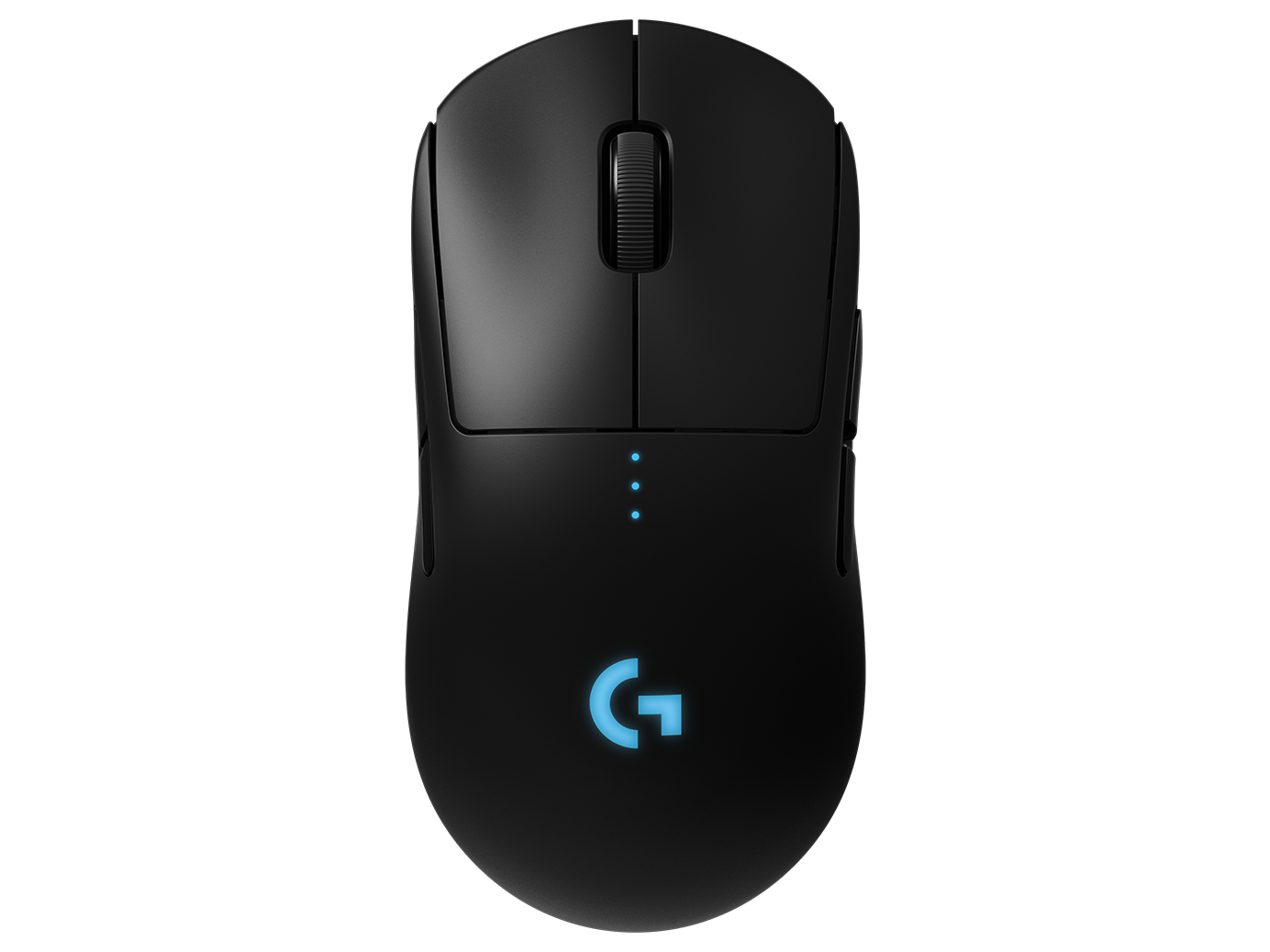
The original G PRO Wireless features removable magnetic buttons on both the left and right flanks. Users swap between blanking plates and tactile switches in seconds, configuring two, three, four, or zero thumb triggers. For southpaw competitors searching for an esports competitive FPS mouse, viable premium wireless choices remain shockingly scarce. Left-handed gamers frequently purchase the base G PRO Wireless solely because tier-one competitive brands have largely phased out symmetrical thumb support.
Durability Realities: Mechanical Switches, Skates, and Software
Longevity creates distinct friction points between older and newer models. The original unit relies on mechanical contacts. Early manufacturing batches famously suffered from unintended double-clicking when low-voltage circuitry failed to read debouncing correctly on 50M Omron switches. Later production runs corrected internal debounce timing algorithms and swapped component tolerances, noticeably improving mechanical switch durability. Even so, traditional metal contacts wear out faster than optical beams that use light paths to register clicks.
Glide performance presents another functional divide. The base chassis shipped with standard dyed black feet, offering far more surface friction than the zero-additive virgin-grade PTFE glide feet standard on newer releases. Fortunately, third-party skate modifications remain widespread and inexpensive, letting owners swap factory pads for dot skates or aftermarket PTFE rings for under $10.
Power management holds up surprisingly well. The internal cell delivers around 48 to 60 hours of continuous tracking with RGB lighting enabled, stretching toward 70 hours when illumination is toggled off through Logitech G HUB customization profiles. The primary headache in 2026 is the legacy Micro-USB socket. Keeping an outdated cable at your desk solely to charge a single peripheral is an annoyance in a landscape dominated by universal USB-C hardware.
Ergonomic Versatility Across Grip Styles
Chassis contours explain why this physical shell refuses to die. The symmetrical egg-style silhouette features an unaggressive top hump positioned directly in the center, paired with flat side walls free of aggressive thumb flare-outs. This neutral geometry accommodates an ergonomic claw and fingertip grip without forcing specific finger placements.
Tactile micro-adjustments rely on personal grip habits:
Claw Grip: The centered 40mm arch nests comfortably against the lower palm knuckles. High-velocity downward swipes feel secure because the thumb and ring finger sit flush against uniform side panels.
Fingertip Grip: Smaller hands find the 80-gram mass noticeable during extended aim-training sessions. Players with hands exceeding 19cm in length manipulate the shell easily, using fingertip precision while keeping palms elevated off the shell.
Palm Grip: Medium hands enjoy comfortable, neutral palm support for marathon tactical shooter sessions, though users who prefer aggressive ergonomic contours tilted outward may find the neutral shell somewhat conservative.
Frequently Asked Questions (FAQ)
Q1: Does the 80-gram weight put you at a measurable disadvantage in tactical shooters?
A1: Not automatically. While tracking-heavy arena shooters reward ultra-low mass, games like Counter-Strike 2 and Valorant demand precise stopping power and crosshair placement. Many tactical players prefer an 80-gram mouse because added inertia prevents slight nervous muscle twitches from disrupting crosshair stability.
Q2: Can the G PRO Wireless double-click issue still occur on units purchased recently?
A2: Later production revisions resolved the rampant firmware and hardware voltage mismatch that triggered chronic double-clicking in early production runs. Mechanical microswitches will naturally degrade over multi-year cycles, but catastrophic failures right out of the box have ceased to be a widespread defect.
Q3: Is upgrading from the base model to a Superlight or Superstrike worth the $100 price difference?
A3: The upgrade only makes competitive sense if you demand an ultra-lightweight profile below 60 grams, require a native USB-C charging pipeline, or demand optical switches to guarantee zero contact degradation. If you play left-handed or prefer a structured, slightly heavier mouse in hand, the high-end flagships actually remove features you use.
The Purchase Decision for 2026 Competitive Gamers
Modern product cycles encourage shoppers to treat previous-generation gear as obsolete relics. The base Logitech G PRO Wireless disproves that assumption. Its legacy Micro-USB connector and mechanical switch design reveal its age, but its internal tracking engine, stable polling consistency, and neutral shell geometry remain fully capable of high-level competitive performance.
If you are a left-handed player requiring modular physical thumb buttons, this classic chassis remains one of the few tournament-grade choices on the market. If you are a right-handed gamer building a competitive setup on a restricted budget, hunting down an original unit during retail clearance cycles provides professional-grade tracking performance at half the entry price of contemporary halo peripherals.


