2026 World Cup Standings Explained: Rules, Tiebreakers, and Knockout Bracket

The expansion of the men's FIFA World Cup to 48 nations fundamentally reshapes international soccer's competitive geometry. Instead of the familiar 32-nation symmetry that governed the tournament from 1998 through 2022, the 2026 tournament across the United States, Canada, and Mexico introduces a sprawling 104-match slate. Tracking the official table requires more than simply checking wins and losses. As documented in the comprehensive Britannica Report, the updated structure replaces the originally proposed three-team groups with 12 four-team groups, preserving the drama of simultaneous final matchdays while engineering a complex race for the knockout rounds.
Every group stage fixture carries mathematical ripple effects that reach well outside its immediate four-team pool. Margin of victory, disciplinary card counts, and defensive discipline directly dictate which squads survive beyond the opening fortnight. With 32 teams entering the knockout stage bracket, understanding how points translate into seeding is essential for following the tournament as it unfolds.
📌 Key Takeaways:
- The Qualification Split: The top two finishers from all 12 groups earn automatic berths, joined by the eight best third-place teams to complete the 32-nation knockout field.
- The Tiebreaker Protocol: Overall goal difference across all group fixtures acts as the primary separator when teams finish level on points, followed by total goals scored and head-to-head records.
- Knockout Bracket Logistics: Advancing teams enter a single-elimination Round of 32 where regulation draws proceed straight to 30 minutes of extra time before penalty shootouts.
The 48-Team Architecture: How the 12 Groups Function
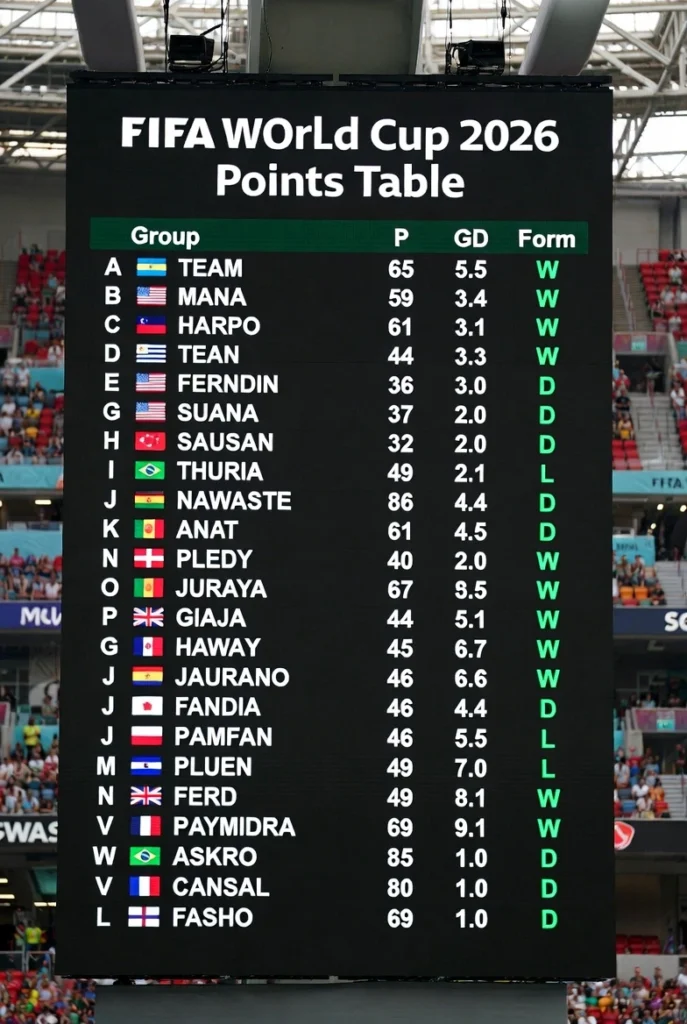
FIFA's council ratified the 12-group format in March 2023, abandoning an earlier concept of 16 three-team groups that threatened to invite collusion on final matchdays. The 48 teams are drawn into Groups A through L. Each squad plays three round-robin matches within its designated pool, generating 72 group-stage fixtures over 16 match days.
A standard points allocation governs the FIFA points table: three points for a victory, one for a draw, and zero for a defeat. The top two teams from each group, 24 sides in total, automatically secure entry into the Round of 32 qualification pool. The remaining eight spots belong to the highest-performing third-place finishers, introducing an cross-group leaderboard that keeps eliminated sides fighting for goal margins until the final whistle of Matchday 3.
Decoding the FIFA Points Table and Tiebreaker Hierarchy
When two or more teams inside the same group conclude their three fixtures level on points, FIFA applies strict tiebreaker rules to settle final positioning. Unlike UEFA club competitions, which prioritize head-to-head records above all else, FIFA places primacy on tournament-wide performance across the entire group phase.
The tiebreaker criteria run in the following sequence:
1. Superior Goal Difference: Total goals scored minus total goals conceded across all three group matches.
- Greatest Number of Goals Scored: Total offensive output across all three group matches.
- Head-to-Head Points: Points earned exclusively in the matches played between the tied teams.
- Head-to-Head Goal Difference: Goal differential calculated exclusively from games involving the tied teams.
- Head-to-Head Goals Scored: Goals tallied in head-to-head games among the tied sides.
- Fair Play Points System: Disciplinary deductions assessed on player and team conduct.
- Drawing of Lots: A physical draw conducted by FIFA officials if every numerical metric remains identical.
The fair play points system operates with strict mathematical penalties. A single yellow card costs a team -1 point. An indirect red card resulting from two yellows costs -3 points. A straight red card subtracts -4 points, while a yellow card followed by a direct red incurs a -5 point deduction. In tournaments where margins are razor-thin, a reckless tactical foul in the 88th minute can eliminate a nation from the knockout stage bracket.
The Scramble for the Eight Best Third-Place Spots
The ranking of third-place teams creates a parallel competition running alongside the group tables. Twelve teams finish third; only eight advance. Because these teams never play one another, FIFA compares their group stage match results through a neutral ladder.
Comparison metrics mirror the group tiebreakers without head-to-head parameters:
1. Greatest number of points obtained in all group matches.
- Superior goal difference across all group matches.
- Highest number of goals scored across all group matches.
- Fair play conduct points.
- Drawing of lots.
Historical data from previous 24-team tournaments using this format, such as the UEFA European Championship and the 1986, 1994 World Cups, reveals that three points with an even or slightly positive goal difference typically guarantees advancement. Teams finishing on three points with a negative goal difference face an agonizing multi-day wait while remaining groups conclude play.
Tournament Evolution: 32-Team Baseline vs. 48-Team Reality
The structural leap from Qatar 2022 to the 2026 tournament fundamentally alters match volume, travel requirements, and survival math. The table below breaks down the systemic changes governing the competition.
| Structural Dimension | Previous Era (1998, 2022) | Expanded Era (2026) |
|---|---|---|
| Total Participating Nations | 32 teams | 48 teams |
| Group Stage Structure | 8 groups of four teams | 12 groups of four teams |
| Matches to Win Championship | 7 matches | 8 matches |
| Knockout Field Size | 16 teams (Round of 16) | 32 teams (Round of 32) |
| Total Tournament Matches | 64 matches | 104 matches |
| Third-Place Team Fate | Eliminated automatically | Top 8 advance to Round of 32 |
Mapping the Knockout Stage Bracket into the Round of 32
The introduction of the Round of 32 creates an entirely new layer of knockout competition. Group winners face either a runner-up from an adjacent group or one of the third-place survivors. FIFA pre-allocates bracket slots using a matrix system that matches specific third-place qualifiers depending on which eight groups yield the advancing third-place sides.
Every match from the Round of 32 through the final operates under standard knockout regulations. If scores sit level after 90 minutes of regulation time, teams play two 15-minute periods of extra time. The golden goal rule remains defunct. If parity persists at the end of 120 minutes, a standard best-of-five penalty shootout determines the winner.
Managing squad fatigue becomes paramount across this expanded roadmap. Finalists must endure eight total fixtures across roughly 39 days, one more match than previous tournament winners faced. Tactical rotations during Matchday 3 of the group stage will heavily influence how well squads perform once the knockout grind begins.
Viewing Schedule and Official Broadcast Windows
With 104 matches spread across four time zones in the United States, Mexico, and Canada, daily schedules feature staggered kickoff times. During the group stage, FIFA utilizes up to four distinct broadcast windows per day, generally starting at 12:00 PM Eastern Daylight Time and running through evening kickoffs at 9:00 PM Eastern.
In the United States, English-language linear coverage airs across FOX and FS1, while Spanish-language rights belong to Telemundo and Universo, alongside streaming on Peacock. In Canada, TSN and RDS carry linear broadcasts. In the United Kingdom, coverage splits between the BBC and ITV. Group standings update live across FIFA's match center and official broadcast partners as goals alter live goal differences in real time.
Frequently Asked Questions (FAQ)
Q1: Can a team with zero wins advance from the group stage?
A1: Yes. A team that records three draws finishes with three points. Depending on goal difference, goal tallies, and the results of other groups, three points can prove sufficient to secure one of the eight best third-place slots.
Q2: What happens if two teams finish with completely identical records and fair play points?
A2: If goal difference, goals scored, head-to-head records, and disciplinary fair play points are identical, FIFA resolves the deadlock through a random drawing of lots organized by the tournament organizing committee.
Q3: Does extra time apply during group stage matches if they end in a tie?
A3: No. Extra time rules apply solely to knockout stage fixtures from the Round of 32 onward. All group stage matches conclude at the end of 90 minutes plus stoppage time, with drawn matches awarding one point to each side.
Strategic Realities for Teams Navigating the 39-Day Marathon
The expanded tournament structure completely redefines risk calculation for managers and technical staff. In the past, dropping three points in the opening fixture pushed a nation to the brink of elimination. Under the 48-team framework, recovering three points across the remaining two fixtures often suffices to reach the Round of 32.
This dynamic shifts how national teams approach goal margins. Heavy defeats are lethal; a single 4-0 loss severely compromises a squad's third-place standing even if it manages a win elsewhere. Conversely, disciplined defensive teams that preserve positive goal margins retain a substantial mathematical cushion. The path to World Cup glory in 2026 requires an exacting balance between squad endurance, tactical caution, and an unrelenting eye on the live points table.