ASL Meaning in Text Explained: Visual Examples Comparing 'As Hell' vs 'Age/Sex/Location'
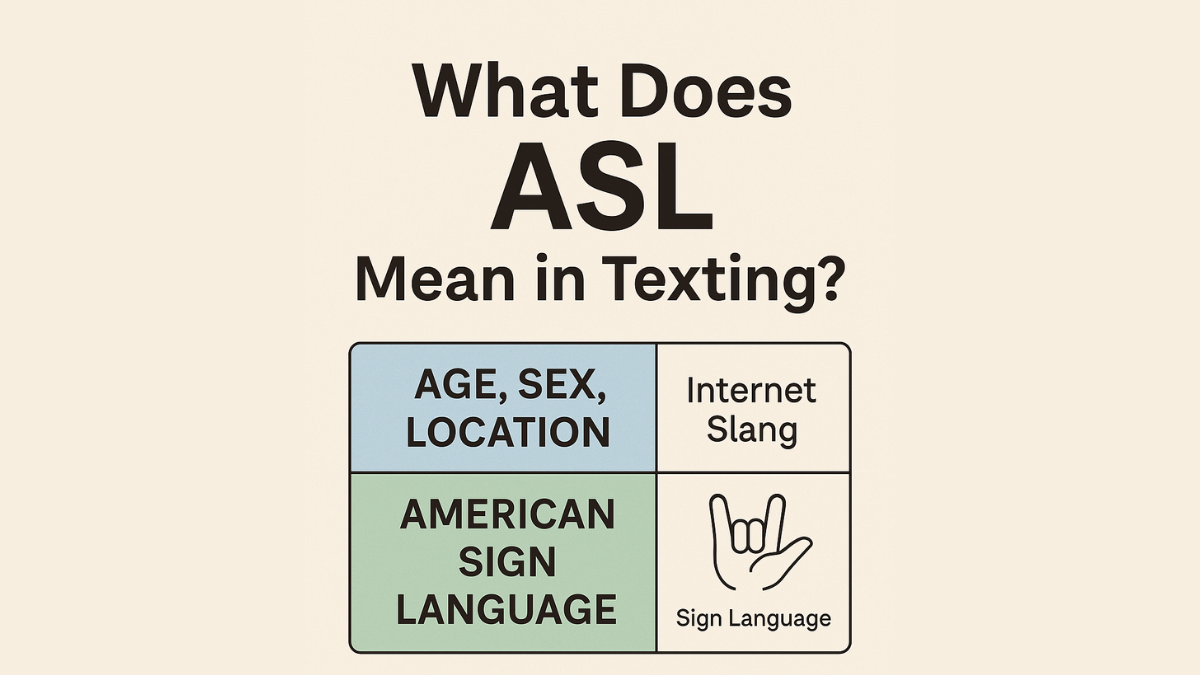
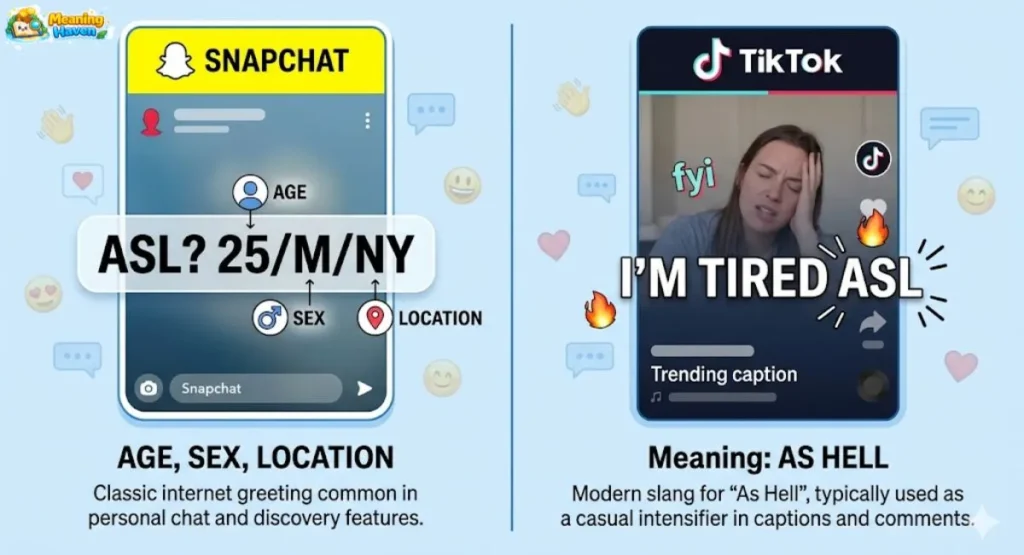
Receive a message that reads "I'm tired asl," and anyone who grew up on early web forums might pause in confusion. Why would someone answer their exhaustion with their demographic profile? Yet for hundreds of millions of smartphone users on TikTok, Snapchat, and iMessage, the meaning is unmistakable: the letters serve as an intensifier, substituting phonetically for "as hell." The acronym has undergone one of the sharpest linguistic shifts in internet history, morphing from a screening tool of dial-up chatrooms into a standard emotional amplifier.
Context dictates everything. Outside informal English texting, the identical string carries official, institutional weight. When Italy's public health authorities dispatched automated health screening reminders via text, citizens questioned data permissions, prompting an investigative Il Sole 24 ORE Report on whether regional health bodies (the Azienda Sanitaria Locale, abbreviated ASL) could push unsolicited messages without prior consent. Meanwhile, in educational circles, the acronym remains the undisputed designation for American Sign Language. Navigating digital conversations in 2026 requires understanding which era, subculture, and syntactic position a sender is drawing from.
📌 Quick Summary:
- The Modern Meaning: In casual texts and social media comments, lowercase "asl" almost universally means "as hell," functioning as an intensifier directly following adjectives (e.g., "funny asl").
- The Historic Meaning: In desktop chatrooms from 1995, 2010, the acronym served as shorthand for "Age, Sex, Location," sent as an introductory question to anonymous strangers.
- The Formal Distinction: Capitalized "ASL" denotes American Sign Language or institutional entities, identified by standalone placement and proper noun capitalization.
The Modern Shift: Why Gen Z Texts 'asl' to Mean 'As Hell'
The linguistic drift of "asl" from demographic questionnaire to casual intensifier took root through African American Vernacular English (AAVE) before spreading broadly across mobile messaging platforms. When pronounced out loud, the individual letters A-S-L mimic the natural cadence and vowel slurring of the spoken phrase "as hell."
On platforms like Snapchat, TikTok, and Discord, typing speed and phonetics trump strict acronym rules. Sending "mad asl" requires fewer keystrokes than spelling out the phrase or typing the alternative abbreviation "af" (as fuck), which carries a harsher vulgarity threshold for younger users dodging algorithmic comment filters.
Consider this standard exchange on a weekend group chat:
Sender A: Are you going to Marcus's party tonight?
Sender B: Nah, worked a double shift. I'm sleepy asl.
Sender A: That sucks, it looks crowded asl on his story.
Sender B is not listing an age or gender. The letters anchor the adjective "sleepy," functioning identically to words like "extremely" or "seriously." The syntax provides the giveaway: whenever "asl" follows an adjective or adverb, it functions strictly as an intensifier.
Decoding the Vintage 1990s Chatroom Prompt: 'Age, Sex, Location'
To understand why older texters often misinterpret the phrase, look at the desktop internet between 1995 and 2008. In the era of America Online (AOL), mIRC, and MSN Messenger, digital spaces were completely anonymous. Users entered public chatrooms masked by handles like Sk8rKid99 or BlueDolphin.
Before establishing a private one-on-one conversation, users needed a basic read on who sat on the other end of the telephone line. The opening gambit was almost always a rapid, unpunctuated prompt:
NewUser: hey
Chatter2: a/s/l?
NewUser: 22/m/chicago. u?
During this period, the term was typically typed with forward slashes ("a/s/l") or capital letters, functioning as a complete sentence and an inquiry. Asking "a/s/l" was the digital equivalent of glancing across a room.
As social media transitioned from anonymous chatrooms to identity-anchored networks like Facebook, Instagram, and LinkedIn, user profiles displayed ages, cities, and identities automatically. The need to screen unknown interlocutors evaporated. By 2012, asking someone "a/s/l" in a text felt not only dated, but invasive and suspicious.
Parsing Context: Real Message Syntax and Tone Breakdowns
Discerning the intended meaning of three identical letters comes down to sentence structure, capital letters, and the communication platform. The following structural matrix outlines how punctuation, placement, and generational habits split the term across modern channels:
| Message Example | Syntactic Position | Decoded Meaning | Primary Era / Platform |
|---|---|---|---|
| "Bro that test was hard asl" | Trailing an adjective | "As hell" (Intensifier) | 2018, 2026 (iMessage, TikTok, Snap) |
| "Hey, asl? Just joined this room" | Standalone question | "Age / Sex / Location" | 1995, 2008 (AIM, mIRC, Omegle) |
| "Does anyone here know ASL?" | Direct object / Proper noun | American Sign Language | All eras (Professional & Academic) |
| "Ur fit is clean asl today" | Adverbial modifier | "As hell" (Very / Extremely) | 2020, 2026 (Instagram, Discord) |
| "ASL Screening notification: check app" | Subject / Header | Azienda Sanitaria Locale | 2024, 2026 (European SMS alerts) |
When reading incoming text, scan immediately for the word preceding the acronym. If that word is a descriptive state of mind or condition ("hungry," "goofy," "cold," "weird"), the sender is using slang. If the term appears alone with a question mark, the sender is asking for your identity or resurrecting an early web convention.
American Sign Language and Institutional Acronyms in Plain Text
Offline culture remains dominant whenever accessibility, communication rights, or healthcare are under discussion. American Sign Language serves as the primary visual language for hundreds of thousands of Deaf and hard-of-hearing individuals across North America. In any context involving learning, schools, or workplace accommodations, the capital letters indicate the formal language system.
Public recognition of this linguistic footprint expanded when philanthropic spotlights highlighted grassroots education. In a March 2025 profile published on Gates Notes, Bill Gates documented the work of an educator who leveraged local transit schedules to teach ASL vocabulary to students, illustrating how visual languages embed themselves in practical, daily environments.
Texts discussing language acquisition, community interpreters, or school electives preserve standard capitalization:
- "Are you taking Spanish or ASL next semester?"
- "The conference provided an ASL interpreter on stage."
Confusion between the language and the modern intensifier is rare in spoken conversation, but text feeds strip out audio cues and facial expressions. Seeing "learning ASL" makes immediate sense; seeing "I'm interested ASL" could indicate an eager student or someone claiming to be "interested as hell." Checking capitalization patterns and surrounding prepositions resolves the riddle.
Avoiding Awkward Misinterpretations in Cross-Generational Chats
Generational collisions happen frequently when parents text their teenage children, or when senior managers supervise younger interns on enterprise messaging platforms like Slack.
A common real-world mix-up occurs when an older relative asks a teenager about their whereabouts:
Parent: Where are you? Dinner is getting cold.
Teenager: On the bus. Driver is moving slow asl.
Parent: Why are you asking for my age? Just come home.
The parent reads the letters through the lens of early personal computer culture, interpreting the trailing acronym as an intrusive question. The teenager, unaware that the letters ever represented demographic screening, views the parent's response as baffling.
Similarly, professional settings demand caution. While "asl" is common in peer-to-peer texting, using it on workplace channels can easily misfire. Colleagues over 35 may view the acronym as inappropriate personal screening, while HR filters may flag it as an attempt to collect protected demographic information. In professional and academic correspondence, spelling out words like "extremely" or specifying "American Sign Language" prevents misdirected friction.
Frequently Asked Questions (FAQ)
Q1: Why do texters write 'asl' instead of 'af'?
A1: Both serve as intensifiers, but "asl" (as hell) carries a milder social connotation than "af" (as fuck). Many social platforms, including TikTok and Instagram, actively downrank or flag stronger profanity, leading users to favor phonetic abbreviations that convey emphasis without triggering moderation filters.
Q2: Is typing 'asl' considered offensive or inappropriate?
A2: It is not inherently offensive, but it is deeply informal. Using it as "as hell" in casual texts with friends is standard practice. However, sending "asl?" as an inquiry to strangers can appear antiquated or creepy, and using it in formal business messaging risks looking unprofessional.
Q3: How do I tell if a message means sign language or slang?
A3: Examine capitalization and grammatical function. If it appears in all-caps as a standalone noun ("fluent in ASL", "ASL interpreter"), it refers to American Sign Language. If it is typed in lowercase immediately following an adjective ("crazy asl", "funny asl"), it means "as hell."
Q4: Did 'asl' meaning 'as hell' come from autocorrect?
A4: No. It developed intentionally through speech patterns and texting efficiency. Texters noticed that the letters *a-s-l*, when spoken aloud, match the phonetic pronunciation of "as hell." It was deliberately adopted across mobile communities rather than generated by smartphone software errors.
The Ongoing Linguistic Drift of Digital Shorthand
Shorthand on the internet is never static. Acronyms that once felt permanent inside specific software environments inevitably shift as new cohorts adopt existing keys to express fresh phonetic rhythms. The evolution of "asl" illustrates how quickly digital tools reshape our vocabulary: an abbreviation designed in the 1990s to pierce the fog of anonymous desktop chatrooms has been repurposed by a smartphone-native generation into pure emotional emphasis.
As language evolves across social messaging networks, deciphering text requires paying attention to syntax rather than relying on outdated definitions. When reading incoming messages, check the preceding words: if an adjective sits in front of the letters, leave your birth year and home state out of the reply.


