Can You Ripen Kiwi on the Counter? The Science of Climacteric Fruit Explained
Pick up a kiwi in the grocery aisle, and it frequently feels like a rock. Most shoppers wonder if that hard, fuzzy oval will ever transform into a juicy snack or if commercial pickers severed it from the vine too early. According to a marthastewart.com Report on produce that matures post-harvest, kiwifruit belongs to an elite biochemical category capable of substantial off-vine transformation.
Millions of kiwis end up tossed into municipal compost bins every year, ruined either by premature slicing or forgotten countertop decay. Knowing how to read physical cues, and managing how ethylene functions within the fruit's tissue, marks the boundary between biting into a mouth-puckering brick and enjoying a fragrant, tender fruit.
📌 Key Takeaways:
- Physical Diagnostics: A gentle pressure test applied across the outer body and stem end firmness provides the single most reliable maturity indicator, far outperforming visual inspection alone.
- Climacteric Biology: Kiwis rely on post-harvest climacteric fruit ripening, continuously converting complex starches into free sugars long after harvest.
- Thermal Control: Leaving hard kiwis on the kitchen counter softens them within three to five days, whereas maintaining an optimal refrigerator storage temperature keeps mature fruit fresh for up to four weeks.
The Post-Harvest Biology of Climacteric Fruit Ripening
Kiwifruit behaves differently than non-climacteric produce like strawberries or citrus, which stop developing the second field hands clip them from the plant. Kiwis store energy as long-chain insoluble starches while growing on the woody vines of Actinidia deliciosa. Commercial growers intentionally harvest the fruit while firm, measuring field sugars at roughly 6.2% to 6.5% Brix to withstand long-distance refrigerated transit without bruising.
Once settled into ambient conditions, climacteric fruit ripening begins. The fruit undergoes a surge in respiration, generating natural plant hormones that dissolve cell walls and convert insoluble starches into glucose and fructose. An unyielding commercial kiwi can surge from a sour 6% Brix up to a luscious 14% to 16% Brix at peak maturity. This conversion changes internal flesh firmness from greater than 14 pounds per square inch (psi) of resistance down to a buttery 2 to 3 psi, which represents the culinary sweet spot.
This process does not require tree attachment. You are not stuck with an unusable dud when you bring home rock-hard kiwis. You are simply holding an unprimed biological package awaiting the correct environmental signals to unlock its natural sugars.
The Sensory Diagnostic: Pressure, Aroma, and Stem End Firmness
Visual appearance alone rarely reveals whether the green interior has softened. Instead, the tactile gentle pressure test serves as your primary diagnostic tool. Hold the fruit between your thumb and forefingers, cradling it in your palm rather than gouging it with your fingertips. Press softly. A rock-hard kiwi offers absolute resistance. A prime kiwi yields smoothly under moderate pressure without collapsing or feeling hollow beneath the skin.
Pay strict attention to the stem end firmness. The area immediately circling the former stem attachment point softens last. If the central belly gives slightly but the stem cap feels completely unyielding, the fruit needs another 24 to 48 hours at room temperature. Slicing it at this stage exposes a stiff, woody core that resists chewing.
A secondary indicator is olfactory. Unripe kiwis emit virtually no scent through their skin. As starches disassemble into volatile esters, a sweet fragrant aroma develops around the blossom end opposite the stem. If you detect a bright, citrus-tinted floral scent, the fruit is primed for consumption. If the scent turns sharp, vinegary, or alcoholic, interior sugars have crossed into anaerobic fermentation.
Green Hayward vs. SunGold: Distinct Signs of Ripeness
Different kiwi cultivars do not age identically. The ubiquitous green Hayward features a dense, bristly coat of hair and thick outer skin. In contrast, yellow-fleshed varieties like the Zespri SunGold display smooth, hairless bronze skin with a distinct beaked crown. Their ripening dynamics follow different physical markers.
| Kiwi Cultivar | Exterior Texture & Visuals | Tactile Give & Ripeness Metric | Flavor & Acid Profile |
|---|---|---|---|
| Classic Green (Hayward) | Fuzzy skin texture, uniform medium-brown coat, firm cylindrical shape. | Yields gently to steady thumb pressure; stem end gives slightly without skin rupture. | Pronounced tart vs sweet flavor profile, higher actinidin enzyme activity, balanced acidity. |
| Golden Kiwi (SunGold) | Smooth, nearly hairless bronze exterior; skin looks taut and paper-thin. | Softens faster; requires lighter pressure to register golden kiwi ripeness. | Naturally lower acid; tropical, mango-like sweetness measuring up to 18% Brix. |
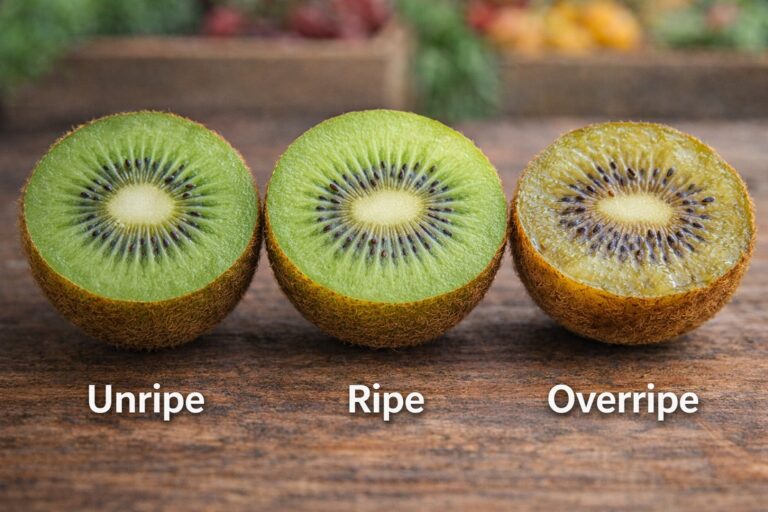
| Overripe (Any Variety) | Skin displays wrinkles, loose puckering, brown water-soaked blotches. | Mushy beneath light touch; thumb leaves a permanent dent or punctures flesh. | Fermented, alcoholic tang with mealy or liquified interior pulp. |
Because golden varieties carry less citric acid and higher base fructose, golden kiwi ripeness can feel slightly softer to the touch than green varieties without being past its prime. The skin will feel like an inflated water balloon nearing slight depressurization, whereas a green kiwi retains a slightly sturdier structural envelope even when fully ripe.

Speeding Up Maturation: The Brown Paper Bag Method
Leaving hard kiwis exposed on an open counter naturally ripens them over three to five days. However, you can compress this timeline down to 24 to 48 hours by managing gas concentration. Kiwis are extraordinarily sensitive to external ethylene gas production, the hydrocarbon gas that plants use to signal tissue senescence.
Deploy the brown paper bag trick. Place firm kiwis inside an unbleached paper bag alongside a high-ethylene emitter, such as an unpeeled banana or a ripe Gala apple. Fold the top of the bag over twice to trap the emitted gas while still permitting minimal oxygen exchange. Never use non-breathable plastic zip bags for this step. Plastic traps transpired moisture, generating condensation that causes fungal rots like Botrytis cinerea to colonize the fuzzy skin within two days.
Keep the bag away from direct sunlight at normal ambient temperatures between 65°F and 72°F (18°C, 22°C). Check the bag every 12 hours. Because ethylene initiates an exponential ripening cascade, fruit can race from rock-hard to peak maturity much faster than anticipated.
The Cold-Chain Protocol: Extending Usable Shelf Life
Knowing how to hold ripe fruit is just as important as knowing how to soften it. Once a kiwi yields gently to your touch, lingering on the counter will send it over the edge into decomposition within two to three days. Cold halts this enzymatic degradation.
Move ripe kiwis immediately into a dedicated crisper drawer set to a refrigerator storage temperature between 32°F and 36°F (0°C, 2°C). At these temperatures, the fruit enters near-stasis. A ripe kiwi will hold its ideal texture inside cold storage for 7 to 10 days. If the kiwis were transferred into the refrigerator while still slightly firm, they can easily last up to four weeks without meaningful cellular collapse.
Prevent accidental exposure to other produce in your crisper drawer. Keep mature kiwis away from cantaloupes, avocados, or bruised stone fruit inside the refrigerator. Even at 34°F, trace ethylene from nearby fruit will slowly penetrate the kiwi's thin skin, softening its structural pectin into unpalatable mush.
How to Identify Overripe Signs and Wrinkles
Kiwis do not rot with obvious color shifts like bananas. Spotting decay requires inspecting both skin tension and internal moisture. Clear overripe signs and wrinkles begin near the stem base. When a kiwi loses excessive internal moisture through cellular breakdown, the previously tight skin loosens, producing microscopic ridges and folds across its surface.
Pick up the kiwi and look for localized soft pockets. If one side feels elastic while the reverse collapses into an indent that fails to spring back, internal rot has taken hold. Slicing into a spoiled kiwi reveals dull, brownish-olive discoloration in place of bright emerald or gold flesh, accompanied by white seeds that have turned gray or translucent.
Surface molds present another clear boundary. The fuzzy skin texture of green kiwis can conceal early sporulation, which often starts as tiny white or blue-gray fuzz colonies tucked inside the recessed stem depression. If you see white powdery rings around the stem or feel wet, slippery skin, discard the fruit.
Frequently Asked Questions (FAQ)
Q1: Can I eat the fuzzy skin of a green kiwi?
A1: Yes, the skin of both green and golden kiwis is completely edible and contains high concentrations of dietary fiber, folate, and vitamin E. To improve the mouthfeel of green kiwis, gently rub the surface with a clean kitchen towel or nylon produce brush under cold running water to strip away the stiffest hairs before slicing.
Q2: Why does kiwi make my tongue tingle or burn when I eat it?
A2: Kiwifruit contains actinidin, a powerful cysteine protease enzyme that temporarily breaks down surface proteins on your tongue and inner cheeks. This sensation is more pronounced in underripe fruit containing higher acid levels. Selecting fully ripe kiwis or opting for SunGold varieties, which naturally produce far lower concentrations of actinidin, drastically reduces this tingling effect.
Q3: Can an underripe kiwi be salvaged once it has already been sliced open?
A3: No. Slicing disrupts cellular integrity, halts the uniform conversion of starches into sugars, and invites rapid microbial colonization. If you slice a hard, sour kiwi prematurely, do not attempt to counter-ripen the wedges. Instead, blend them into smoothies alongside sweeter fruits or puree the flesh into a meat marinade, where its natural actinidin enzymes serve as a tenderizer.
Smarter Countertop Management for Everyday Kitchens
Managing kiwifruit comes down to timing the fruit's internal clock to match your household's appetite. Rather than hunting through grocery bins for rare, ready-to-eat fruit that risks bruising on the ride home, purchase firm kiwis in bulk. You control the ripening schedule by keeping the bulk supply in the cold drawer while bringing out two or three specimens at a time to soften on the counter.
Watch the stem end, apply gentle palm pressure, and use paper bags with an apple whenever dinner calls for fresh fruit on short notice. Controlling temperature and ethylene exposure transforms this often misunderstood grocery item into one of the most reliable fresh staples in your kitchen.