Cups to Liters Visualized: Quick Conversion Chart for Cooking, Baking, and Daily Hydration

Fill a European electric kettle to the maximum fill line, and you stare at a numeral stamped in liters. Turn to an American soup recipe, and the instructions demand three and a half cups of chicken stock. This quiet disconnect between measurement systems derails dinner prep, ruins delicate sourdough hydration ratios, and complicates everyday wellness routines. Even monitoring everyday hydration has grown more precise, especially after a recent New York Post Report detailed how container materials and beverage choices influence the concentration of microplastics consumers swallow alongside their daily fluids.
The baseline mathematical reality is straightforward: one liter equals approximately 4.227 US customary cups. If you work with the standardized metric cup used across Australia, New Zealand, and parts of Canada, one liter equals exactly 4 metric cups. Confusing the two introduces an 8% volume disparity that can turn a tender cake gummy or make a reduction sauce taste unpleasantly salty.
📌 Key Takeaways:
- The Direct Conversion: One liter equals 4.227 US customary cups (roughly 4 cups plus 3.5 tablespoons) or exactly 4.0 metric cups (250 ml each).
- Regional Variance: US customary cups measure 236.59 ml, legal nutrition cups measure 240 ml, and imperial cups hold 284.13 ml.
- Culinary Impact: Soups and stews tolerate minor conversion discrepancies, but baking formulas require weight-based metric precision to prevent texture collapse.
The Standard Answer: US Customary vs. Metric Cup Math
The metric system builds on clean powers of ten, defining a liter as 1,000 milliliters. In contrast, the United States customary system inherited a fractured web of fluid ounces, pints, and quarts rooted in British medieval commerce.
When an American recipe lists cups, it assumes the US customary cup, defined as 8 US fluid ounces or 236.588 milliliters. Divide 1,000 milliliters by 236.588, and the answer is 4.22675 cups. For quick culinary estimates, home cooks round this down to 4 and 1/4 cups.
1 Liter = 1,000 mL
1 US Customary Cup = 236.59 mL
1,000 mL ÷ 236.59 mL = 4.227 US Cups (approx. 4 cups + 3.5 tbsp)
The math shifts outside the United States. Commonwealth countries phased out the British imperial system during the late 20th century, creating the 250 ml metric cup. In Australia, New Zealand, and South Africa, pouring one liter fills precisely 4 cups. A half liter to cups conversion in these countries yields exactly 2 cups, avoiding fractional math.
Federal agencies inside the United States complicate the picture further. The Food and Drug Administration (FDA) requires packaged food manufacturers to calculate nutrition labels using a "legal cup," fixed at exactly 240 milliliters. Under FDA rules, one liter contains 4.167 legal cups. While this subtle variance rarely ruins a meal, it frequently puzzles home cooks auditing packaged goods against digital fitness logs.
Why Recipes Collapse: US, Imperial, and 250 ml Metric Cups
Volume measurements create hidden hazards because an object labeled "one cup" represents three distinct volumes depending on where you bought it.
The Imperial cup measurement remains common in vintage British cookbooks and across older households in the United Kingdom. Rooted in the imperial pint of 20 imperial fluid ounces, an imperial cup contains 10 imperial fluid ounces, equivalent to 284.13 milliliters. One liter yields only 3.52 imperial cups.
Pouring four imperial cups into a pan yields 1,136 milliliters of liquid, more than 13% above the targeted liter mark. If you make a delicate custard or an egg-based tart, that extra liquid prevents proteins from coagulating firmly, leaving a runny filling.
This variation causes serious problems in international baking. Savory cooking relies on continuous evaporation and seasoning adjustments. If a beef stew contains 4.2 cups of broth instead of 3.8, simmering the pan uncovered for an extra ten minutes solves the issue. Baking offers no such flexibility. Leavening agents, starches, and fats demand exact hydration ratios. Translating baking measurement equivalents between European liter-based formulas and American cup-based tools without checking the standard causes sunken cakes, flat cookies, and dense breads.
Complete Visual Kitchen Measurement Chart
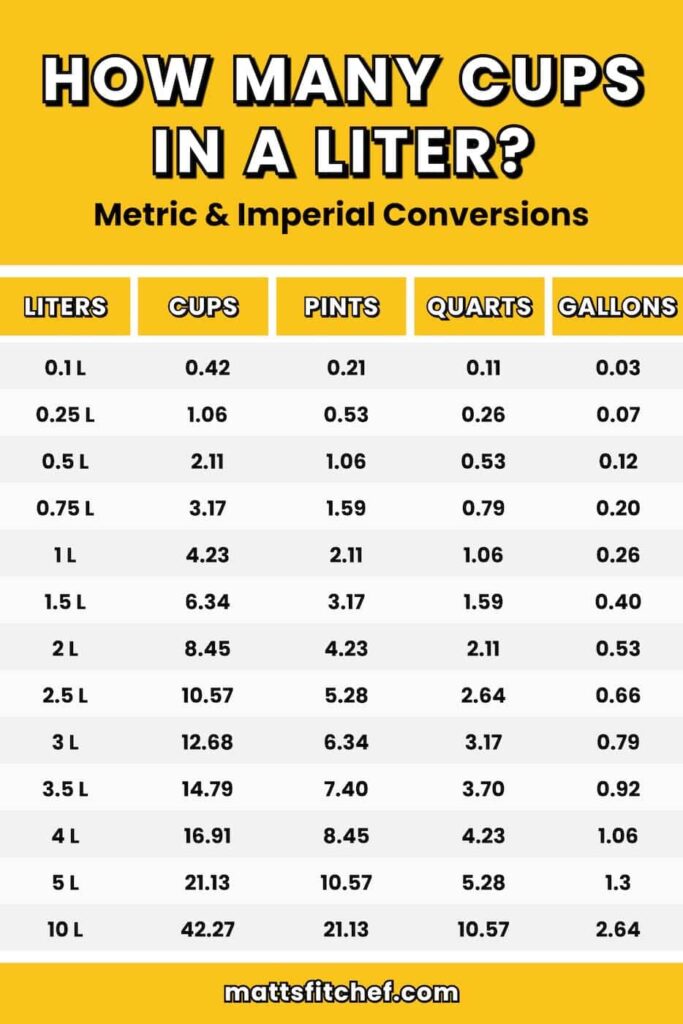
Converting fluid ounces to liters and milliliters to cups while balancing a hot saucepan invites kitchen errors. The structured reference table below bridges the divide between metric packaging, electric kettle gauges, and common measuring vessels.
| Volume (Liters) | Milliliters (mL) | US Customary Cups | Metric Cups (250 mL) | Fluid Ounces (US fl oz) |
|---|---|---|---|---|
| 0.25 L | 250 mL | 1.06 cups (1 cup + 1 tbsp) | 1.00 cup | 8.45 fl oz |
| 0.50 L (Half Liter) | 500 mL | 2.11 cups (2 cups + 1.8 tbsp) | 2.00 cups | 16.91 fl oz |
| 0.75 L | 750 mL | 3.17 cups (3 cups + 2.7 tbsp) | 3.00 cups | 25.36 fl oz |
| 1.00 L | 1,000 mL | 4.23 cups (4 cups + 3.6 tbsp) | 4.00 cups | 33.81 fl oz |
| 1.50 L | 1,500 mL | 6.34 cups (6 cups + 5.5 tbsp) | 6.00 cups | 50.72 fl oz |
| 1.70 L (Kettle Standard) | 1,700 mL | 7.19 cups (7 cups + 3 tbsp) | 6.80 cups | 57.48 fl oz |
| 2.00 L | 2,000 mL | 8.45 cups (8 cups + 7.2 tbsp) | 8.00 cups | 67.63 fl oz |
For everyday cooking volume conversion, remember that an extra quarter cup per liter can significantly alter pasta dough, bread crumb structure, and braising liquids. Keep a printed or bookmarked kitchen measurement chart near your prep station to save time.
Precision Liquid Measuring Cups and Baking Equivalents
Beyond the conversion math, tool selection introduces physical measurement errors. Pouring oil, milk, or water into nesting metal dry-measuring cups distorts the volume.
Dry cups require a sweep-level surface across the brim. When filling them with water, surface tension creates a convex meniscus that rises above the metal rim. Transporting a brim-filled dry cup to a mixing bowl almost always spills liquid.
Liquid measuring cups solve this. Crafted from tempered glass or clear BPA-free plastic, they feature pour spouts, reserve space above the top gradation line, and dual markings for milliliters and US fluid ounces.
How to read a liquid measuring cup:
- Set the cup on a dead-flat surface (countertop, not in your hand).
- Lower your eyes to the liquid level.
- Align the bottom of the curved meniscus with the target line.
Professional pastry chefs avoid volume cups altogether, relying instead on digital kitchen scales. One milliliter of pure water at room temperature weighs exactly one gram. Therefore, one liter of water equals 1,000 grams (or one kilogram). Converting an American recipe calling for 2 cups of milk into 473 grams eliminates meniscus reading errors, cup discrepancies, and unwashed glassware.
Liquid densities also matter for non-water ingredients. Honey, maple syrup, whole milk, and vegetable oils vary in mass:
- 1 liter = 1,000 grams
- 1 liter = 1,030 grams
- 1 liter = 918 grams
- 1 liter = 1,420 grams
Weighing ingredients bypasses volume confusion entirely. A gram remains constant regardless of national borders or historical measurement traditions.
Hydration Goals and Electric Kettles: Translating Liters for Daily Routines
Health guidelines often advise consuming two to three liters of fluids daily, but personal hydration habits run into conflicting container metrics.
Most consumer electric kettles produced for international markets feature a maximum capacity line stamped at 1.7 liters. Translating that capacity to standard US drinkware yields 7.19 US cups. If you brew coffee or steep herbal tea in large 12-ounce mugs, that full 1.7-liter boil supplies just under five mugs.
For monitoring daily water intake, modern wellness apps and smart water bottles track hydration in milliliters, fluid ounces, or liters. The classic health rule suggesting "eight 8-ounce glasses of water a day" totals 64 US fluid ounces. Convert those 64 fluid ounces to metric volume, and you get 1.89 liters.
Hitting a clean two-liter daily hydration milestone requires drinking 8.45 US customary cups or 8 metric cups. Understanding that half a liter represents two full 250 ml glasses provides a simple mental shortcut for tracking hydration without manual data entry.
Frequently Asked Questions (FAQ)
Q1: Is 4 cups exactly equal to one liter?
A1: No. Four US customary cups equal 946.35 milliliters, falling roughly 54 milliliters (3.6 tablespoons) short of a full liter. Only international metric cups (standardized at 250 milliliters each) yield four cups to the liter.
Q2: How many cups are in a 2-liter soda bottle?
A2: A standard 2-liter bottle contains 8.45 US customary cups, roughly 8.33 US legal nutrition cups, and exactly 8.00 Commonwealth metric cups.
Q3: Can I substitute US cups for metric cups in regular cooking?
A3: For soups, pasta sauces, braised meats, and marinades, the tiny variance of 13.4 milliliters per cup will not harm the dish. For baking, pastry doughs, and custards, this difference can ruin the bake. Use an accurate digital scale set to grams instead.
Navigating Global Units in the Modern Kitchen
Global recipe access has outpaced tool standardization. A baker in Chicago routinely pulls sourdough instructions written in grams from Germany, cross-references a custard base measured in Australian metric cups, and finishes the dish with an American measurement set.
Instead of treating volume conversion as guesswork, keep the core metric clear: a liter is 4.23 US cups or 4 metric cups. When consistency matters, bypass volumetric glassware entirely and weigh ingredients on a digital scale. One milliliter of water equals one gram, turning messy conversions into simple math and protecting recipes from regional measurement mismatches.