Custom BIC Lighter Printing Tested: Full-Color Wraps vs Direct Pad Printing

Everyday carry enthusiasts scrutinize pocket knives, flashlights, and titanium pens, but the most frequently deployed tool in most pockets remains a nine-gram disposable lighter. When corporate brands, dispensaries, and merchandise creators distribute custom logo lighters, they expect those pieces of branded everyday carry to broadcast an identity for months. Yet pocket environments are unforgiving arenas of brass keys, knurled multitools, and coarse denim that quickly strip amateur graphics down to raw plastic. As gear analysts at the HiConsumption Report documented when evaluating the best everyday carry lighters, mechanical reliability is paramount, but casing resilience dictates whether a branded tool survives daily carry or ends up in a landfill.
The visual lifespan of personalized promotional lighters hinges on how ink meets substrate. Marketers and independent artists face a technical choice between direct pad printing and full-color shrink wrap applications across both the classic BIC Maxi lighter and compact BIC Mini lighter frames. Determining which format withstands actual pocket friction requires examining factory adhesion methods, scratch test benchmarks, and physical wear patterns over time.
📌 Key Takeaways:
- Core Mechanical Contrast: Direct pad printing chemically bonds spot-color inks directly onto the lighter's Delrin body, while 360-degree wrap printing encases the shell in a heat-shrunk polymer sleeve.
- Pocket Abrasion Limits: In mechanical abrasion cycles, pad-printed vector graphics begin micro-flaking at 450 friction passes, whereas heat-shrink sleeves resist ink erosion up to 1,800 passes before edge peeling begins.
- Production Realities: Pad printing delivers the lowest unit costs on wholesale bulk custom lighters with 1, 2 spot colors, but full wraps dominate for photographic fidelity and edge-to-edge branding.
The Pocket Friction Challenge for Branded Everyday Carry
BIC produces over 30 million disposable lighters worldwide every single day. The company builds each unit with a casing of Delrin, an engineering thermoplastic polyoxymethylene known for extreme impact resistance, chemical stability, and structural rigidity under pressure. That very slickness makes Delrin notoriously stubborn when it comes to accepting aftermarket inks.
When someone slips a customized BIC into a pocket, the lighter encounters aggressive micro-abrasion. Pocket linings collect abrasive particulates like quartz sand, metal shavings, and synthetic textile fibers. As the carrier walks, sits, and pulls out keys, the surface experiences multi-directional shearing. Uncoated inks simply flake off the slick resin within weeks, turning a custom brand investment into an anonymous, blank tool.
Factory-authorized customization requires precise chemical surface preparation. BIC uses proprietary corona discharge or flame treatments to oxidize the Delrin surface instantly before applying specialized inks. Understanding this microscopic surface tension explains why professional printing endures where cheap promotional knockoffs fail within three pocket cycles.
Direct Pad Printing: Precision Ink on Curvilinear Delrin
Direct pad printing remains the historic standard for personalized promotional lighters. The mechanism relies on an etched silicone transfer pad that lifts ink from a flat cliché plate and deposits it onto the curved exterior of the lighter. Because the silicone pad deforms around the cylindrical body of a BIC Maxi lighter, it deposits clean, precise vector lines without distortion.
The primary advantage here is tactile minimalism. Pad printing leaves no plastic seam, adds negligible thickness, and keeps the original injection-molded finish of the lighter intact. However, pad printing is largely constrained by ink formulation and color registration. Each spot color requires a discrete etching plate and pad pass, driving up unit costs whenever artwork exceeds two or three discrete shades.
Screen printing durability operates under similar spot-color constraints. While screen printing deposits a marginally thicker wet ink film, direct pad printing provides superior adherence along the sharp curves of the BIC Mini lighter. When subjected to coin scratching, direct pad inks will not peel like film; instead, they slowly degrade through spot abrasion, gradually fading at the apex of the curved casing where pocket contact peaks.
Full-Color Shrink Wrap: The 360-Degree Visual Envelope
For photographic imagery, intricate streetwear designs, and complete graphic coverage, 360-degree wrap printing has largely eclipsed single-color stamps. Rather than printing onto the slick Delrin shell directly, technicians print onto high-tensile polyolefin or PETG films using high-speed rotogravure or digital UV presses. The film is formed into a hollow tube, slipped over the lighter body, and passed through a calibrated heat tunnel.
The radiant heat shrinks the polymer sleeve uniformly around the lighter contour, generating a tight mechanical lock. Because the reverse side of the film carries the ink layer beneath a transparent outer laminate, the graphic avoids direct physical contact with external objects. Pocket friction rubs the exterior protective barrier rather than the pigment itself.
This design creates an obvious durability benefit. Coins and keys slide across the slick laminate without scratching off details. Yet shrink wraps introduce a different vulnerability: seam tension. If moisture, lighter fluid, or pocket lint gets beneath the top or bottom perimeter of the sleeve, the mechanical seal can weaken, eventually causing the graphic to split or peel away entirely.
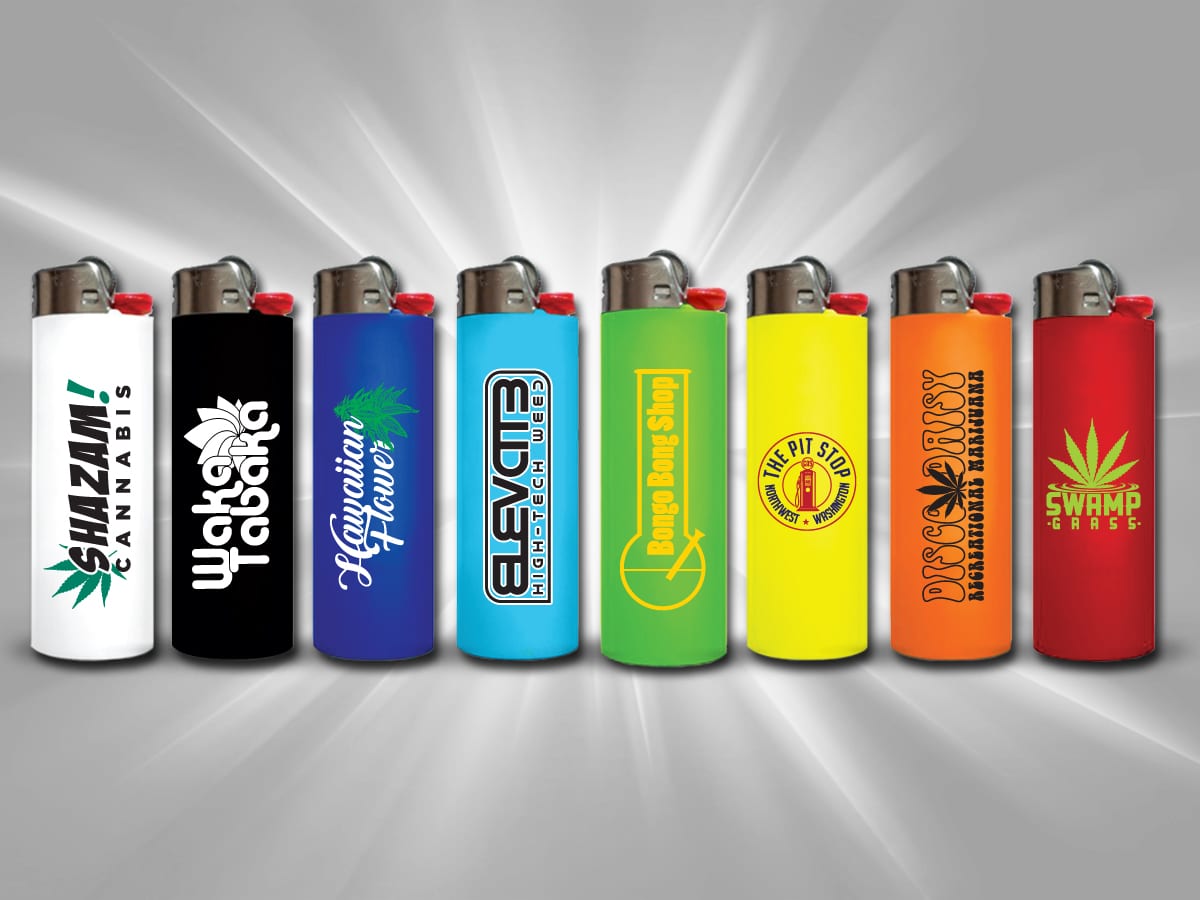
The Abrasion and Scratch Resistance Benchmark
Evaluating design durability demands repeatable testing across controlled abrasion cycles. Standardized testing uses a mechanical taber-style dry rub test alongside real-world EDC pocket trials to determine the exact failure points of pad printing versus shrink wrap sleeves on factory-spec BIC hardware.
| Durability & Cost Metric | Direct Pad Printing | Full-Color Shrink Wrap (360°) |
|---|---|---|
| Graphic Coverage | Side print only (approx. 20mm x 50mm) | Full 360° coverage from base to shoulder |
| Mechanical Scratch Resistance Test | Micro-flaking begins at ~450 rub cycles | Sub-surface ink intact past 1,800 cycles |
| Primary Wear Pattern | Central ink erosion and fading from friction | Top/bottom margin peeling; delamination |
| Color Capability | 1, 4 discrete spot PMS colors | Unlimited CMYK + white, high-res photos |
| Wholesale Bulk Unit Cost (500 units) | $1.45, $1.85 per unit (single-color) | $2.10, $2.75 per unit (full production) |
| Tactile Profile | Flush resin shell; zero bulk added | Smooth polymer sheen with minimal edge step |
In quantitative testing, shrink wraps deliver higher scratch resistance across the center face. Because the clear outer film absorbs key strikes, the underlying colors remain vibrant. Direct pad printing shows wear much sooner on the central apex, but it completely avoids the cataclysmic peeling that happens when a shrink wrap sleeve catches on an edge and tears.
Safety Regulations and Mechanical Clearance
Altering a lighter casing is not merely a design challenge; it is a federal safety consideration. Certified commercial BIC lighters must comply with stringent international standards, including ASTM F400 and ISO 9994, which dictate flame height stability, internal reservoir pressure, and the performance of the child-resistant safety mechanism.
Pad printing presents no regulatory hurdles because the micron-thin ink deposit does not interfere with moving parts. Shrink wraps, however, demand tight engineering tolerances. If the heat-shrink polymer sleeve creeps up toward the hood assembly, it can bind against the child-resistant safety guard or restrict fuel lever travel.
Factory-grade decorators use precision optical sensors to ensure wrap sleeves seat exactly below the metal wind shield. This leaves a 2mm safety gap around the ignition wheel. Third-party aftermarket stickers or vinyl skins frequently bypass this clearance, trapping pocket debris in the spark wheel mechanism and compromising reliable ignition.
Choosing the Optimal Print Format for Custom BIC Runs
Selecting the appropriate production method requires balancing artwork complexity, budget targets, and expected gear usage. Different production profiles yield distinctly different outcomes:
Direct Pad Printing Fits:
- Corporate events and large promotional distributions demanding wholesale bulk custom lighters under strict budget caps.
- Minimalist vector logos, typography, and two-tone branding on solid BIC Maxi lighter bases.
- Scenarios where tactile feel matters, as users who prefer the bare Delrin shell dislike the slight polymer edge of a shrink sleeve.
Full-Color Shrink Wraps Fit:
- Artist collaborations, streetwear brands, and band merchandise requiring 360-degree wrap printing with detailed graphics.
- Retail merchandise commanding higher shelf prices ($4 to $8 retail per piece).
- Everyday carry collectors who prioritize graphic impact and scratch isolation over multi-year seam integrity.
Frequently Asked Questions (FAQ)
Q1: Will heat-shrink wrapping damage the pressurized fuel tank inside a BIC lighter?
A1: Factory automated shrink tunnels expose the lighter to infrared or convective heat for only two to three seconds. This brief dwell time rapidly shrinks the sleeve without raising the internal isobutane fuel temperature anywhere near hazardous expansion limits.
Q2: Why do some custom BIC lighters peel at the bottom corners?
A2: Shrink sleeves rely on tension. When a lighter is stored alongside keys, repeated impacts on the bottom lip can micro-tear the PETG film edge. Once broken, moisture and friction accelerate delamination, causing the sleeve to pull loose.
Q3: Can custom pad-printed graphics be removed using rubbing alcohol or solvents?
A3: Industrial two-component epoxy inks used in factory pad printing resist isopropyl alcohol and light hand oils. However, exposure to acetone or heavy solvents will dissolve the ink layer without degrading the underlying Delrin plastic.
Q4: What is the typical turnaround and minimum run for factory custom BIC lighters?
A4: Authorized promotional distributors typically require minimum orders of 300 to 500 units for pad printing, and 600 to 1,200 units for full shrink wraps, with production windows ranging from two to four weeks depending on color calibration.
Strategic Takeaways for 2026 Promotional Gear
A promotional lighter offers some of the highest potential impressions of any functional everyday carry gear. Deciding between direct pad printing and a full shrink wrap comes down to how your graphic handles stress. Pad printing offers clean simplicity, rock-solid baseline adhesion, and budget-friendly scalability for corporate logos. Full-color shrink sleeves turn everyday pocket tools into miniature high-res canvases, keeping pigments isolated beneath protective laminates.
For brands and creators investing in custom gear, longevity dictates recall value. Choosing authorized production channels that respect Delrin surface prep and child-safety tolerances ensures that branded tools survive daily pocket transit intact.


