Daily Japanese Essentials: Complete Morning Routine Vocabulary and Customs

Stepping out into a Tokyo dawn reveals a choreography governed by sound and posture. Convenience store clerks announce greetings the instant the sliding doors chime, while transit workers exchange disciplined nods on station platforms. In Japan, saying good morning transcends simple linguistic translation. It serves as an active social contract that signals mutual respect, resets interpersonal standing, and aligns bodily awareness. A September 2025 study from Tohoku University demonstrated that the disciplined physical habits embedded in historic Japanese daily routines, specifically those preserved from samurai training traditions, measurably enhance lower-body stability and postural control; details of these findings are documented in the tohoku.ac.jp Report. Morning rituals in Japan train both language and physical presence in tandem.
Every morning interaction involves navigating an intricate ladder of linguistic registers. Choosing between a clipped, friendly word with a sibling and a multi-syllable honorific offered to an office manager requires continuous awareness of context. Mastering morning vocabulary requires understanding not just vocabulary terms, but the societal expectations and physical customs that give them weight.
📌 Key Takeaways:
- Linguistic Hierarchy: The phrase Ohayou gozaimasu relies on grammatical politeness markers, while informal Ohayou remains strictly reserved for peers, family, and social equals.
- Somatic Integration: Spoken greetings work alongside ojigi (bowing culture), requiring distinct back angles that signal varying degrees of deference.
- Temporal Flexibility: Japanese workplace etiquette permits the use of Ohayou gozaimasu at any hour of the day, provided it marks the start of a worker's shift.
Linguistic Roots: Decoding Ohayou Gozaimasu and Its Kanji Origins
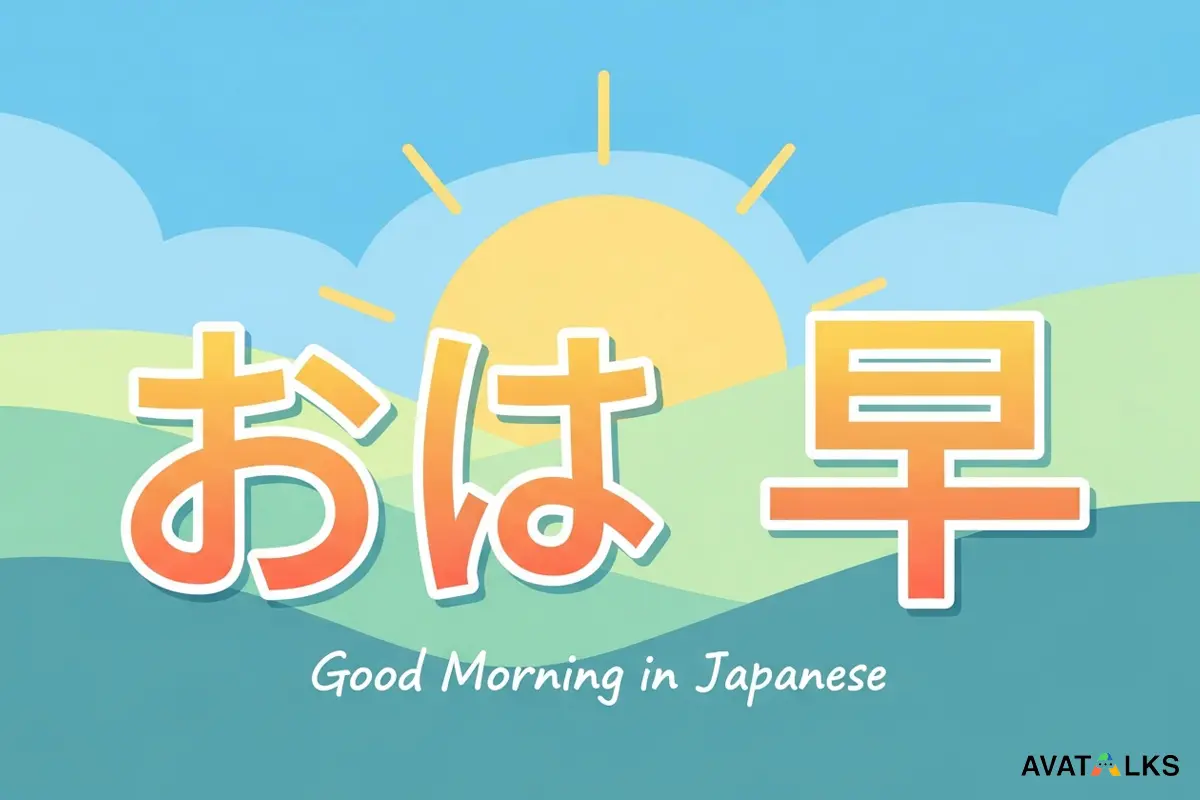
At its core, the standard morning greeting is Ohayou gozaimasu (おはようございます). When broken down into its historic written form, the root appears as お早う. The central kanji is 早 (haya / sou), which means early. The prefix o- (お) adds an honorific sheen, softening the delivery, while gozaimasu acts as the polite copula derived from classical keigo honorifics. Translating the phrase directly yields an observation rather than an overt wish: "It is honorably early."
In modern Japanese texts and everyday signage, writer conventions heavily favor hiragana (おはよう) over kanji. This stylistic preference simplifies daily communication, though the underlying meaning remains tied to an acknowledgment of diligence. Arriving early to labor in fields, workshops, or offices historically signaled community dedication. Remarking on that early hour honored the recipient's dedication.
Pronunciation follows clean phonetic cadence. The Japanese pronunciation guide groups syllables into equal time units called morae: o-ha-yo-u go-za-i-ma-su. The final vowel in gozaimasu is frequently devoiced in modern standard Tokyo dialect. Rather than vocalizing a drawn-out "soo," the word snaps shut cleanly on a sibilant "s" sound: ohayou gozaimas'. Rushing the vowels or over-stressing syllables can disrupt the natural flow that native speakers expect.
The Mechanics of Aisatsu: Workplace Norms and Shift Schedules
Morning greetings form the bedrock of aisatsu (挨拶), the cultural framework governing Japanese greetings across civic, educational, and professional institutions. Japanese workplace etiquette treats consistent aisatsu as a baseline performance metric. Arriving at an office and quietly slipping into a cubicle without offering an audible Ohayou gozaimasu signals friction, emotional distress, or a lack of professional awareness.
Corporate etiquette carries a counterintuitive rule: Ohayou gozaimasu is not bound by the position of the sun. In media production houses, hospital wards, logistics centers, and retail outlets, employees routinely utter Ohayou gozaimasu at 3:00 PM or 10:00 PM. When an individual steps onto the workplace floor for their shift, it represents their personal morning. Shouting Konbanwa (good evening) to a supervisor at the start of a night shift feels jarring to Japanese ears because it reflects the ambient clock rather than professional readiness.
The boundary between formal vs informal Japanese remains absolute inside corporate environments. Subordinates should never shorten the greeting to a brisk Ohayou when greeting superiors. Casual forms belong strictly outside the professional perimeter, exchanged only among close peers during informal breaks.
The Posture of Respect: Ojigi Bowing Culture and Physical Presence
Words carry only half the message; physical carriage delivers the rest. The act of bowing, or ojigi (お辞儀), anchors traditional interactions. As highlighted by physical culture researchers at Tohoku University, historic practices demand that posture originates from the hips rather than the cervical spine, protecting the neck while activating the core and lower limbs. When executing a greeting bow, the spine stays straight while the neck remains aligned with the torso.
Social interactions rely on three distinct angles of ojigi:
- Eshaku (会釈): A casual 15-degree tilt used when greeting colleagues of equal status or passing acquaintances in corridors. Hands hang naturally at the sides for men or rest gently crossed in front for women.
- Keirei (敬礼): A deliberate 30-degree incline directed toward clients, managers, and prospective business partners. This represents the workhorse bow of the commercial sector.
- Saikeirei (最敬礼): A deep 45-degree bow reserved for senior corporate leadership, profound apologies, or solemn formal ceremonies.
A common error among non-native speakers is the "bobbing bow," where the speaker dips their head repeatedly while talking. Professional etiquette requires sequential execution: make brief eye contact, speak the phrase Ohayou gozaimasu, bow smoothly, hold for one beat, and then rise steadily back to an upright position.
Morning Routine Vocabulary: Scripts from Sunrise to Departure
A standard Japanese morning follows predictable conversational patterns. Everyday Japanese conversation relies on paired, ritualistic formulas (kimarimonku) that eliminate ambiguity and reaffirm familial or domestic bonds.
| Phrase (Japanese) | Romaji & Pronunciation | Context & Register |
|---|---|---|
| おはよう | Ohayou (oh-hah-yoh) | Casual / Household; directed toward children, siblings, peers. |
| おはようございます | Ohayou gozaimasu (oh-hah-yoh go-zah-ee-mas) | Formal / Public; used with elders, managers, teachers, service staff. |
| いただきます | Itadakimasu (ee-tah-dah-kee-mas) | Said right before eating; expresses gratitude for food. |
| ごちそうさまでした | Gochisousama deshita (go-chee-soh-sah-mah desh-tah) | Spoken immediately after finishing a meal; thanks the cook or host. |
| 行ってきます | Ittekimasu (eet-teh-kee-mas) | Stated by the person leaving the house ("I'm leaving and coming back"). |
| いってらっしゃい | Itterasshai (eet-teh-rahs-shah-ee) | The reply from those remaining inside ("Go safely and return"). |
The breakfast table brings its own etiquette. Saying itadakimasu involves placing the hands together flat against each other in front of the chest, fingers aligned, accompanied by a small nod. This phrase acknowledges the life of the ingredients and the labor of the cook. Once the meal finishes, gochisousama deshita closes the ritual, recognizing the hospitality provided.
The departure script acts as a domestic anchor. Yelling Ittekimasu! as you slip your shoes on at the genkan (entryway) alerts the household that you are crossing the threshold into the outside world. The obligatory response from those inside, Itterasshai!, confers safe passage. Leaving home in silence feels disjointed to Japanese native speakers, as it removes the communal acknowledgment of departure.
Navigating Conversational Boundaries and Register Traps
Knowing when to dial formality up or down separates fluent practitioners from conversational novices. Cultural etiquette in Japan hinges on evaluating uchi (in-group) versus soto (out-group) connections. Misjudging these boundaries risks causing unintended discomfort.
Foreign learners often default to casual speech too quickly, assuming that conversational warmth requires casual language. Shortening the morning phrase to Ohayou when talking to a neighbor or an older shopkeeper often sounds abrasive rather than friendly. Unless a bond is forged over years of close acquaintance, default to Ohayou gozaimasu. Politeness rarely causes offense; unearned familiarity regularly does.
Conversely, hyper-correctness can feel equally out of place. Uttering a drawn-out, high-level honorific phrase to a young child or a domestic pet breaks natural rhythm and creates awkward social distance. Casual Japanese relies on short vowels, relaxed intonation, and dropped particles. A parent greeting their child will use a warm Ohayou, perhaps followed by Yoku nemureta? (Did you sleep well?).
Frequently Asked Questions (FAQ)
Q1: Is it acceptable to say "Ohayou" to a stranger on a morning run or hike?
A1: On mountain trails or quiet residential running paths, greeting passersby with Ohayou gozaimasu is common practice. In dense urban centers like central Tokyo or Osaka, however, shouting greetings at unfamiliar strangers on public streets is unexpected and may cause confusion. Reserve public greetings for communal outdoor settings or service counters.
Q2: Why do retail workers say "Irasshaimase" instead of "Ohayou gozaimasu" in the morning?
A2: Irasshaimase means "welcome" and serves as a dedicated commercial announcement directed outward to customers. While shop staff use Ohayou gozaimasu when greeting fellow staff members in back rooms, customer-facing interactions require commercial service honorifics.
Q3: Can "Ohayou gozaimasu" be used via text message or chat apps like LINE?
A3: Yes. Messaging apps follow the same hierarchy as spoken Japanese. A casual message to a friend reads おはよう, often styled with lighthearted emojis or stickers. Work messages to colleagues or managers, however, should open with おはようございます before detailing the day's tasks.
Mastering Daily Japanese Etiquette
Language functions best when treated as an active social practice. The phrases that structure an ordinary morning, from the first Ohayou murmured in a dim hallway to the crisp Ohayou gozaimasu directed across a corporate floor, frame everyday relationships. They create consistency, clarify social context, and establish mutual trust.
Focusing on the physical and vocal delivery of these expressions builds confidence. Keep your back straight, deliver the words clearly, and observe how others around you adjust their cadence. Understanding how Japanese society balances language and body language turns routine interactions into seamless cultural connections.