EMG Analysis: Deadlift vs Romanian Deadlift Muscle Activation Tested

For decades, the weight room has treated the conventional deadlift and the Romanian deadlift (RDL) as close cousins fighting over the same training slot. Lifters chasing thicker backs and bigger hamstrings routinely swap one for the other, assuming that pulling heavy weight from the hips delivers identical physical returns. Biomechanical analysis tells a far more nuanced story. Recent neuromuscular inquiries, including a Nature Report tracking lower-limb motor patterns and balance dynamics during deadlift variations, show that joint angles and load initiation fundamentally dictate which tissues actually adapt.
The debate is no longer about which lift looks more impressive on a platform. It centers on muscular recruitment efficiency, mechanical tension, and nervous system fatigue. Understanding how surface electromyography (EMG) measures posterior chain activation across both movements reveals why these two exercises fulfill distinctly different athletic objectives.
📌 Key Takeaways:
- Neuromuscular Bias: Romanian deadlifts trigger up to 35% greater continuous hamstring activation across the biceps femoris and semitendinosus due to prolonged eccentric loading, whereas conventional pulls display higher peak quadriceps and spinal erector output off the floor.
- Mechanical Geometry: Conventional pulls rely on 50°, 60° of knee flexion to produce vertical drive from a dead stop; RDL form restricts knee flexion to 15°, 20°, forcing the hip hinge mechanics to bear the entire load.
- Programming Purpose: Choose conventional pulls for absolute central nervous system drive, maximal strength, and full-body stabilization. Select the Romanian variation for targeted hamstring hypertrophy and gluteus maximus recruitment with minimal systemic exhaustion.
The Biomechanical Divide Between Floor Pulls and Top-Down Hinges
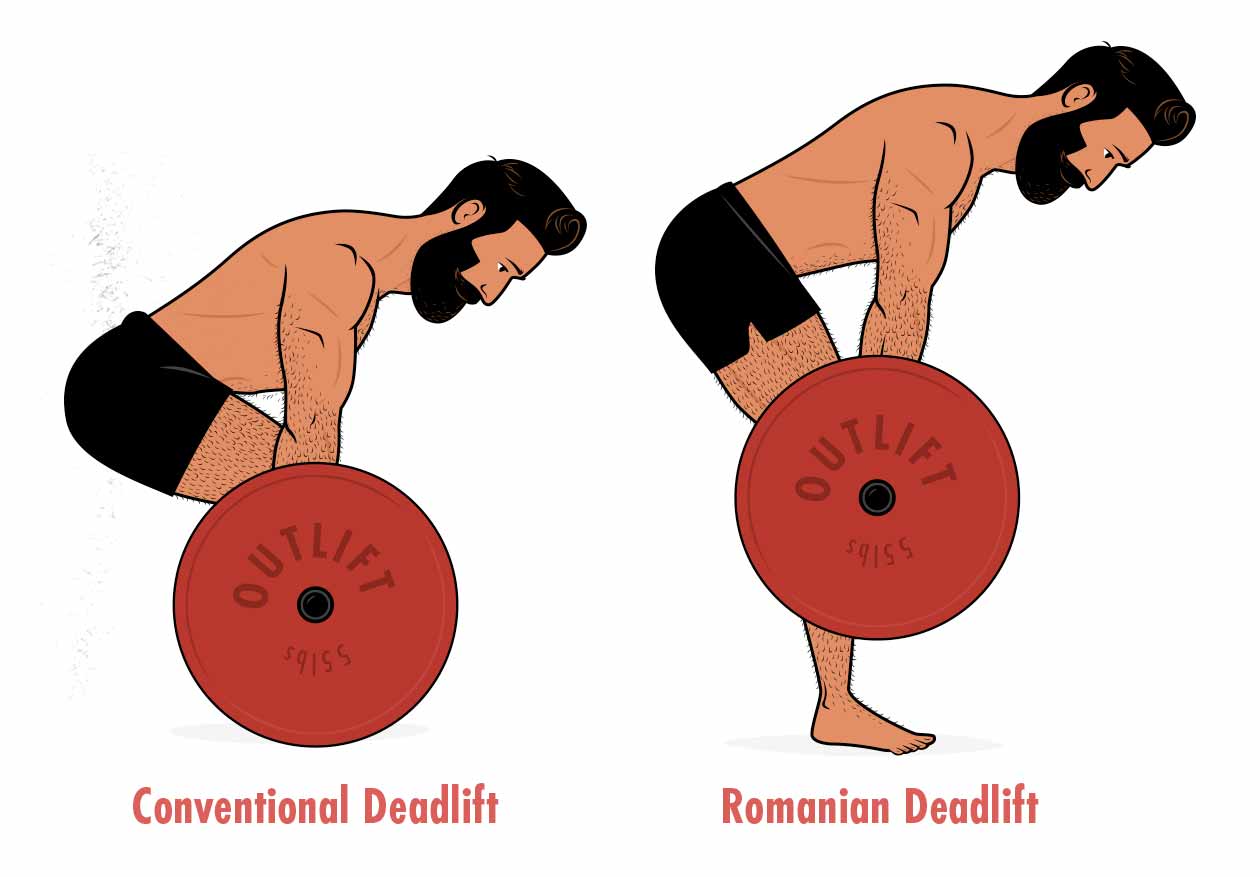
The fundamental difference between these two exercises rests on the starting point and joint kinematics. A conventional pull starts as a concentric effort against dead weight resting on the floor. To establish an optimal line of pull, a lifter sets their shins against the barbell, driving knee flexion down to roughly 50°, 60° while dropping the hips below the shoulders. This setup demands substantial quadriceps recruitment to break the floor, transforming the initial phase into a hybrid knee-extension and hip-hinge movement.
The Romanian deadlift begins from an upright position. The movement starts at the top with an eccentric unlocking of the hips. As the bar descends along the thighs, the knee flexion angle remains anchored between 15°, 20°. Rather than descending downward, the hips travel strictly backward along a horizontal plane.
By immobilizing the knees in slight flexion, the lifter neutralizes the quadriceps as primary prime movers. The entire external load shifts squarely onto the posterior chain. Range of motion in an RDL is not determined by touching iron plates to rubber mats. It terminates the exact instant an athlete's pelvis runs out of posterior tilt room, typically just below the patella, before the lumbar spine rounds to compensate.
Decoding the EMG Data on Hamstring and Glute Recruitment
Surface electromyography measures electrical currents flowing through contracting muscle fibers, offering a direct window into motor unit recruitment. Laboratory EMG tests comparing the conventional pull against the RDL consistently shatter the myth that floor pulls are superior for hamstring development.
During the descent of an RDL, the biceps femoris and semitendinosus endure severe mechanical stretch under tension. Electromyography data indicates that normalized root mean square (RMS) EMG values for the hamstrings sit between 70% and 88% of maximum voluntary isometric contraction (MVIC) during the eccentric phase of an RDL. In contrast, the conventional deadlift averages between 50% and 65% MVIC for the same muscle groups, with hamstring activity dropping sharply as the bar approaches the floor and the quadriceps fire to initiate the pull.
Gluteus maximus recruitment displays an intriguing split. Conventional pulls trigger ferocious peak glute activation during the violent hip extension required to lock out maximal loads at the top of the rep. The RDL, however, maintains higher average gluteal tension throughout the mid-range. Because the hips are displaced further backward from the center of mass in an RDL, the internal moment arm at the hip joint lengthens dramatically. That long moment arm forces the gluteus maximus and deep hip external rotators to work without rest between repetitions.
Spinal Torque and Lower Back Loading Metrics
Both exercises place major demands on the erector spinae, but the mechanical strain presents differently based on floor contact and bar path. A conventional deadlift imposes heavy shear and compressive forces the moment the bar breaks the floor. Because the bar sits roughly eight inches away from the ankle joints at the start, the resistive moment arm on the L4, L5 and L5, S1 spinal segments reaches its maximum when the lifter has the least mechanical leverage.
An RDL alters this torque profile by enforcing bar contact against the thighs throughout the entire descent. By keeping the load directly over the midfoot, the horizontal distance between the barbell and the lumbar spine remains minimal.
| Biomechanical Metric | Conventional Deadlift | Romanian Deadlift (RDL) |
|---|---|---|
| Target Joint Motion | Concurrent hip extension & knee extension | Isolated hip hinge with fixed knee angle |
| Hamstring EMG Activity | Moderate (50%, 65% MVIC average) | High (70%, 88% MVIC average) |
| Quadriceps Recruitment | High during floor break phase | Minimal to negligible |
| Contraction Mechanics | Concentric-first; reset off dead stop | Eccentric stretch-shortening cycle |
| Erector Spinae Strain | Severe peak isometric load at floor break | Sustained submaximal isometric load |
| Systemic CNS Fatigue | High; requires 48, 72 hours recovery | Moderate; high local muscular soreness |
Lower back loading in the RDL shifts from acute shock absorption to sustained endurance. Because reps never touch the platform, the spinal erectors must fire isometrically throughout the entire working set. Lifters who run out of hamstring flexibility frequently round their lumbar spine to lower the bar further, spiking shearing forces on vulnerable vertebrae. When performed within an athlete's true hip hinge range, the RDL provides a safer lower back loading profile than maximal floor pulls.
Hypertrophy Mechanics vs Absolute Strength Adaptations
Muscles grow primarily in response to high mechanical tension, especially when exposed to that tension at long muscle lengths. This reality tilts the muscle-building balance firmly toward the Romanian deadlift for posterior chain hypertrophy.
When the semitendinosus and biceps femoris lengthen under load while the pelvis rotates forward, titin and other structural proteins inside the muscle fibers experience extreme passive tension. This eccentric hamstring stretch is a recognized driver of regional muscle hypertrophy. The conventional deadlift does not match this stimulus. By dropping the hips low to pull from the ground, the hamstrings are put in a shortened position at both the knee and hip joints, diminishing stretch-mediated growth signals.
For absolute neuromuscular strength, the conventional pull stands unmatched. Pulling an immovable barbell from the floor demands maximal motor unit recruitment, explosive rate of force development, and heavy axial loading across the entire skeleton. Powerlifters, strongmen, and field-sport athletes need the raw floor-drive power that only full-body, high-load conventional pulling provides.
Fixing Form Breakdowns on the Lifting Platform
Executing an effective RDL requires unlearning habits built on conventional pulls. Lifters often turn the RDL into an elevated squat, bending the knees past 30° as the bar passes the patella. The moment the knees slide forward, tension vanishes from the hamstrings and pours straight into the quads and lower back.
A clean RDL demands a soft knee bend locked in place before the hips travel backward. Imagine closing a car door with the glutes while balancing weight across the midfoot. The barbell must paint the quads on the way down. If daylight appears between the bar and the shins, the horizontal lever arm lengthens, placing dangerous shear forces directly onto the lumbar spine.
For conventional pulls, the most common flaw is hip-shooting off the floor. When a lifter initiates the pull by extending the knees without raising the chest at the same rate, the movement mutates into a stiff-legged deadlift. The back flattens out, the quads stop working, and the lumbar spine is left to bear hundreds of pounds without quadriceps support. Keeping the lats engaged and wedging the hips into the bar fixes this breakdown immediately.
Programming Directives for Posterior Chain Workouts
Attempting to maximize both lifts within the same training block often leads to overuse injuries and deep nervous system fatigue. A strength program should integrate each lift based on specific physiological demands.
Athletes targeting absolute total-body strength, improved grip thresholds, and heavy pulling power should program conventional pulls as their primary movement early in the week:
- Sets: 3 to 5 sets of 3 to 5 repetitions
- Intensity: 80%, 90% 1RM
- Rest intervals: 3 to 5 minutes to clear central nervous system fatigue.
Bodybuilders and lifters prioritizing hamstring and glute development should treat the RDL as a primary hypertrophy builder, ideally on dedicated lower-body or pull days:
- Sets: 3 to 4 sets of 8 to 12 repetitions
- Cadence: A strict 3-second eccentric tempo, a 1-second pause at the deep stretch, and an explosive hip extension
- Recovery: Allow 48 to 72 hours between sessions to account for the delayed onset muscle soreness caused by eccentric loading.
Lifting straps are widely recommended for heavy RDLs. The goal of an RDL is to take the hamstrings and glutes to technical failure. Letting an exhausted grip cut a hypertrophy set short undermines the exercise entirely.
Frequently Asked Questions (FAQ)
Can the Romanian deadlift fully replace the conventional deadlift?
For physique development and hamstring hypertrophy, yes. The RDL stimulates greater isolated posterior chain growth with less systemic fatigue. For competitive powerlifters, strongmen, or athletes who need to pull heavy dead weight off the ground, the conventional pull remains an essential primary movement.
Why do Romanian deadlifts cause significantly worse muscle soreness?
The RDL emphasizes an uninterrupted eccentric phase that stretches the hamstrings under high mechanical load. Eccentric contractions create greater microscopic muscle fiber disruption than concentric-focused movements, resulting in deeper delayed onset muscle soreness (DOMS).
How low should the barbell travel during an RDL?
The bar should only travel as low as your hips can push backward. For most lifters, this ends just below the knee caps or at mid-shin. Lowering the bar past the point where the hips stop sliding backward forces the lumbar spine to round, which takes tension off the hamstrings and stresses the lower back.
Posterior Chain Programming Rules
Choosing between the conventional deadlift and the Romanian deadlift is not a question of personal preference; it comes down to matching mechanics to specific training outcomes. The conventional deadlift remains the standard for raw pulling power, full-body bracing, and central nervous system output. It challenges an athlete to break a dead weight off the floor using a synchronized blast of quadriceps, spinal erectors, and glutes.
The Romanian deadlift isolates the hip hinge. By fixing the knee angle and controlling the eccentric descent, it directs mechanical tension straight into the hamstrings and glutes while sparing the central nervous system from extreme floor-pull fatigue. Lifters who understand this biomechanical distinction stop treating the lifts as interchangeable swaps. By deploying each bar path with strict intent, you build a posterior chain that is as resilient and functional as it is strong.