Evolution of the Hidden In-N-Out Menu: How Decades of Hacks Went Mainstream
When crowds pitched tents on sidewalks outside Nashville to greet California’s quintessential drive-thru chain, they were not waiting for the sparse items printed on the illuminated overhead board. As documented in The Tennessean Report on In-N-Out's eastern expansion, interstate travelers and local converts camped overnight to secure grease-stained white paper sacks packed with off-menu lore. The physical menu at In-N-Out lists precisely four food offerings: hamburger, cheeseburger, Double-Double, and French fries. Yet beneath that mid-century minimalism operates the most thoroughly institutionalized underground ordering system in fast food history.
(Source: The Tennessean: "In-N-Out's California 'aura' lands in Nashville, fans camp out, fly in")
This off-menu catalog was never conceived in a modern corporate marketing sprint. It accumulated over six decades through a push-and-pull between car-culture obsessives, short-order line cooks, and strict kitchen assembly protocols. What began as informal modifications in the San Gabriel Valley evolved into a universal dialect that reshaped how fast food chains manage customer identity, inventory limits, and digital virality.
📌 Key Takeaways:
- Baldwin Park Origins: The underground menu started in the 1960s when drive-thru line cooks accommodated local hot-rodders looking for off-brochure textures and heavier seasonings.
- Assembly Architecture: Every modification relies entirely on existing stock, mustard searing, secret spread variations, and produce restructuring, requiring zero external inventory.
- The Structural Limit: A viral 2004 stunt pushed kitchen capacity past the breaking point, forcing corporate management to cap custom orders permanently at four patties and four cheese slices.
The Baldwin Park Roots of Drive-Thru Modifications
The secret menu started with drive-thru logistics. Harry and Esther Snyder opened the original Baldwin Park stand in 1948 with a two-way speaker box, cutting parking attendants out of the transaction entirely. Fast turnaround dictated an ultra-lean inventory: fresh beef, sponge-dough buns, American cheese, whole potatoes, spread, lettuce, tomato, and onions. Nothing went into a walk-in freezer because the original buildings did not have one.
By the early 1960s, local teenagers and drag racers idling in the drive-thru lanes began asking line cooks to tweak their orders. The cooks worked open kitchens under direct customer scrutiny. Accommodating an off-hand request for crisper patties or raw onions tucked between melted cheese was not corporate rebellion. It was good customer service for neighborhood regulars. Because the supply chain remained stubbornly fixed, cooks improvised using heat, timing, and arrangement. They discovered that altering the sequence of standard ingredients could produce an entirely distinct sandwich without introducing a single new SKU to the storeroom.
Deconstructing Animal Style and Kitchen Standardization
The undisputed cornerstone of this unwritten catalog is Animal Style. Legend holds that the name originated around 1961 at Store No. 1, where rowdy late-night customers, dubbed "animals" by store managers, began requesting specific customizations. The modification soon became code across Southern California outposts.
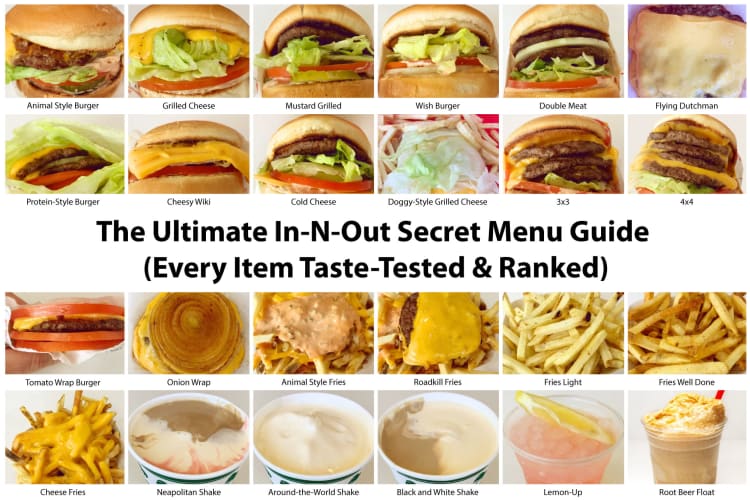
The culinary mechanics are exact. Ordering any burger Animal Style triggers a precise sequence on the flat-top. The cook applies mustard to the raw side of the fresh beef puck before flipping it, creating a mustard-cooked patty where searing oil and vinegar carmelize directly onto the meat crust. The bun receives an extra ladle of the house secret spread recipe, a thousand-island variant heavy on sweet pickle relish and mayonnaise, interspersed with crisp pickles and a dense mound of caramelized, diced grilled onions. When applied to fries, the kitchen covers a boat of freshly sliced Kennebec potatoes with melted American cheese, grilled onions, and spread.
The brilliance of the preparation rests on internal logistics. The line cooks already carried yellow mustard at the grill station; pickles were already prepped for standard setups. By codifying customer modifications into standardized shorthand, the company turned potential service delays into streamlined, high-speed execution.
The 100x100 Debacle and the Structural 4x4 Burger Limit
For decades, In-N-Out maintained an informal policy: if a customer could pay for the meat and cheese, the crew would build it. Enthusiasts ordered 3x3s, 4x4s, and occasionally monstrous towers wrapped in layers of butcher paper. This open-door policy ran smoothly until the internet converted private novelty into competitive public performance.
On Halloween night in 2004, a group of diners entered a Willows, California location and ordered a single burger containing 100 beef patties and 100 slices of American cheese. The order cost $90. Line cooks spent nearly forty minutes attempting to balance the structural monstrosity across multiple cardboard trays, halting the entire store's drive-thru flow. Photos of the structural failure ricocheted across early internet forums and food blogs.
Corporate management realized that unchecked modifications threatened their core metric: speed of service. Shortly thereafter, the company instituted a hard, non-negotiable 4x4 burger limit across all registers. Customers could still customize their stacks, but kitchen crews would never again construct an engineering hazard on the flat-top.
| Era / Year Range | Customer Hack or Modification | Kitchen Operational Response |
|---|---|---|
| 1961, 1975 | Animal Style burger customization emerges from local drive-thru regulars. | Grill cooks standardize mustard-searing and grilled onion holding pans. |
| 1975, 1989 | Flying Dutchman invented; Protein Style burger ordered by carb-conscious Southern Californians. | Whole iceberg lettuce leaves set aside for bun replacement; point-of-sale registers add custom mod keys. |
| 2004 | The viral 100x100 burger order halts kitchen workflow at a Northern California outpost. | Corporate imposes a permanent 4x4 maximum threshold on all sandwich builds. |
| 2015, 2026 | Viral onion-wrapped patties and chopped chili hacks explode across social platforms. | Store managers mandate strict register definitions to maintain ticket velocity under viral spikes. |

Dietary Subversions: Protein Style, Dutchman, and Chili Customization
Long before low-carbohydrate and ketogenic diets hit grocery store shelves, In-N-Out customers were dismantling the traditional burger build. Former company president Rich Snyder officially introduced the Protein Style burger in the late 1970s after watching health-conscious Los Angeles patrons abandon their toasted buns in the trash. The order swaps bread for large, whole-leaf iceberg lettuce cups, wrapping the hot meat and melted cheese in a watertight crisp fold.
For pure carnivores, the menu holds the Flying Dutchman. Named after former company operations manager Dutch Snow, the item discards buns, lettuce, and tomatoes entirely. The result is pure structural efficiency: two beef patties encasing two slices of melted American cheese, served inside a wax-paper clam shell.
Micro-customizations run deeper. Serious regulars frequently order well-done fries to combat the limp texture caused by In-N-Out's single-fry potato method, or ask for a whole grilled onion, a solid, caramelized cross-section slab placed directly against the patty rather than standard diced onions. Diners can request cascabella yellow chilies either whole on the side or sliced directly into the burger layers, lending a vinegary, sharp heat that cuts through heavy animal fats. Vegetarian customers frequently order the grilled cheese option, which simply doubles up on toasted buns, melted cheese slices, spread, lettuce, and tomato without a beef patty.
Drink stations also house their own sub-dialect. While chocolate, strawberry, and vanilla shakes are standard, ordering a Neapolitan shake yields a three-way ribboned pour of all three flavors in a single cup.
The Social Media Dilemma and Kitchen Friction
In the digital era, the nature of off-menu ordering shifted from quiet local knowledge to performative online consumption. TikTok creators continuously invent new configurations, occasionally breaking down the kitchen's delicate assembly line. The most prominent example is the whole-grilled-onion Flying Dutchman hack, where customers demand two thick slices of caramelized onion to function as the outer bun for a meat-and-cheese core.
These viral spikes cause operational friction. Grilling an intact onion slab takes significantly longer than tossing pre-diced onions on the flat-top. When hundreds of drive-thru customers simultaneously demand custom onion buns, the entire kitchen tempo stutters. Several high-volume stores briefly experimented with charging separate customization fees or directing customers to build the items themselves at the table.
This dynamic highlights why In-N-Out refuses to aggressively market its secret items. The chain publishes a modest "Not So Secret Menu" on its official website, acknowledging basic items like Double-Double hacks, Protein Style, and the Flying Dutchman. By officially recognizing only the foundational modifications, corporate leadership creates a release valve: validating customer culture without institutionalizing complex orders that would destroy drive-thru throughput.
Frequently Asked Questions (FAQ)
Can an In-N-Out store refuse to make a specific off-menu request?
Yes. While line cooks honor hundreds of ingredient combinations, managers routinely refuse orders that threaten kitchen safety, compromise food safety guidelines, or create intolerable drive-thru gridlock. Requests for raw burger meat, deep-fried items outside the standard fry line, or stacks exceeding four patties are denied across all locations.
What is the proper way to order fries extra crispy?
Ask for "well-done fries" at the register. Because In-N-Out cuts fresh Kennebec potatoes directly into water without par-boiling or freezing them, standard fries cook quickly and soften fast. Requesting them "well-done" or "light well" keeps the potato basket submerged in the sunflower oil longer, creating a deeper golden crispness.
Is the secret spread recipe just thousand island dressing?
Not exactly. While it shares the same pink profile, the formulation contains mayonnaise, sweet pickle relish, distilled vinegar, sugar, and a proprietary blend of seasonings balanced specifically to melt into the hot beef fats of a mustard-cooked patty. Individual packets of spread can be requested free of charge at the window or counter.
The Strategy of Controlled Friction
Fast food chains have spent decades chasing algorithmic trends, cycling through limited-time offerings, gimmicky coatings, and celebrity-branded meal promotions. Most of these campaigns evaporate as soon as media buys dry up. In-N-Out accomplished the opposite by refusing to print new menu cards.
The unwritten ordering catalog transforms a fast-food transaction into an act of cultural participation. Ordering an Animal Style Double-Double with cascabella yellow chilies and a whole grilled onion requires language specific to that kitchen. The customer feels less like an anonymous ticket number and more like a participant in a specialized food culture. By protecting that dialect while enforcing hard operational limits like the 4x4 ceiling, In-N-Out built a self-sustaining marketing engine that requires zero advertising spend, powered entirely by the customers leaning out their car windows to order.