Fact Check: Did the Internet Just Buy Spirit Airlines, and Where Does the $88M Really Go?
Did the Internet Just Buy Spirit Airlines? The Truth Behind the Viral Takeover Drive
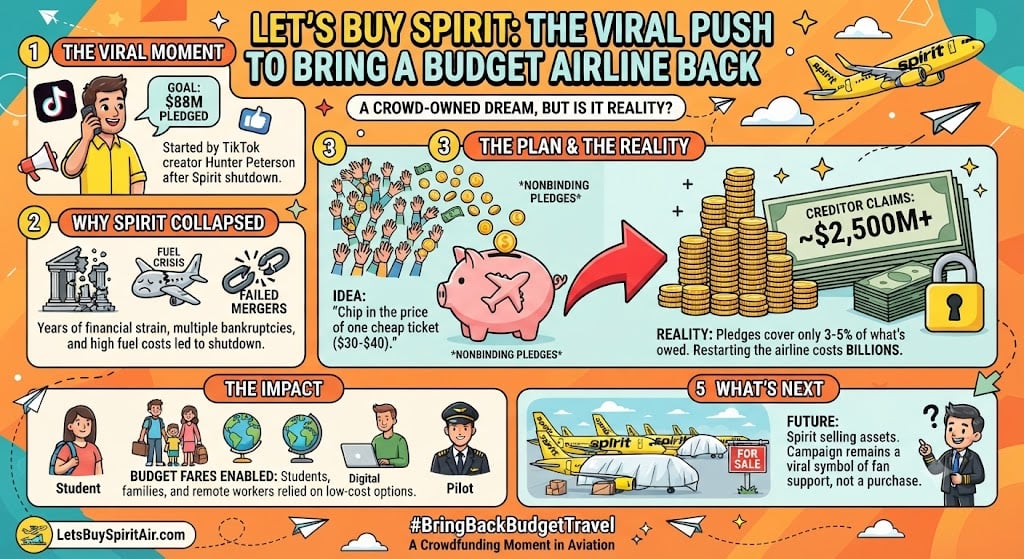
A tongue-in-cheek social media gag has mutated into one of the weirdest financial spectacles of 2026. After a creator floated a mock plan on TikTok to pool loose change and buy out Spirit Airlines, tens of thousands of travelers rushed to back the scheme. According to coverage tracking the frenzy from a Yahoo Finance report, more than 40,000 individuals pledged over $26 million within days of the clip going live, before secondary campaigns and speculative social counters pushed the theoretical pledged total north of $88 million.
The campaign captured widespread frustration with vanishing ultra-low-cost flights, spiraling baggage fees, and the carrier's looming financial distress. Yet underneath the viral buzz lies a tangle of non-binding forms, regulatory minefields, and rampant misinformation. Internet users did not purchase an airline, and the pledged millions are nowhere near an escrow account.
📌 Key Takeaways:
- The Factual Bottom Line: No money has actually exchanged hands; the widely cited $88 million figure represents voluntary, non-binding pledge forms generated by satirical crowdfunding trackers rather than collected cash.
- The Origin: What started as a joke video on TikTok mocking Spirit's slashed market capitalization spiraled into a serious-looking retail campaign amid the airline's restructuring woes.
- Regulatory Reality: Federal law, SEC regulatory compliance standards, and Department of Transportation (DOT) citizenship mandates make buying a commercial airline through decentralized internet pledges legally impossible.
From Punchline to Pledge Form: The Spark Behind the Movement
The movement ignited when short-form video creators began dissecting Spirit Airlines' cratering equity. With the carrier wrestling with sustained operational losses and heavy debt maturities, commentators pointed out that the entire market value of the company had dipped below the cost of a handful of new Airbus narrow-body aircraft. One creator pitched a simple proposal: if every frequent flyer chipped in a few hundred dollars, everyday passengers could seize control, fire Wall Street advisors, and mandate free carry-on bags forever.
The bit hit a cultural nerve. Passengers who relied on Spirit’s no-frills, low-fare routes between secondary hubs saw an opportunity to vent, laugh, and rebel against corporate consolidation. Within 48 hours, the phrase "let's buy Spirit Airlines" dominated TikTok algorithms, spawning copycat skits, custom merch, and third-party landing pages soliciting pledges.
Humor quickly blurred into earnest participation. Reddit communities like r/WallStreetBets and passenger rights groups debated whether a decentralized autonomous organization (DAO) or an employee-customer cooperative could submit a formal bid in bankruptcy court. What began as satire was suddenly being reported as a grassroots hostile takeover bid.
The Elon Musk "SpiritX" Hoax and the Spread of Rumors
As the pledge tally climbed, online myth-making kicked into overdrive. Speculative posts on X and YouTube claimed Elon Musk had quietly stepped into the fray to partner with retail backers, allegedly rebranding the carrier under a satirical banner dubbed SpiritX. AI-generated graphics showed yellow Airbus jets repainted in matte black with Tesla logos emblazoned on the tail fins.
The rumor grew so pervasive that media watchdog monitors and independent fact-checkers intervened. NewsGuard's Reality Check and business analysts quickly debunked the claims as baseless satire that algorithmically hijacked real-time search queries. Neither Musk nor any of his holding entities had filed disclosures with the Securities and Exchange Commission or initiated contact with Spirit’s board.
The fake "SpiritX" narrative demonstrated how quickly financial fiction travels when an iconic, struggling brand intersects with internet meme culture. For days, retail investors flooded message boards asking if purchasing Spirit shares would grant them swap rights into a privatized aerospace venture, exposing the severe financial literacy gap driving the viral wave.
Viral Numbers Against Aviation Realities
The gap between a viral pledge tally and the balance sheet of an ultra-low-cost carrier is vast. Running an airline demands liquid reserves, debt servicing, and capital expenditures that dwarfed the numbers circulated on social feeds.
| Metric / Operational Factor | Internet Campaign Claims | Spirit Airlines Balance Sheet Reality |
|---|---|---|
| Capital Raised | $26M, $88M pledged online | $0 collected; non-binding online signups |
| Outstanding Debt & Obligations | Assumed negligible by social media users | Over $3 billion in debt, leases, and liabilities |
| Daily Fuel & Labor Costs | Ignored in viral business models | $8M, $12M required daily just to maintain schedule |
| Regulatory Approvals Required | Believed to be a direct asset sale | FAA, DOT, DOJ, and SEC compliance review |
| Fleet Ownership Structure | "We buy the 200+ planes" | Majority of planes leased from third-party lessors |
Even if campaign organizers collected the high-end $88 million estimate in real cash, that sum would cover approximately eight days of ordinary flight operations. Jet fuel contracts, gate leasing fees at major airports like Fort Lauderdale and Orlando, and maintenance reserves consume tens of millions weekly. Crowdfunding an operating deficit is simply impossible at commercial aviation scale.
The Regulatory Wall: FAA Certificates and DOT Ownership Rules
Even if retail organizers held billions in liquid capital, purchasing a commercial airline cannot be executed through an informal syndicate. Aviation remains one of the most strictly regulated sectors under United States law.
Every commercial airline flies under an FAA Part 121 operating certificate alongside an economic fitness determination issued by the Department of Transportation. Under 49 U.S.C. § 40102(a)(15), a carrier must satisfy strict U.S. citizenship standards: at least 75% of the voting interest must be held and controlled by U.S. citizens, and the president and two-thirds of the board of directors must be American citizens.
Crowdfunded entities with thousands of anonymous online contributors cannot satisfy "actual control" and citizenship tests without complex, heavily vetted structures. The DOT regularly blocks transactions if beneficial ownership cannot be traced to accredited, verified individuals. A loose network of social media followers cannot legally hold title to an airline certificate.
SEC rules impose another insurmountable hurdle. Soliciting money from the public with the expectation of equity, profits, or managerial control triggers federal securities registration under the Securities Act of 1933. Without a formal, registered prospectus or an established private placement exemption, pooling retail funds for an acquisition would constitute an illegal unregistered securities offering.
Where the Pledged Dollars Actually Reside
No consumer money has been vanished, seized, or transferred to an airline restructuring account. The landing pages that gathered steam during the peak of the trend functioned exclusively as marketing funnels or digital pledge sheets.
Users who filled out forms input an email address and typed an arbitrary dollar figure they claimed they would be willing to commit. No credit cards were billed, no escrow accounts were registered with financial custodians, and no bank routing information was drawn. In instances where creators set up third-party tipping pages or sold commemorative merchandise, proceeds flowed directly to the creators themselves as commercial revenue, not to Spirit Airlines or its creditors.
Spirit Airlines itself, operating under the oversight of financial restructuring advisors and federal judges during its turnaround efforts, never acknowledged the online pledges as a viable capital infusion. Creditor committees require cash collateral, secured debtor-in-possession financing, and institutional commitments, none of which can be replaced by an online petition.
Frequently Asked Questions (FAQ)
Q1: Did anyone lose money by pledging to buy Spirit Airlines online?
The vast majority of participants filled out non-binding web forms that collected names and hypothetical pledge amounts without payment processing. However, consumers who bought unofficial campaign merchandise or tipped social media creators via digital wallets made non-refundable personal payments that do not translate into equity or flight perks.
Q2: Could retail investors legally organize a cooperative to buy an airline in bankruptcy court?
While retail investors can technically purchase publicly traded common stock, common equity in distressed airline restructurings is typically canceled or heavily diluted. Organizing an independent retail bidding group to acquire operating assets requires formal representation by registered broker-dealers, proof of hundreds of millions in committed cash, and rigorous Department of Transportation fitness reviews.
Q3: Did Elon Musk or his companies submit any bid for Spirit Airlines?
No. Claims regarding Elon Musk launching "SpiritX" originated from satirical humor accounts and AI-manipulated images. Regulators and company records confirm no filings, talks, or acquisition proposals were ever initiated by Musk or his affiliated companies.
The Reality of Budget Aviation in 2026
The "let's buy Spirit Airlines" phenomenon was never a corporate transaction; it was a digital collective sigh. Millions of travelers watched ultra-low-cost alternatives buckle under debt, engine availability constraints, and corporate consolidation, leaving them with fewer choices and climbing ticket prices. Cracking jokes about crowdsourcing an airline offered a temporary sense of agency in a sector dominated by distant boardrooms and institutional bondholders.
Spirit Airlines faces genuine structural questions as it renegotiates debt, rationalizes its fleet, and redefines its product mix for modern travelers. Resolving those balance sheet headwinds requires institutional capital, disciplined capacity management, and FAA regulatory compliance. The internet provided widespread attention and a mountain of memes, but passenger airlines run on hard cash, sovereign legal frameworks, and aviation fuel.


