Fact-Checking Medical Abbreviations: Is ACHS on the 'Do Not Use' List?
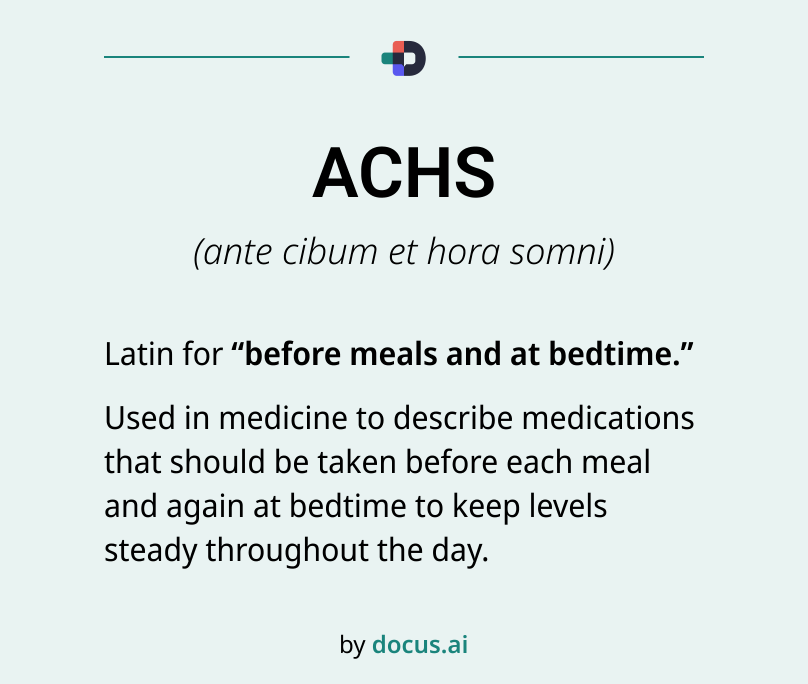
Every morning across hospital medical-surgical floors and intensive care units, nurses pull up medication administration records to check capillary blood glucose levels before breakfast trays arrive. Scrawled across legacy paper charts or embedded within electronic order sets, one four-letter string appears constantly alongside sliding scale insulin orders: ACHS. While clinicians instinctively reach for a glucometer and prepare insulin pens, an enduring compliance debate circulates through hospital pharmacy and therapeutics committees: Is ACHS an officially banned medical abbreviation, or is it an accepted standard for daily bedside care?
The ambiguity stems from decades of federal patient safety crackdowns and institutional policy splits. Standard prescription shorthand draws from centuries of apothecary Latin, where speed frequently trumped legibility. Yet as detailed in the Wikipedia (en) Report on medical prescription terminology, regulatory bodies have spent the past two decades systematically dismantling ambiguous acronyms to eradicate preventable clinical errors. Dissecting the clinical reality of ACHS requires separating federal mandates from local hospital guidelines, parsing its Latin origins, and examining how bedside timing errors still endanger patient safety.
📌 Key Takeaways:
- The Regulatory Reality: ACHS is not on The Joint Commission's official minimum "Do Not Use" list, but elements of it appear on the Institute for Safe Medication Practices (ISMP) list of error-prone medical abbreviations.
- The Clinical Meaning: ACHS stands for ante cibum et hora somni ("before meals and at bedtime"), directing dosage administration timing and blood glucose monitoring four times daily.
- The Primary Charting Hazard: The "HS" component is frequently misread as "half-strength" or confused with "qhs" and "every hour," prompting leading hospital networks in 2026 to demand plain-text electronic orders.
The Latin Mechanics of Ante Cibum and Hora Somni
To evaluate the safety profile of ACHS, clinicians must understand the prescription abbreviation meaning behind its Latin roots. The acronym represents a fusion of two distinct directives: ante cibum (AC), translating to "before meals," and hora somni (HS), translating to "at the hour of sleep" or "bedtime." Combined, the phrase directs staff to perform an intervention four times throughout a 24-hour cycle, typically before breakfast, lunch, and dinner, followed by a final check before the patient sleeps.
In standard nursing chart documentation, this timing pattern aligns directly with physiological insulin demands. Diabetic patients experiencing inpatient hyperglycemia require tight glycemic control. Checking capillary blood glucose ante cibum allows nurses to evaluate baseline glucose levels and administer mealtime prandial or correctional insulin to offset postprandial spikes. The bedtime check verifies that circulating insulin will not trigger nocturnal hypoglycemia while the patient sleeps unmonitored. Despite this clinical utility, fusing two distinct temporal concepts into a single four-letter block creates structural communication vulnerabilities.
The Regulatory Verdict: The Joint Commission vs. ISMP Standards
A widespread misconception across hospital breakrooms claims that The Joint Commission explicitly outlawed ACHS when it established the National Patient Safety Goals in 2004. That claim is technically incorrect. The Joint Commission's mandatory "Do Not Use" list targets five high-risk notations: "U" (unit), "IU" (international unit), "Q.D./QOD" (daily/every other day), trailing zeros (such as 5.0 mg instead of 5 mg), and "MS/MSO4/MgSO4" (confusing morphine sulfate with magnesium sulfate).
The Institute for Safe Medication Practices presents an entirely different assessment. On the ISMP List of Error-Prone Medical Abbreviations, Symbols, and Dose Designations, the abbreviation "HS" carries an explicit warning. Handwritten or poorly rendered digital orders for "HS" are routinely misinterpreted as "half-strength." In critical care environments, misinterpreting a bedtime order as a directive to cut a drug dose in half leads directly to underdosing, while mistaking "qhs" for "q1h" can prompt catastrophic tenfold overdoses. Consequently, while federal inspectors will not automatically cite a hospital solely for the presence of ACHS, internal accreditation reviews routinely pressure health networks to replace Latin shorthand with explicit instructions.
The Danger Zone: Sliding Scale Insulin and Bedside Glucose Checks
The operational danger of ACHS rarely lies in reading the letters in isolation. It emerges during high-tempo workflows involving blood glucose monitoring and rapid-acting insulin administration. When an endocrinologist enters an order for "Fingerstick blood glucose ACHS with regular insulin per sliding scale," the actual timing rests entirely on meal delivery logistics rather than a rigid clock schedule.
Breakfast trays arrive late. Patients leave the floor for magnetic resonance imaging. If a nurse logs a capillary glucose reading under an ACHS protocol at 11:30 AM, but the patient does not receive lunch until 1:15 PM, administering rapid-acting insulin lispro or aspart based on the pre-meal order invites severe hypoglycemia. Between 2024 and 2026, hospital safety incident monitors identified that timing discrepancies between fingerstick testing, food intake, and correctional insulin delivery account for over 38% of inpatient glycemic adverse events. The ambiguity of ACHS obscures the vital temporal link: insulin calibrated for ante cibum must be paired directly with active caloric consumption, not just a charting timestamp.
Evaluating Prescribing Shorthand Against Modern Safety Protocols
Clinical decision support teams continuously balance charting brevity against medical error prevention. The following framework outlines how common Latin scheduling notations compare against safety guidelines and modern charting alternatives.
| Medical Shorthand | Latin Origin & Meaning | Primary Safety Vulnerability | 2026 Standard Protocol |
|---|---|---|---|
| ACHS / ac & hs | Ante cibum et hora somni (Before meals and at bedtime) | "HS" confused with half-strength; meal trays out of sync with testing | Plain English: "Before meals and at bedtime" with discrete order times |
| QID | Quater in die (Four times a day) | Confused with "QD" (daily); spaced evenly across 24h regardless of meals | Specific fixed hours (e.g., 0900, 1300, 1700, 2100) |
| QHS | Quaque hora somni (Every bedtime) | Misinterpreted as "q1h" (every hour); variable patient sleep schedules | "Nightly at bedtime" or fixed electronic prompt (e.g., 2100 or 2200) |
| PC | Post cibum (After meals) | Mistaken for "per centimeter" or confused with "AC" in messy documentation | "After meals" or linked directly to meal-end delivery confirmation |
Electronic Health Records and the Push for Plain-Text Protocols
The rapid evolution of electronic health records (EHR) such as Epic and Oracle Health has systematically altered how clinical orders are transmitted. In early computerized provider order entry (CPOE) systems, physicians typed legacy shorthand codes directly into search fields. Typing "ACHS" simply triggered a backend conversion that scheduled tasks for standard hospital hours, such as 0730, 1130, 1630, and 2100.
That system created an artificial sense of precision. A nurse seeing an automated prompt for 1130 might perform a fingerstick on time, record a blood glucose reading of 240 mg/dL, and chart the correctional insulin dose, unaware that the hospital cafeteria was delayed and lunch would not arrive until 1300. By 2025, major academic medical networks updated their EHR master order catalogues to ban raw Latin entries entirely. Clinical interfaces now prompt prescribers with structured checkboxes: "Pre-meal (within 30 minutes of meal delivery) and at bedtime." This shift anchors clinical documentation to patient-centered physiology rather than archaic administrative shorthand.
Defensive Charting and Interprofessional Handoffs
Bedside nursing documentation demands absolute clarity. When handoff reports occur during shift changes at 0700 and 1900, critical information about nutritional intake and insulin coverage must survive the transfer without misinterpretation.
Experienced charge nurses train incoming staff to verify whether an ACHS order reflects a patient's actual oral intake status. If a diabetic patient transitions from a normal diet to NPO (nil per os, nothing by mouth) status for emergency surgery, an ACHS fingerstick order becomes clinically obsolete. Meals are no longer arriving, meaning "ante cibum" timing loses its reference point. In these circumstances, the order must instantly transition to a fixed interval, such as "fingerstick every 6 hours", and sliding scale insulin must be recalculated to prevent sudden metabolic shock. Verifying that the medication administration record accurately reflects the patient's current intake status prevents errors before an unneeded dose is administered.
Frequently Asked Questions (FAQ)
Q1: Is ACHS explicitly banned on The Joint Commission's official list?
A1: No. The Joint Commission maintains a strict minimum "Do Not Use" list that excludes ACHS. However, because ISMP flags "HS" as error-prone, many individual healthcare facilities prohibit ACHS within their internal administrative bylaws.
Q2: How does ACHS differ from QID in clinical practice?
A2: QID indicates four times daily spaced at equal intervals across waking or 24-hour periods, regardless of food intake. ACHS synchronizes testing and medication directly with three meals and nighttime sleep, prioritizing nutritional timing over fixed hourly spacing.
Q3: What should a nurse do if an order reads "Insulin Lispro 5 units ACHS"?
A3: The nurse should contact the prescriber immediately for order clarification. Rapid-acting insulin should never be administered at bedtime without an accompanying meal or explicit correctional parameters, as a fixed dose at hour of sleep can cause catastrophic nocturnal hypoglycemia.
Navigating Prescribing Standards in Clinical Environments
The persistence of ACHS in hospital wards demonstrates the pull of medical habit. For over half a century, physicians wrote those four letters to convey a complex, four-part daily schedule in a fraction of a second. Yet modern pharmacology leaves zero room for abbreviations that require guesswork. While regulatory bodies like The Joint Commission have not outright banned the acronym from hospital servers, clinical practice in 2026 demands complete clarity. Eliminating archaic shorthand in favor of explicit, plain-English scheduling protects clinicians from misinterpretations and ensures that every bedside insulin injection is delivered safely.


