Fact-Checking the 9/11 Death Toll: Official Figures vs. Long-Term Health Casualties
When historians record the catastrophic events of September 11, 2001, they anchor the day to a definitive baseline: 2,977 victims murdered across Lower Manhattan, the Pentagon, and a field in Somerset County, Pennsylvania. That official count excludes the 19 hijackers. Yet a quarter-century later, forensic laboratories in New York are still working to attach names to thousands of unidentified bone fragments. As documented in an npr.org Report covering the long-delayed burial of Flight 11 passenger Barbara Keating, the forensic aftermath remains an active, ongoing effort.
The official tally from that Tuesday morning tells only half the story. Over the subsequent two and a half decades, a secondary toll has mounted quietly across clinics and cancer wards. Hundreds of tons of pulverized concrete, asbestos, dioxins, and benzene poisoned the air surrounding Ground Zero. Today, the number of first responders, recovery crews, and downtown residents who have died from World Trade Center-related illnesses has surpassed the immediate death toll from the towers themselves. Determining precisely how many people died because of 9/11 requires examining both the immediate morning of the attacks and the medical fallout that followed.
📌 Key Takeaways:
- The Direct Ledger: Exactly 2,977 people lost their lives in the immediate strikes: 2,753 at the World Trade Center, 184 at the Pentagon, and 40 in Shanksville, Pennsylvania.
- The Latent Crisis: More than 5,000 first responders and survivors have since died from toxic exposure conditions, surpassing the number killed on the morning of September 11.
- Ongoing Identification: Approximately 40% of World Trade Center victims still have no matched physical remains, keeping the New York City medical examiner's DNA operation active.
The 2,977 Immediate Victims: Breaking Down the Ground Zero and Pentagon Counts
The morning death toll remains fixed across government records and memorial walls. When hijacked airliners slammed into the Twin Towers, American Airlines Flight 11 struck the North Tower at 8:46 a.m., followed by United Airlines Flight 175 hitting the South Tower at 9:03 a.m. Inside the complex, 2,753 people died, including civilian office workers, visitors, flight crews, and emergency personnel who rushed into the burning stairwells.
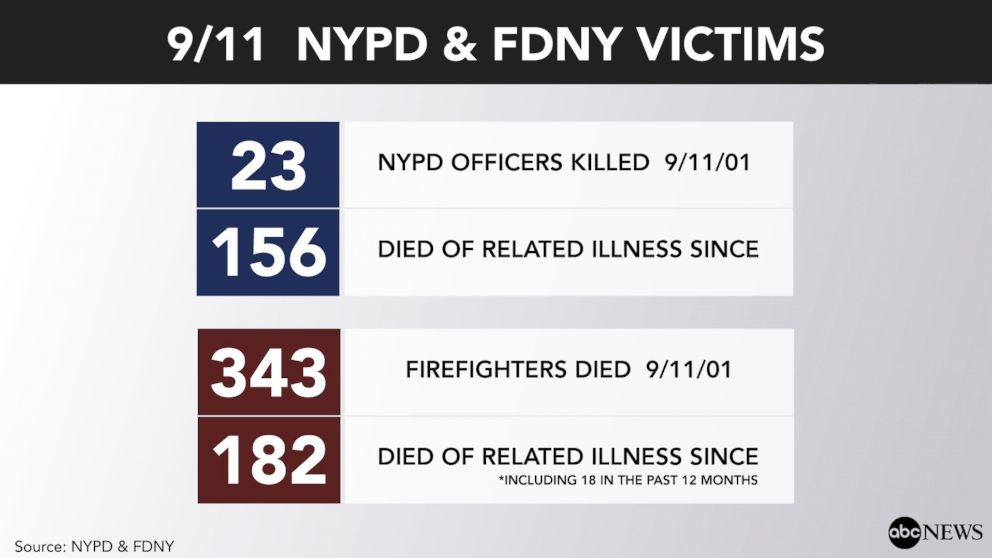
Rescue workers suffered devastating losses in Lower Manhattan. The Fire Department of the City of New York (FDNY) lost 343 members, including an entire department chief, a chaplain, and dozens of whole engine and ladder companies. The Port Authority Police Department lost 37 officers, while the New York City Police Department (NYPD) confirmed 23 fallen officers. Private paramedic companies and voluntary hospital ambulance crews suffered additional casualties as both towers collapsed.
At 9:37 a.m., American Airlines Flight 77 struck the western facade of the Pentagon in Arlington, Virginia. The crash and subsequent fireball claimed 184 lives: 125 military personnel and civilian defense workers inside the facility, alongside 59 passengers and crew aboard the Boeing 757. Less than an hour later, United Airlines Flight 93 crashed into an open strip mine outside Shanksville, Pennsylvania, after passengers stormed the cockpit, killing all 40 passengers and crew aboard. The 19 hijackers are universally omitted from victim registries, leaving the confirmed immediate death toll at 2,977.
Ground Zero Toxic Dust: The Secondary Wave of Chronic Fatalities
When the Twin Towers fell, an estimated 400,000 people were exposed to a dense cloud of caustic dust and airborne carcinogens. The collapse vaporized building materials, burning plastics, computer equipment, jet fuel, and an estimated 400 tons of asbestos. The United States Environmental Protection Agency (EPA) faced sharp public scrutiny after early statements assured the public that the air in Lower Manhattan was safe to breathe. Those assertions proved dangerously inaccurate.
Subsequent medical studies led by Mount Sinai and the World Trade Center Health Program documented high rates of aerodigestive disorders, pulmonary fibrosis, and more than 60 specific forms of cancer among recovery teams. Workers at the 16-acre disaster site, often referred to as "the Pile", labored 12-hour shifts for nearly ten consecutive months without adequate respiratory protection.
By 2024, the FDNY had added hundreds of names to its World Trade Center Memorial Wall at its Brooklyn headquarters, honoring firefighters and emergency medical workers who succumbed to post-9/11 illnesses. The department's post-attack death toll crossed 360 members, officially exceeding the 343 firefighters killed during the collapse itself. The NYPD has experienced a parallel trajectory, recording more than 350 officer deaths linked to toxic dust illnesses contracted during recovery and perimeter security duties.
The Statistical Divide: Comparing Immediate Losses and Exposure Deaths
Evaluating the full scope of 9/11 fatalities requires distinguishing between the mechanical trauma of September 11, 2001, and the long-latency physiological damage documented by federal monitors:
| Casualty Category | Location / Population | Confirmed Fatalities |
|---|---|---|
| Immediate Impact: World Trade Center | Lower Manhattan (Towers & Airplanes) | 2,753 |
| Immediate Impact: The Pentagon | Arlington, Virginia (Facility & Flight 77) | 184 |
| Immediate Impact: Flight 93 | Shanksville, Pennsylvania | 40 |
| First Responder Post-9/11 Illnesses | FDNY, NYPD, PAPD, EMS, Volunteers | 1,000+ |
| Civilian Survivors & Cleanup Crews | Downtown Manhattan, Staten Island Landfill | 4,000+ |
| Total Estimated Cumulative Loss | Combined Immediate and Chronic Toll | 8,000+ |
Federal monitors update these chronic illness tallies on a continuous cycle. The World Trade Center Health Program serves more than 125,000 enrolled members, tracking clinical links between exposure zones and diseases such as multiple myeloma, non-Hodgkin lymphoma, prostate cancer, and chronic obstructive pulmonary disease.

Forensic Progress Inside the OCME: Why the Tally Remains Active
The physical toll of September 11 remains an open case inside the Office of Chief Medical Examiner of New York City (OCME). Out of the 2,753 people murdered at the World Trade Center, approximately 40% have never had any remains identified. The intense heat generated by jet-fuel fires and the crushing structural collapse fragmented bone tissue, stripping away fragile biological signatures.
Scientists inside the OCME forensic biology department continue re-analyzing 21,905 recovered physical samples. Technicians employ advanced Next-Generation DNA Sequencing (NGS), an approach capable of teasing usable profiles out of minute, severely degraded genetic material. In 2023, the OCME announced two new identifications: a man and a woman whose names were withheld at their families' request. In early 2024, another individual was officially identified through renewed forensic matching.
Every new identification shifts a name from a missing-persons record to verified scientific confirmation. For surviving relatives, these breakthroughs end decades of legal and emotional ambiguity, enabling families to hold formal burials for remains identified decades after the towers collapsed.
The Federal Backstop: Funding Care Under the VCF and Health Program
Recognizing the human and economic cost of post-exposure disease, Congress enacted the James Zadroga 9/11 Health and Compensation Act of 2010. Named after an NYPD detective who died of respiratory complications at age 34, the legislation codified federal responsibility for cleanup-related illnesses. The act created the World Trade Center Health Program and re-opened the September 11 Victim Compensation Fund (VCF).
The program required fierce advocacy from surviving responders and labor advocates before gaining permanent stability. In July 2019, Congress passed the Never Forget the Heroes Act, extending the Victim Compensation Fund through 2090, effectively guaranteeing financial support for the lifetimes of all registered survivors.
Official filings show the VCF has awarded more than $12.8 billion in total compensation across more than 55,000 approved claims. While the fund initially compensated traumatic injuries suffered on the day of the attacks, claims tied to chronic illness and post-9/11 deaths now make up the overwhelming majority of its annual allocations.
Frequently Asked Questions (FAQ)
Q1: What is the official immediate death toll of 9/11?
The official death toll from the morning of September 11, 2001, is 2,977 people. This counts 2,753 victims in Lower Manhattan, 184 at the Pentagon, and 40 in Shanksville, Pennsylvania. The 19 hijackers are not included in this count.
Q2: Have more people died from 9/11-related illnesses than died on the day itself?
Yes. As of 2024, cumulative records from the World Trade Center Health Program and the September 11 Victim Compensation Fund track more than 5,000 certified deaths from exposure-related cancers and chronic pulmonary illnesses, far exceeding the 2,977 who died on September 11.
Q3: Why are some 9/11 victims still unidentified?
The catastrophic forces of the tower collapses subjected remains to extreme friction, pressure, moisture, and chemical degradation. Approximately 40% of the individuals killed at the World Trade Center have no identified physical remains, though the NYC Office of Chief Medical Examiner continues testing samples with modern DNA sequencing.
Q4: Who is eligible for the World Trade Center Health Program?
Eligibility extends to emergency first responders, recovery and cleanup personnel at Ground Zero, the Pentagon, and Shanksville, as well as civilian survivors who lived, worked, or attended school in the Lower Manhattan exposure zone below Houston Street between September 11, 2001, and July 31, 2002.
The Evolving Human Record of September 11
The true casualty count of September 11 refuses to stay frozen in the morning hours of 2001. Public memorials, museum exhibits, and federal registries increasingly acknowledge that the attacks sparked two distinct disasters: the acute violence of the hijacked planes and an insidious, decades-long wave of toxic illness.
Medical specialists and municipal unions project that World Trade Center-related deaths will continue rising for years to come, reflecting long latency periods for respiratory cancers and mesothelioma. What began as a tragedy measured in minutes on a single Tuesday morning has stretched across decades. Accurate accounting requires honoring the 2,977 immediate victims while cataloging the thousands of lives claimed by Ground Zero long after the dust settled.


