From Ocean Pests to Gourmet Delicacies: How Living Barnacles Sparked a Global Craze

Wander along any rocky shoreline at low tide, and you might mistake the gray, craggy crust covering the stone for an inanimate mineral formation. Touch one, however, and you may see a tiny feathered fan suddenly dart back inside a calcified fortress. Barnacles are not rocks, corals, or mollusks; they are highly specialized, living marine animals. These creatures spend their adult lives permanently glued to surfaces, enduring crashing breakers, maritime predators, and the scorching sun.
Understanding whether barnacles are alive reveals a startling chapter of crustacean biology. While maritime industries spend billions scraping them off cargo hulls, culinary adventurers pay staggering sums to eat them. As highlighted in a Smithsonian Magazine Report, coastal foragers regularly risk life and limb along slick, wave-pounded cliffs to harvest goose barnacles. What boaters treat as stubborn biofouling, upscale diners view as one of the rarest maritime delicacies on earth.
📌 Key Takeaways:
- Biological Identity: Barnacles are living arthropods and true crustaceans, closer in kinship to crabs and lobsters than to clams or snails.
- Extreme Adaptation: As sessile organisms, they anchor themselves permanently using a natural protein cement that outperforms commercial industrial adhesives.
- Culinary Prestige: Goose barnacles, known commercially as percebes, command prices between $100 and $300 per kilogram due to the lethal risks required to gather them.
The Crustacean Reality Behind the Stony Armor
The stony exterior of an acorn barnacle routinely leads beachcombers to misclassify it as a cousin of the mussel or oyster. In 1830, naturalist J.V. Thompson tracked their free-swimming larval stages, revealing that barnacles belong squarely within the phylum Arthropoda. They shed exoskeletons, possess jointed limbs, and emerge from eggs as microscopic, free-swimming nauplii.
When a juvenile cyprid larva finds a hospitable surface, whether a granite ledge, a wooden pier, or the flank of a humpback whale, it explores the terrain with its antennae. Once satisfied, specialized cement glands in the head secrete an extraordinary waterproof glue made of dense, cross-linked proteins. The animal flips upside-down, fixes its forehead permanently to the substrate, and secretes protective calcareous shell plates around its soft body.
Biologists often describe the creature's morphology through a famous analogy: imagine a human lying on their back, cementing their forehead to the floor, wrapping a stone fortress around their torso, and kicking food into their mouth with their legs. As sessile organisms, adult barnacles surrender the power of locomotion completely, trading mobility for defensive armor.
| Species Group | Physical Structure | Primary Habitat | Commercial / Ecological Profile |
|---|---|---|---|
| Acorn Barnacles (Balanomorpha) | Stalkless, volcanic cone composed of rigid calcareous plates | Intertidal rocks, boat hulls, harbor pilings | Primary biofouling agent; costs global shipping billions annually in fuel drag |
| Goose Barnacles (Pollicipes pollicipes) | Flexible, muscular peduncle (stalk) topped with a chalky capitulum | Exposed, wave-bludgeoned intertidal cliffs and flotsam | Coveted culinary luxury (percebes); harvested by hand in high-risk surge zones |
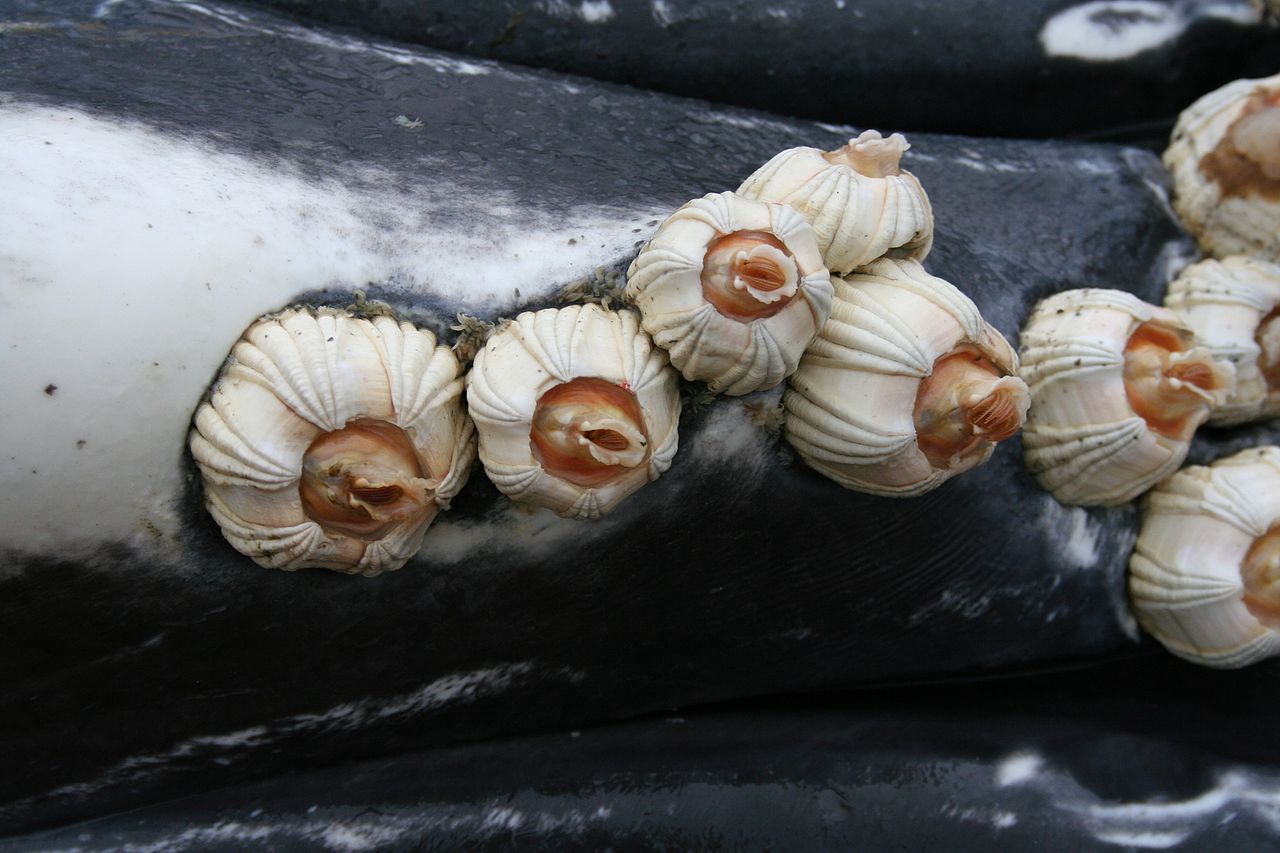
| Whale Barnacles (Coronulidae) | Thick, flattened crowns that embed deeply into skin tissue | Baleen whale skin, specifically humpbacks and right whales | Obligate commensal symbionts; carry vital isotopic climate histories for researchers |
Why Gourmet Diners Pay Top Dollar for Percebes
Along the jagged, fog-bound shores of Galicia in northern Spain and the Atlantic coast of Portugal, living goose barnacles support one of the most hazardous fishing industries on the planet. Known locally as percebes, these organisms cluster tightly in the surf zone, where oxygen-rich, raging water continuously sweeps past. The most prized specimens grow where the waves strike with maximum ferocity.
Harvesting them is the exclusive domain of percebeiros. These foragers tether themselves to ropes or leap without safety lines onto slick rocks exposed for only seconds between crashing breakers. Armed with a flat metal scraper called a cavadura, a harvester must sever the barnacle cluster clean at the base without puncturing the edible peduncle. An injured stalk spoils the meat and leaks the mineral-rich oceanic brine that defines its flavor profile.
Dozens of harvesters have lost their lives to rogue swells on Galicia’s Costa da Morte (Coast of Death). Because bad weather prevents boats from launching and tides limit foraging windows to roughly two hours per cycle, supply remains razor-thin. At seafood auctions in A Coruña and Lisbon, prime percebes regularly fetch €80 to €150 per kilo, spiking past €300 per kilo during the winter holiday season. High-end kitchens in Madrid, Tokyo, and New York steam them briefly in sea water and serve them whole. Diners peel away the leathery outer skin to expose a tender, purplish cylinder of meat that tastes like a concentrated cross between sweet lobster and fresh ocean sea-mist.
Cirri, Currents, and Plankton Filter Feeding
Survival without the ability to move demands ingenious mechanical engineering. Inside its shell, an adult barnacle stays alive by operating an intricate rhythmic pump. When submerged, a set of movable opercular plates opens like a trapdoor, and the animal extends its cirri feeding appendages out into the flow.
These cirri are modified, feathered thoracic legs covered in micro-sensory hairs. By rhythmically sweeping through the water or holding their fans steady against incoming wave currents, these plankton filter feeders sift suspended detritus, microalgae, and tiny copepods directly from the water column. In areas with sluggish flow, the barnacle pumps its limbs back and forth up to several dozen times a minute. Where wave action is violent, it simply angles its cirri into the current, letting the ocean drive food into its grasp.
When the tide drops, survival becomes a battle against desiccation. The animal clamps its calcareous plates shut using an internal muscle, locking in a tiny chamber of sea water. This self-contained reservoir keeps its gills wet and prevents the soft tissue from drying out during hours of exposure to baking sun and wind. Intertidal zone marine life relies on these precise micro-climatic defenses to bridge the gap between high tides.
The Biological Logistics of Sessile Reproduction
Living your entire adult life fixed to a single patch of rock creates an obvious evolutionary hurdle: how do you mate if you cannot move? Nature’s answer in barnacles is as mechanically extreme as their shell design.
Barnacles solve this spatial riddle through hermaphroditic reproduction, possessing both male and female sex organs. While they can occasionally self-fertilize when isolated, cross-fertilization produces vastly healthier genetic diversity. To reach stationary neighbors, a barnacle deploys an expandable copulatory organ that can stretch up to eight to ten times the length of its shell.
This sensory organ probes the immediate perimeter, feeling across adjacent rock crevices and penetrating the shell openings of receptive neighbors to deposit sperm. Once fertilized, the parent broods the eggs within its shell until they hatch into free-floating larvae. Millions of microscopic young are expelled into coastal currents simultaneously, drifting for weeks across open ocean corridors before chemical cues prompt them to settle and start the cycle anew.
From Ship Drag to Whale Rider Symbiosis
While goose barnacles fuel luxury restaurant checks, their stalkless relatives provoke persistent headaches for naval engineers. Acorn barnacles latch aggressively onto boat hulls, shipping containers, and harbor pilings. The resulting surface roughness increases hydrodynamic drag significantly, forcing commercial cargo fleets to burn up to 40 percent more fuel to maintain cruising speeds. Scrubbing, repainting, and maintaining drydocks for antifouling defense costs global maritime commerce an estimated $30 billion per year.
Their capacity for adhesion extends seamlessly to living biology. Whale barnacle attachment represents one of the ocean's most intriguing examples of commensalism. Species like Coronula diadema do not burrow as blood-sucking parasites; rather, their shells develop radial prongs that interlock directly with the growing skin tissue of baleen whales. Riding on the jaws and flukes of a forty-ton mammal gives the barnacles an endless, free-flowing buffet of plankton as the whale moves through nutrient-dense polar waters.
A single humpback whale can carry up to 1,000 pounds of living barnacles. While this extra mass adds friction, the rough, hard shells also provide defensive armoring against killer whale attacks and deliver abrasive impact during violent head-slapping displays against rival males.
Frequently Asked Questions (FAQ)
Q1: Are barnacles dead when they wash up on drift wood or the beach?
A1: It depends on how long they have been out of the water. If the shell plates are tightly shut and moist inside, the animal inside is typically alive in a dormant state. If the internal chamber is completely dry, empty, or smells strongly of decay, the organism has died, leaving only its hollow calcium carbonate shell behind.
Q2: Can you eat ordinary acorn barnacles found on rocks?
A2: While non-toxic, common acorn barnacles are rarely eaten because their yield is minuscule; crushing them yields far more sharp shell debris than meat. By contrast, goose barnacles (percebes) produce a thick, fleshy, accessible peduncle stalk that makes harvesting and cooking commercially worthwhile.
Q3: Does a barnacle hurt the animal it attaches to?
A3: In moderate quantities on large hosts like humpback whales, barnacles do no structural harm because they feed solely on floating plankton rather than host tissue. However, if barnacle colonies grow excessively dense on slower creatures like sea turtles, the weight and surface drag can severely drain the animal's energy and impair swimming.
Navigating Ocean Pressures and Changing Shores
The humble barnacle demonstrates that staying alive does not require continuous motion. By trading the ability to wander for permanent structural stability, these armored crustaceans have survived every major mass extinction event since the Cambrian period. From deep-sea hydrothermal vents to the hulls of modern container ships, their evolutionary design holds fast against continuous hydraulic force.
As warming ocean waters alter marine alkalinity and shift traditional intertidal habitats, the pressure on living barnacle colonies is mounting. Higher sea acidity challenges their ability to synthesize thick calcium plates, while volatile storm seasons disrupt historical harvesting calendars for foragers along the Iberian Peninsula. For now, on wave-battered headlands around the world, percebeiros continue to gamble their lives against incoming ocean swells, proving that these tenacious, rock-bound animals remain among the most ecologically durable and commercially prized organisms in the ocean.


