From Ring Submission to TV Climax: The Timeline and Modern Evolution of 'Full Nelson'
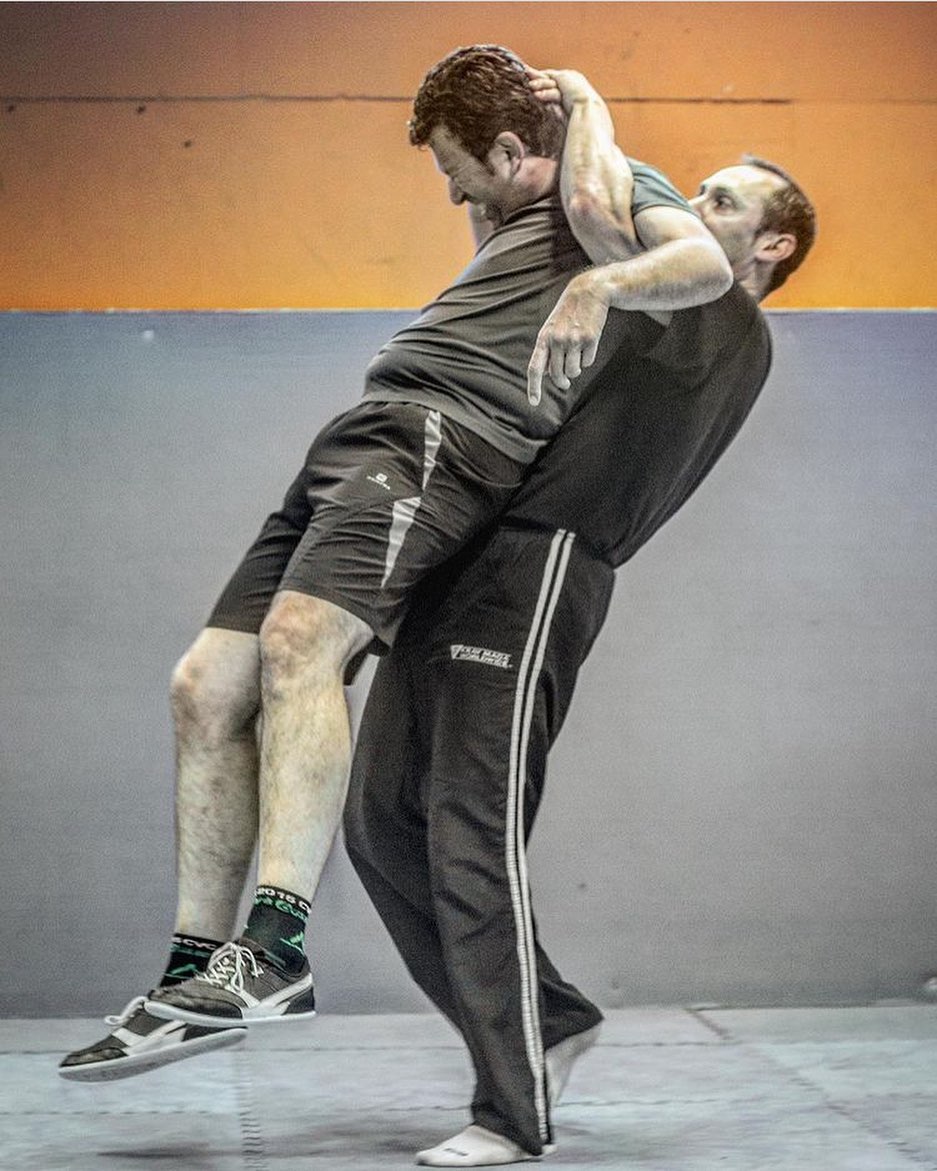
Locking hands behind an opponent's neck after threading both arms under their armpits represents one of the most recognizable postures in combat sports history. Long before it surfaced as conversational shorthand for absolute entrapment, the full nelson functioned as a bone-jarring submission hold designed to force compliance through sheer mechanical advantage. Today, its cultural imprint spans far beyond the mat, appearing everywhere from narrative television titles like the climactic finale of Peacemaker Season 2 to theatrical character journeys documented in a recent denvergazette.com Report.
Yet behind its fame lies a stark sporting reality: modern competitive grappling organizations overwhelmingly prohibit the hold. What began as a standard catch-as-catch-can staple transformed into a prohibited maneuver due to severe spinal hazards. Understanding the full nelson requires navigating the delicate border where brutal human biomechanics meets lasting pop culture slang.
📌 Key Takeaways:
- The Physical Definition: A grappling hold executed from behind, securing double underhook leverage while pressing both hands against the cervical spine to force the head forward.
- The Regulatory Ban: Amateur wrestling rules, including scholastic (NFHS), collegiate (NCAA), and international Olympic divisions (UWW), classify the full nelson as strictly illegal due to severe risks of cervical hyperextension.
- The Idiomatic Shift: Modern usage treats "full nelson" as a metaphor for an inescapable bind, complete control over a rival, or an intractable organizational dilemma.
Catch Wrestling Origins and the Mechanics of Total Immobilization
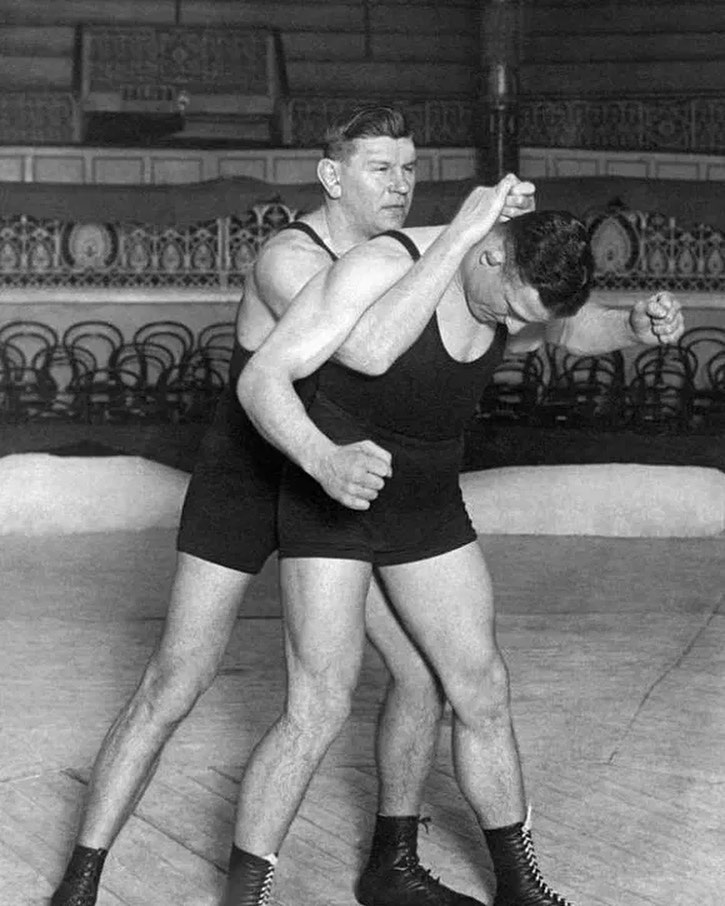
The hold trace back to nineteenth-century Lancashire catch wrestling, a working-class style built on rough-and-tumble submissions where combatants could win by fall or surrender. Practitioners realized early that controlling the head dictated where the rest of the body could move. By advancing both arms under the opponent’s shoulders from behind, establishing deep double underhook leverage, the attacker clasped their fingers or overlapping palms directly against the base of the victim's skull.
Wrestlers used the maneuver not just to pin an adversary, but to exhaust them. The attacker's forearms act as class-two levers against the opponent's collarbones, while the interlocked fingers force the head downward toward the chest.
This posture robs the trapped athlete of their defensive posture. Because the arms are bent backward and upward, the shoulder joints bear tremendous torque. Any resistance by the bottom wrestler drives the cervical spine deeper into hyperflexion, leaving little recourse other than conceding the fall or tapping out.
Why Modern Rulebooks Classify the Lock as an Illegal Maneuver
As amateur wrestling developed structured rules in the early 20th century, athletic commissions confronted a sharp increase in neck injuries. The fundamental issue with the full nelson is not merely pain compliance; it is catastrophic cervical spine pressure.
When applied with malice or abrupt force, the hold becomes an unyielding neck crank. The human neck can absorb compression along its vertical axis far better than forced, loaded flexion combined with forward displacement. In a locked full nelson, the victim’s chin is mashed against their sternum while the attacker's body weight drives forward. This dynamic can rupture ligaments, herniate discs, or fracture the delicate vertebrae of the C1, C7 cervical complex.
Because the victim’s arms are pinned behind their torso, they cannot brace against the mat during a takedown. If an aggressive wrestler lifts their opponent off their feet while holding a full nelson and drives them forward, the trapped wrestler cannot break their fall. Their forehead and face absorb the full kinetic impact of both bodies.
Consequently, the National Federation of State High School Associations (NFHS), the NCAA, and United World Wrestling (UWW) completely ban the full nelson. Officials issue an immediate whistle and penalty point the moment fingers interlock behind the neck.
Half Nelson Comparison: The Technical Evolution of Upper-Body Control
To keep the positional utility of upper-body control without paralyzing risks, wrestling systems embraced asymmetrical variations. The most pervasive of these is the half nelson, a foundational pinning hold practiced across every scholastic wrestling room in the world.
Understanding why one variation remains legal while another draws disqualification comes down to rotational freedom and spinal loading:
| Technique | Mechanical Focus | Competitive Legality | Primary Injury Risk |
|---|---|---|---|
| Half Nelson | Single underhook across one armpit, hand placed on neck to turn opponent onto back | Universal (Folkstyle, Freestyle, Greco-Roman) | Low to moderate; shoulder strain if torqued past natural range |
| Three-Quarter Nelson | Single underhook combined with secondary arm weaving under opponent's chest | Legal in folkstyle and freestyle | Moderate; rib and chest compression during rotational turns |
| Full Nelson | Double underhooks with fingers interlocked directly behind the cervical spine | Banned across all modern amateur wrestling divisions | Severe; cervical spine hyperflexion, nerve impingement, disc herniation |
| Catch Nelson Neck Crank | Full nelson locked with body scissors around the waist to maximize spinal stretch | Permitted only in non-striking submission grappling / historic catch | Catastrophic; lumbar and cervical hyperextension, vertebral fractures |
A half nelson applies torque along an axis that forces the defensive wrestler to roll onto their back, providing a clear path to escape or concede points without crushing the spinal cord. In contrast, the bilateral trap of the full nelson locks the shoulder girdle symmetrically. It leaves no path for energy dissipation other than spinal deformation.
From Ring Control to Pop Culture Slang and Screenplays
While competitive sports safety initiatives expelled the hold from the mat, professional wrestling kept it alive in the public imagination. Mid-century performers popularized the hold as an insurmountable torture device. Promoters billed it as a hold no wrestler could break once locked in, turning the maneuver into theater.
That dramatic spectacle allowed the phrase to slide effortlessly into English idioms. By the late 20th century, writers, political analysts, and everyday speakers began using "full nelson" to describe situations where someone had zero room to maneuver. A company trapped between rising debts and collapsing sales was "caught in a full nelson." A politician handcuffed by competing legislative factions suffered the same fate.
This idiomatic weight explains its recurring presence across contemporary media. In October 2025, director James Gunn released the season two finale of DC's Peacemaker, titling Episode 8 simply "Full Nelson." The title served as an evocative metaphor for the protagonist's emotional paralysis and tactical helplessness throughout the climactic arc. The term communicated inescapable confinement far better than any generic action descriptor could manage.
Self-Defense Realities: Escape Paths and Defensive Liabilities
Despite its fearsome reputation on screen, real-world self-defense instructors caution against attempting to use a full nelson in a street altercation. The hold requires substantial setup time and leaves the aggressor exposed to devastating retaliatory strikes.
Because the attacker stands upright and presses their torso against the defender's back, they surrender their defensive perimeter:
- The defender can stomp the attacker's instep, drive an elbow downward into the solar plexus, or deliver a backward headbutt directly into the attacker's face.
- Groin strikes with backward hammer-fists remain wide open.
- If the defender possesses basic grappling knowledge, they can squat deeply, trap the attacker's wrists, and perform a shoulder throw, launching the aggressor over their head onto the asphalt.
Applying the hold also creates immense legal liability. In many jurisdictions, securing a neck-cranking restraint outside a sanctioning body's ring constitutes felony aggravated assault or battery. Law enforcement guidelines have removed such holds from compliance protocols, recognizing that compressed airways and compromised cervical columns can transform simple restraint into manslaughter.
Frequently Asked Questions (FAQ)
Q1: Why is it called a "Nelson" hold?
A1: Wrestling historians generally link the moniker to Horatio Nelson, the 18th-century British naval hero famed for aggressive tactics at the Battle of Trafalgar. Catch wrestlers adopted his name to signal holds designed to comprehensively overwhelm an opponent. Other regional theories suggest it was named after a prolific 19th-century wrestler, though historical records from early British wrestling favor the naval tribute.
Q2: Can you do a full nelson in Brazilian Jiu-Jitsu (BJJ) competitions?
A2: Under the International Brazilian Jiu-Jitsu Federation (IBJJF) rulebook, the full nelson is completely banned across all belt divisions, including black belt. While certain neck cranks are permitted in advanced No-Gi formats (such as ADCC), spinal locks that force the chin to the chest without an arm trapped in the choke are heavily restricted across the sport to prevent paralysis.
Q3: How do you escape a full nelson if it gets locked on?
A3: The fastest physiological escape is to avoid letting the hands clasp. If locked, the defender should shrug their shoulders hard toward their ears to reduce cervical leverage, bend their knees to drop their center of gravity below the attacker's hips, and peel one of the attacker's pinky fingers or wrists outward to shatter the double-underhook grip.
The Enduring Cultural Grip of a Prohibited Maneuver
The trajectory of the full nelson reveals how combat techniques survive long after athletic commissions banish them from legitimate competition. Its mechanical reality, driving extreme force through the cervical spine via double underhooks, makes it an indefensible liability on the modern sports mat. Decades of injury tracking confirmed that no athletic victory justifies the risk of permanent vertebral trauma.
Yet that very lethality secured its linguistic immortality. English speakers do not employ the idiom to represent mild inconvenience; they deploy it when someone is pinned against a wall with zero options left. From the gritty Lancashire catch circuits to modern serialized screenwriting, the hold remains the ultimate symbol of unconditional physical and psychological surrender.


