How to Sign 'Happy Birthday' in ASL: Complete Beginner Tutorial, Tips, and FAQs

Celebrations bring people together, but standard acoustic traditions leave many participants on the outside looking in. When candles flicker on a cake and a room erupts into song, individuals unfamiliar with visual communication miss an opportunity to connect. In recent years, casual learners have increasingly turned to introductory signing to make milestones inclusive. Broadcasters and educational initiatives frequently highlight this transition, as seen in an OzarksFirst.com Report detailing basic holiday greetings for regional Deaf Awareness Month coverage.
Mastering "Happy Birthday" in American Sign Language requires more than memorizing two isolated gestures. The greeting hinges on clear handshapes, spatial discipline, and expressive non-manual markers that convey genuine celebration. Whether you want to greet a Deaf colleague or sign along with family, getting the mechanics right demonstrates genuine cultural respect.
📌 Key Takeaways:
- Core Mechanics: The greeting combines an upward-sweeping open hand for "Happy" with an open 8 handshape touching the chin and chest for "Birthday."
- Grammar Rules: Facial expressions act as grammatical non-manual markers in ASL; signing without an active smile makes the greeting linguistically incomplete.
- Cultural Reality: Deaf gatherings replace spoken vocal harmony with rhythmic, visual pacing and swap acoustic clapping for raised, twisting hands.
Hand Positioning and Spatial Execution for Happy and Birthday
Every sign in ASL relies on five fundamental parameters: handshape, palm orientation, location, movement, and non-manual markers. Altering any single element changes the meaning of the word entirely.
To produce "Happy," start with your dominant hand in an open flat-hand shape, fingers held together with the thumb resting comfortably alongside. Turn your palm facing inward toward your torso. Place the hand roughly two inches off your chest. Move the hand in an upward, circular brushing motion, patting lightly against your sternum once or twice. The upward motion physically reflects the uplifting concept of the word. You can execute this sign using only your dominant hand for casual settings, or use both hands symmetrically for formal emphasis.
The sign for "Birthday" most widely recognized across North America uses the "open 8" handshape. Extend your dominant hand with fingers straight, then bend your middle finger forward at the primary knuckle while keeping the other fingers extended. Turn your palm inward toward your face. Touch the tip of your extended middle finger to your chin, then arc the hand smoothly downward to touch the center of your upper chest. Keep your non-dominant hand relaxed at your side or resting on your lap during this single-handed production.
Regional Variations Across the United States and Canada
American Sign Language is a natural, living language shaped by geographic distance, regional residential schools for the Deaf, and generational shifts. Because of this historical evolution, the sign for "Birthday" features at least four prominent regional variants across North America.
The chin-to-chest open-8 variation remains standard in academic curricula and national broadcasts. In parts of the American Midwest and the South, many signers prefer a compound construction: signing "born" followed immediately by "day." To sign "born," hold your non-dominant hand palm-down near your stomach while your dominant hand moves beneath it, emerging upward to mimic an infant being held. To sign "day," rest your dominant elbow on your non-dominant fingertips and arc your dominant index finger downward across the visual field like a setting sun.
| Sign Variation | Handshape | Movement Profile | Regional / Social Context |
|---|---|---|---|
| Standard Open 8 | Open 8 (middle finger bent forward) | Chin touch descending to upper chest touch | National standard; common in media and ASL classrooms |
| Compound (Born + Day) | Flat open hand transitioning to Index "1" | Emerging motion under palm, then sweeping arc | Prevalent in older generations and Southern US regions |
| Ear-to-Mouth Variation | "Y" handshape or bent middle finger | Taps earlobe once, then moves near corner of mouth | Common in specific Mid-Atlantic and East Coast pockets |
| Flick / Candle Variation | Modified Open 8 / Pinch to Open | Flicking outward near chin or chest once | Informal youth slang and localized Deaf community clubs |
None of these variations are incorrect. When interacting within a specific regional community, mirror the variation your conversational partners use. Doing so demonstrates linguistic awareness and flexibility.
The Critical Function of Non-Manual Markers
Beginners often focus entirely on fingers, ignoring the face. In spoken English, vocal tone conveys warmth, sarcasm, or skepticism. In American Sign Language, your face carries that identical grammatical burden through non-manual markers.
If you produce the signs for "Happy Birthday" while maintaining a neutral, blank stare, the utterance reads as insincere, robotic, or even annoyed. The physical signs supply the raw vocabulary, but your facial expression provides the emotional syntax. Relax your forehead, smile openly, and establish direct eye contact with the person you are celebrating. A slight nod on the downward stroke of the birthday sign emphasizes your positive intent.
Eye contact serves as conversational punctuation. Looking away while signing breaks the visual line of communication. Keep your gaze centered on your recipient until your hands return to a rested baseline position.
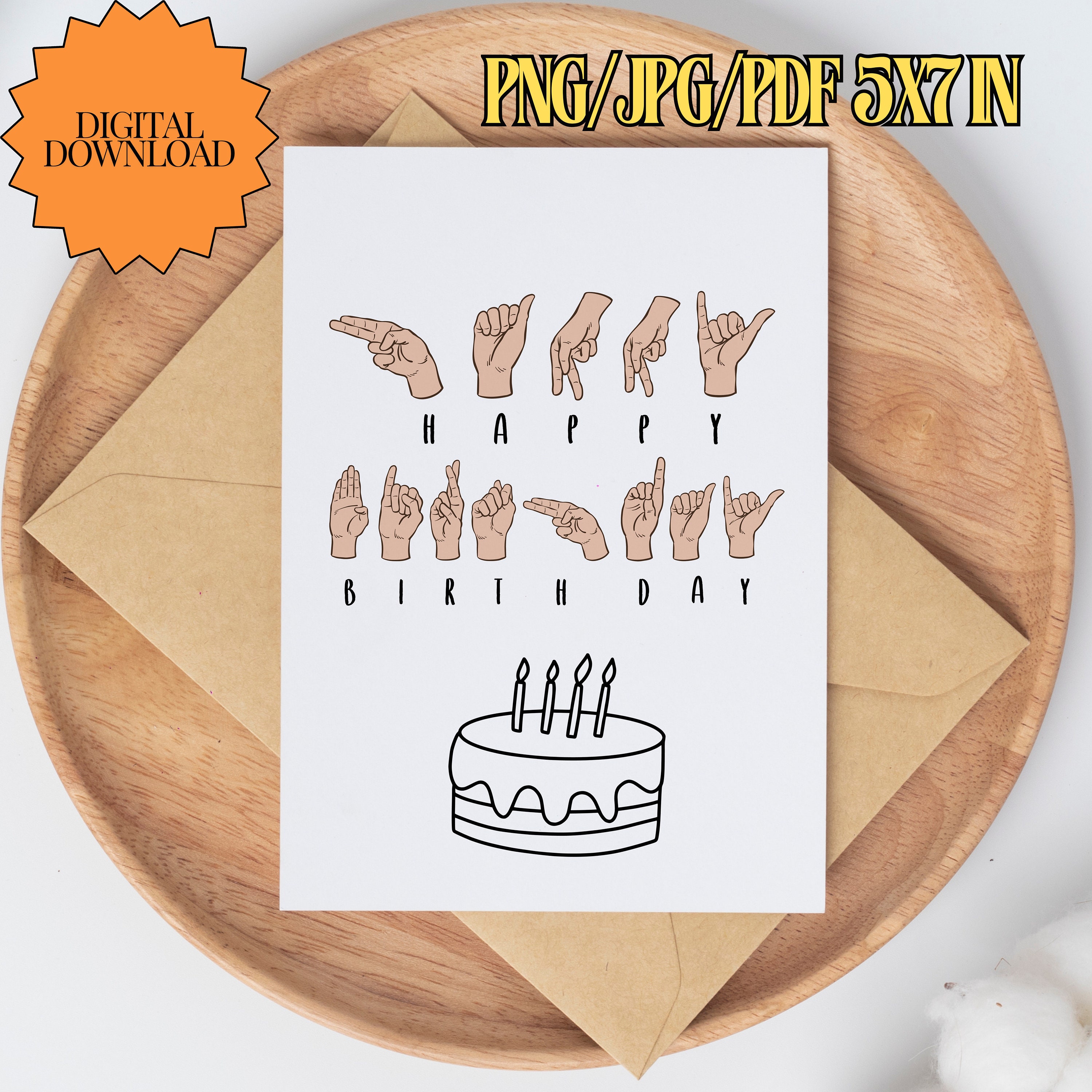
Signing the Song: English Syntax vs. Visual Pacing
A common mistake among hearing beginners is attempting to translate the spoken "Happy Birthday to You" track word-for-word into English-based sign systems. Signed Exact English forces unnecessary filler gestures, such as inventing an awkward sign for "to" before pointing at the recipient. ASL grammar avoids this artificial clutter.
When signing the celebratory song in an ASL environment, drop prepositions entirely. Sign "HAPPY BIRTHDAY" directly, then use an index pointing gesture toward the person being honored to express "you." Maintain a clear, shared visual tempo with other signers in the room rather than rushing ahead.
Because Deaf celebrations prioritize visual communication over background acoustic tracks, the pacing of the song differs noticeably from typical party sing-alongs. Signers synchronize their hand movements visually. They pause at key transitional intervals to let the birthday person acknowledge the room. Rushing through the signs breaks that collective rhythm.
Deaf Culture and Celebratory Etiquette
True communication requires cultural competence alongside physical technique. Hearing visitors attending a Deaf event often clap loudly with their palms when the cake arrives. In a Deaf space, this produces acoustic noise without offering any visual impact.
Deaf applause involves raising both hands into the air at head height, palms open, and rotating the wrists back and forth rapidly. This visual wave of applause allows the recipient to see the celebration from every angle of the room simultaneously. Adopting this practice immediately marks you as a thoughtful guest.
Spatial awareness matters just as much. Never walk between two people who are actively signing to reach for a drink or slice of cake. If you must pass through a signing space, walk straight through quickly without ducking or making dramatic apologetic gestures. Ducking draws unnecessary visual attention, which disrupts the conversation far more than simply walking by.
Frequently Asked Questions (FAQ)
Q1: Which hand should I use to sign Happy Birthday?
A1: Always use your dominant hand for single-handed signs or as the active lead in two-handed signs. If you are right-handed, your right hand produces the sign while your left hand acts as the stationary base. Switching hands mid-sentence creates visual confusion and is considered poor technique.
Q2: Is the "open 8" sign for birthday the same as the sign for favorite?
A2: The handshape is identical, but the location and movement differ. The sign for "favorite" taps the middle finger on the chin twice without moving to the chest. "Birthday" moves continuously from the chin downward to the upper chest.
Q3: Should I mouth the English words while I sign?
A3: Natural mouthing of base concepts is common in conversational ASL, especially during cross-cultural social interactions. Mouthing "Happy Birthday" naturally as you sign helps reinforce clarity, provided it does not distort your natural non-manual facial expressions.
Building Lifelong Fluency Beyond Basic Greetings
Learning how to sign a celebratory greeting serves as an accessible entry point into American Sign Language. It shifts casual interaction away from passive observation and builds direct, human connection. Yet single greetings represent only the initial threshold of a complex, expressive language with its own literature, humor, and grammar.
To advance beyond basic social gestures, focus on mastering the 26 manual alphabet shapes and everyday conversational questions. Seek out community events hosted by local Deaf advocacy organizations, enroll in classes taught directly by Deaf instructors, and practice spatial clarity over raw signing speed. Approaching visual language with cultural humility turns a brief birthday greeting into a foundation for meaningful, lasting communication.