Inside the 5-Billion-View Playbook: How Chordal Scaled TikTok Commercial Sounds

When a business account uploads a video with unlicensed mainstream audio, TikTok's automated copyright filters strip the sound within seconds. For years, corporate social media teams faced a frustrating wall: either commission bespoke original tracks, navigate agonizing multi-week sync clearances, or settle for generic royalty-free acoustic jingles. That logjam broke wide open after sync platform Chordal pushed deep into the platform's commercial infrastructure. According to a landmark Music Ally Report published on May 11, 2026, tracks distributed through Chordal's pipeline generated over 5 billion cumulative views across the TikTok Commercial Music Library (CML).
The figure demonstrates that commercial sound rights no longer represent a bureaucratic afterthought for rights holders. By feeding pre-cleared commercial music directly into enterprise creator workflows, Chordal transformed static back catalogs into self-sustaining viral assets. Brands gained instant access to production-ready music with zero legal exposure, while indie labels and legacy artists tapped an automated revenue pipeline that bypasses traditional sync gatekeepers entirely.
📌 Key Takeaways:
- The Metric: Chordal generated over 5 billion views by supplying pre-cleared songs to corporate accounts via TikTok's Commercial Music Library.
- The Mechanism: Direct integration with TikTok's commercial sound catalog automates royalty clearance and master synchronization for verified corporate handles.
- Catalog Rebirth: Legacy pop acts like The Ting Tings ran dedicated CML distribution trials in mid-2026, demonstrating how vintage hooks can monetize inside enterprise marketing budgets.
The Licensing Chokehold on TikTok Business Accounts
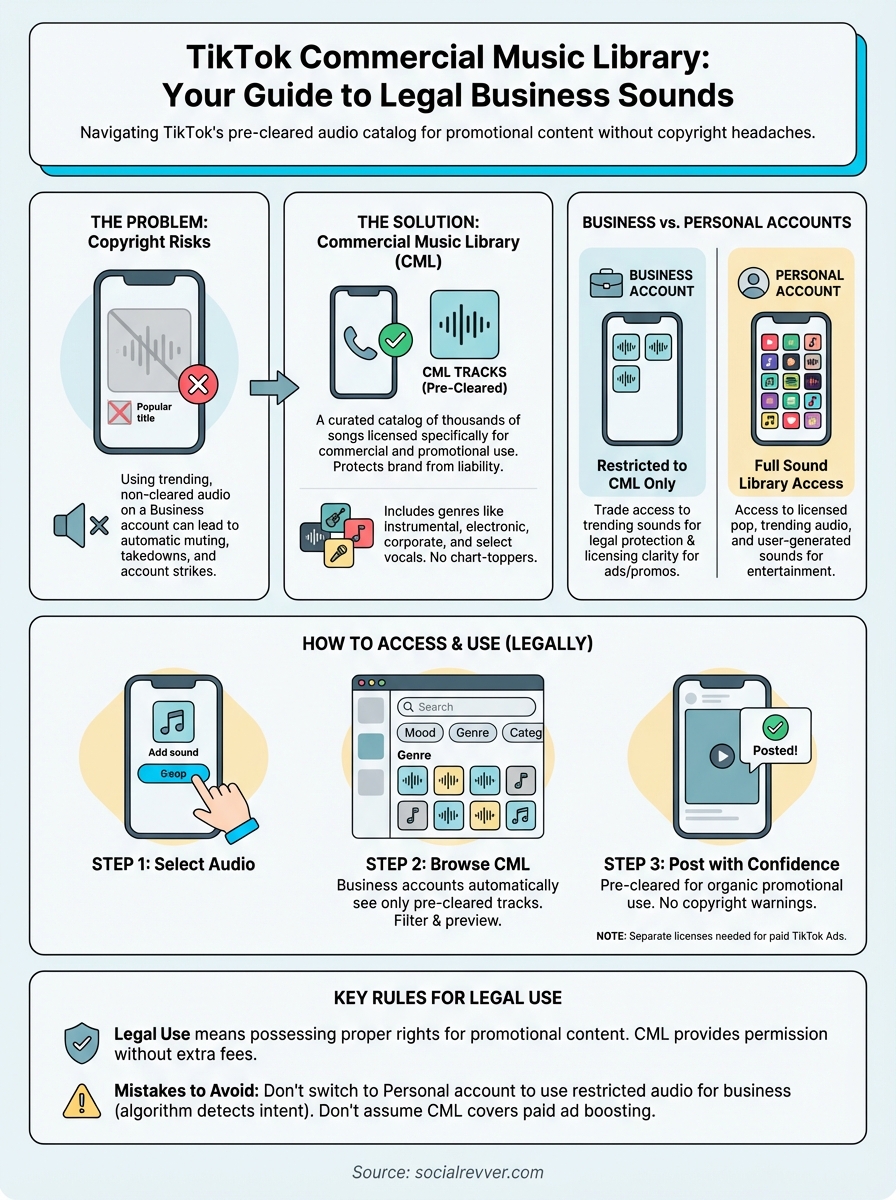
Corporate accounts operate under strict copyright constraints that ordinary users rarely see. While standard personal profiles can soundtrack clips with Billboard Hot 100 recordings under blanket consumer agreements, commercial profiles face immediate takedowns if they touch those same audio stems for marketing purposes. Using an unlicensed track in a corporate campaign invites swift statutory damage claims under intellectual property law.
For corporate social media managers, this divide created an artistic vacuum. Brands were barred from the cultural zeitgeist unless their legal teams negotiated six-figure ad licenses for single 15-second posts. The TikTok Commercial Music Library was built to resolve this tension, offering a pool of sounds pre-cleared for global corporate distribution, brand partnerships, and paid commercial ads.
Yet the library initially suffered from quality issues. Enterprise accounts routinely dismissed early CML selections as bland elevator instrumentals. The bottleneck broke on July 10, 2025, when Music Business Worldwide revealed that TikTok had begun integrating Chordal’s sync licensing tech stack directly into the platform. By connecting verified rights holders with real-time rights clearing pipelines, Chordal began injecting legitimate indie and catalog recordings straight into enterprise sound pickers.
Inside the 5-Billion-View Viral Audio Pipeline
Scale requires frictionless clearance. When an enterprise account selects an audio file, clearance verification must happen in milliseconds, not months. Chordal structured a sync-licensing network where publishing and master rights arrive fully pre-cleared for commercial marketing. As reported by Fast Company in May 2026, this mechanism quietly turned the CML into a discovery engine where brand campaigns actively create trending hits instead of merely piggybacking on existing ones.
The math behind the 5 billion views milestone comes down to recurring corporate utility. A dynamic beat or quirky vocal hook that fits a workplace trend gets picked up by hundreds of distinct business profiles within hours. Each brand video acts as a paid distribution node, boosting the master sound across millions of algorithmic feeds.
Rights holders do not rely exclusively on traditional micro-penny streaming royalties in this ecosystem. Instead, they capture backend monetization tied to commercial views, paid ad amplification, and direct sync allocations. When a beauty retailer, an airline, and a regional retail chain all deploy the same energetic indie pop chorus in their product spots, cumulative reach snowballs without requiring the artist to sign individual licensing releases for each placement.
The Ting Tings Experiment: Reviving Catalog Hits Through CML
The real potential of this model appeared in mid-2026, when artists with established catalogs started treating the CML as an active sync distributor rather than a dumping ground. On June 26, 2026, Music Ally reported on an experimental rollout conducted by British indie-pop duo The Ting Tings. Known for rhythmic mid-2000s classics like "That's Not My Name" and "Shut Up and Let Me Go," the band explored what happens when alternative recordings and catalog selections are made directly available to enterprise marketing teams.
The experiment revealed unexpected dynamics:
- Business profiles favor tracks with crisp rhythmic stops, sarcastic vocal hooks, and high-energy transitions that match fast pacing.
- Older catalog hits bypassed the saturated consumer audio library to find heavy rotation among corporate social managers eager for recognizable cultural energy.
- The resulting reach drove downstream streaming increases on Spotify and Apple Music, as casual viewers searched for the full songs they heard in corporate clips.
Instead of waiting for an agency music supervisor to pitch their tracks for a holiday TV campaign, The Ting Tings placed their hooks directly in front of thousands of daily social content creators. The findings proved that established musicians can use business-tier distribution to monetize deep-catalog assets without devaluing their master rights.
Comparing Social Sync Licensing Frameworks
Understanding how modern rights management operates on video-first platforms requires analyzing clear divisions between personal usage, traditional sync workflows, and the CML framework.
| Operational Metric | Standard Creator Sound Catalog | Traditional Advertising Sync | TikTok CML via Chordal |
|---|---|---|---|
| Clearance Speed | Instant (Consumer blanket license) | 2, 8 weeks manual negotiation | Instant (Pre-cleared API routing) |
| Commercial Brand Safety | Zero (Infringement risk for businesses) | Total (Bespoke legal indemnity) | Total (Guaranteed platform indemnity) |
| Royalty Settlement Model | Pro-rata consumer streaming pools | Fixed upfront sync fee ($15k, $250k+) | Performance sync splits & ad pools |
| Eligible User Base | General personal accounts only | Single brand client per contract | All enterprise and business profiles |
Scale Through Collective Rights: The 21-Partner Expansion
Single catalog experiments cannot sustain platform-wide consumption on their own. On June 5, 2026, Music Ally reported that Chordal added 21 new partners to its sync-licensing network. The cohort included independent distributors, mid-tier publishing houses, and boutique production music agencies.
This expansion resolved a key structural challenge in digital music rights: fragmentation. Historically, syncing a song meant tracking down split-sheet owners across three distinct publishers and two separate record labels. If a single 5% co-writer declined or missed an email, the entire deal collapsed.
Chordal addresses this bottleneck by requiring 100% pre-cleared master and publishing representation before any title enters the commercial sound catalog. By establishing programmatic clearance pools, independent rights holders can pit their songs directly against major label stock in an environment where speed dictates success. Corporate social managers pick the first track that fits their creative edit, making instantaneous availability an artist's greatest competitive advantage.
Frequently Asked Questions (FAQ)
Q1: Why can't corporate TikTok accounts simply use popular songs trending on personal feeds?
A1: Major label agreements covering personal TikTok accounts do not permit commercial promotion. When a corporate account uses consumer-cleared songs to sell products, run ads, or build corporate goodwill, it breaches copyright terms and risks immediate sound muting or costly copyright lawsuits.
Q2: How do musicians earn royalties through the TikTok Commercial Music Library?
A2: Tracks cleared for the CML monetize through platform commercial usage funds, ad-supported view metrics, and performance royalties distributed through sync partners like Chordal. When brands feature a track in paid campaigns or viral organic videos, rights holders receive automated payouts matching aggregate corporate views.
Q3: Does enrolling music in the CML forfeit an artist's standard sync rights elsewhere?
A3: No. Chordal's licensing agreements are typically non-exclusive regarding the underlying master and publishing rights. Artists remain free to pitch the same music for film, television, and traditional commercial campaigns while collecting passive CML income.
Programmatic Sync as the New Distribution Standard
The milestone of 5 billion views proves that sync licensing is moving away from friction-heavy manual transactions toward high-speed, programmatic clearance. For decades, the music business regarded commercial licensing as an elite craft reserved for prime-time television slots, video games, and cinema trailers. Social media's enterprise economy overturned that structure completely.
Brands now generate continuous streams of short-form video, requiring a steady supply of high-production audio with ironclad commercial protections. Chordal's architecture bridges this divide. It protects corporate marketing teams from copyright strikes while transforming neglected master recordings into revenue-generating brand soundtracks. As programmatic clearance networks expand throughout 2026, the Commercial Music Library will no longer serve as a backup option for enterprise brands. It is rapidly becoming the primary engine driving modern viral audio marketing.


