Inside Willie Nelson's Fortune: Songwriting Royalties, Cannabis, and Real Estate

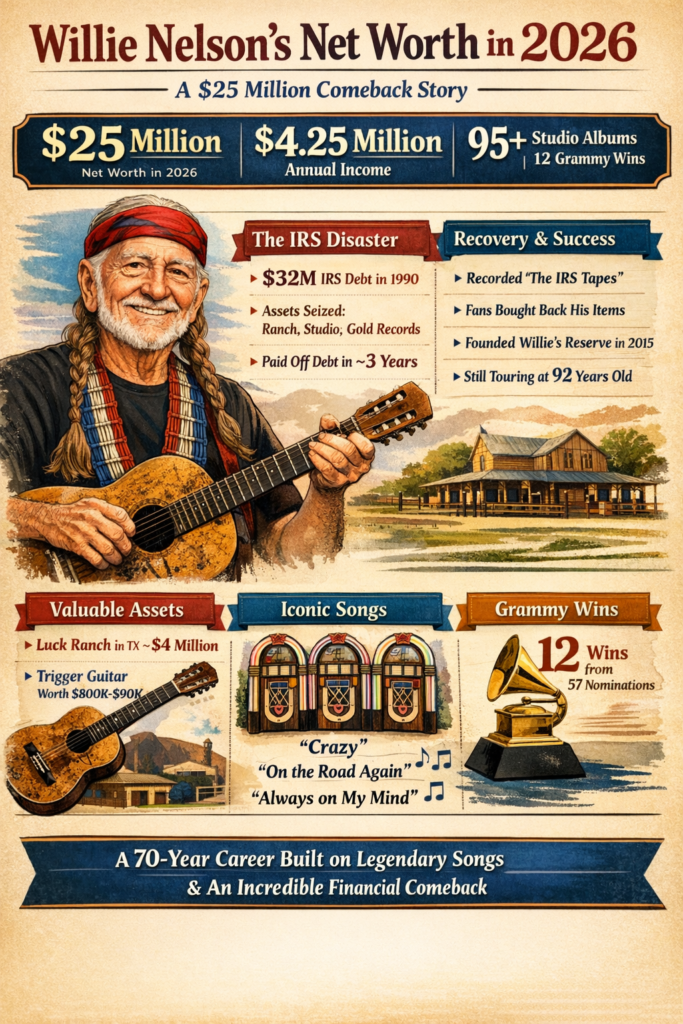
Willie Nelson has outlived his contemporaries, outlasted the golden era of physical album sales, and engineered one of the most resilient independent financial ecosystems in American music. Contemporary industry estimates place Willie Nelson's net worth at $25 million to $30 million, a figure that surprises observers who expect the nine-decade-old icon to hold a nine-figure war chest.
That valuation reflects an aggressive tax settlement, decades of heavy philanthropy, and an atypical business philosophy prioritizing liquidity and cash flow over asset hoarding. Nelson survived financial ruin in the early 1990s through creative dealmaking and turned outlaw status into an enduring commercial engine spanning live production, licensing, and legal cannabis.
📌 Key Takeaways:
- Core Valuation: Nelson sits on an estimated personal net worth of $25 million to $30 million, buffered by high-margin touring and active master publishing.
- The IRS Rebound: A crushing federal tax lien in 1990 stripped his physical assets, inspiring an unprecedented commercial partnership that cleared his balance sheet by 1993.
- Diversified Income: Beyond music royalties for standards like "Crazy" and "On the Road Again," his wealth stems from Willie's Reserve, the Outlaw Music Festival, and prime real estate in Texas and Hawaii.
The November 1990 Seizure and the IRS Tapes Survival Blueprint
The baseline for Willie Nelson's modern estate began in November 1990. Federal agents raided his Texas properties and seized nearly everything he owned to satisfy a staggering $32 million federal tax bill, an enforcement action chronicled in detail by an American Songwriter Report. Negligent tax shelters assembled by Price Waterhouse in the early 1980s collapsed under regulatory scrutiny, leaving Nelson personally exposed.
The Internal Revenue Service negotiated the demand down to $16.7 million, but Nelson lacked the liquid cash to satisfy the balance. Rather than filing Chapter 7 bankruptcy to discharge the liabilities, Nelson entered into an extraordinary revenue-sharing agreement with the government.
In 1992, he released The IRS Tapes: Who'll Buy My Memories?, an unadorned acoustic collection sold directly through an 800-number television campaign managed by Sony Music. Half of the album's gross proceeds bypassed Nelson entirely, flowing straight to the Department of the Treasury.
Nelson's inner circle rallied during the public auctions. Friends and fellow musicians bought back his recording studio, memorabilia, and core ranch land in Spicewood, Texas, preserving his essential creative infrastructure until he officially settled the balance in 1993. That crisis fundamentally altered how Nelson managed intellectual property, instilling a preference for direct revenue capture and creative independence that protected his future earnings.
Evergreen Publishing: How Patsy Cline’s 'Crazy' Anchored Nelson's Catalog
Long before Nelson became the bandana-wearing face of outlaw country, he operated as a Nashville songwriter turning out steady commercial hits for other voices. Songwriting catalog royalties remain the quiet foundation of his financial durability.
In 1961, Patsy Cline recorded his ballad "Crazy." Her definitive performance created one of the most played jukebox and radio singles of the twentieth century. Every terrestrial radio broadcast, streaming play, and sync license for the recording produces dual royalties: performance money collected through BMI and mechanical royalties generated from covers and digital distributions.
Nelson maintained ownership stakes in his early songwriting catalog while retaining significant music publishing rights across his golden run in the 1970s and 1980s. When paired with his signature anthem "On the Road Again", which won the Grammy for Best Country Song in 1981 and became an indispensable track for cinematic licensing, road-trip playlists, and commercial advertisements, his publishing equity generates steady, predictable seven-figure annual returns.
Unlike peers who cashed out their lifetime publishing rights during the venture-backed catalog boom between 2020 and 2024, Nelson kept his core works intact. This steady publishing baseline insulates his balance sheet from standard industry volatility, yielding continuous passive cash flow.
Breaking Down the Assets: Revenue Engines Across Seven Decades
Nelson's wealth portfolio functions as an operational company rather than a stagnant pile of capital. His cash generation shifts between music operations, brand ventures, and physical land holdings.
| Asset / Income Vertical | Estimated Annual Contribution / Value | Operational Role |
|---|---|---|
| Live Touring & Festivals | $8M, $15M Gross Annually | Primary liquidity driver powered by the Outlaw Music Festival and standalone theater dates. |
| Music Publishing & Royalties | $2M, $4M Net Annually | Evergreen mechanical, sync, and streaming revenue from standard master and writing rights. |
| Willie's Reserve & Licensing | $1M, $3M Net Royalties/Dividends | Licensing fees and equity dividends derived from state-legal retail cannabis and hemp derivatives. |
| Real Estate (Texas & Hawaii) | $12M, $18M Capital Asset Base | Includes the 500-acre Luck Ranch in Spicewood, Texas, and an oceanfront compound in Paia, Maui. |
Touring generates his most reliable liquid cash. Nelson built the Outlaw Music Festival into a premier summer road package, co-headlining with artists like Bob Dylan, John Mellencamp, and Chris Stapleton. The tour consistently generates sellouts across North American amphitheaters, grossing tens of millions over each summer run. Nelson claims a direct cut of ticket gates and merchandise sales, converting high-volume tour routing into immediate operating income.
Willie’s Reserve and the Commercialization of Outlaw Counterculture
Decades before recreational marijuana emerged as a regulated multi-billion-dollar market, Nelson served as its premier cultural ambassador. His repeated public arrests for cannabis possession between the 1970s and 2010 established authentic credibility that Madison Avenue agencies could never fabricate.
In 2015, Nelson capitalized on that personal history by launching Willie's Reserve, a commercial cannabis brand. Rather than constructing massive grow operations, Nelson deployed an asset-light licensing model. His company partners with independent local cultivators and processors across legal markets including California, Colorado, Washington, and Nevada. The growers supply the inventory, while Nelson licenses his name, imagery, and curated strains in exchange for a percentage of wholesale revenue.
The enterprise expanded into the non-psychoactive space via Willie's Remedy, marketing hemp-derived tinctures, topicals, and CBD coffees to consumers nationwide. While shifting state regulations and heavy tax burdens make cannabis business unpredictable, Nelson’s brand avoids large capital expenditures by licensing intellectual property, delivering consistent, low-risk revenue.
Spicewood and Paia: The Tangible Value of Luck Ranch and Hawaii
Nelson stores substantial equity in physical real estate, centered on two legacy compounds. His primary base is Luck Ranch, an expansive property covering roughly 500 acres in Spicewood, Texas, nestled within the Texas Hill Country outside Austin.
Luck Ranch serves as an operations hub rather than an ordinary country retreat. The grounds feature a functioning Old West movie set constructed for the 1986 film adaptation of his concept album Red Headed Stranger. The replica town includes a saloon, a chapel, an intimate performance stage, and an equestrian sanctuary for dozens of rescued horses.
During the annual South by Southwest conference, the ranch hosts the boutique Luck Reunion festival, monetizing his personal grounds via high-ticket corporate sponsorships, exclusive live broadcasts, and festival admissions.
His second primary holding sits on the North Shore of Maui in Paia, Hawaii. Nelson bought into the remote enclave decades ago, creating an off-grid sanctuary powered by solar arrays and biodiesel generators. Surrounding himself with longtime friends like Woody Harrelson and Kris Kristofferson, the Hawaiian compound has appreciated into an eight-figure coastal asset.
Philanthropy vs. Personal Wealth: The Farm Aid Distinction
Public estimates of country music wealth often conflate personal assets with non-profit balance sheets. Nelson’s lifelong public association with Farm Aid leads casual observers to overestimate his net worth.
Nelson founded the organization in 1985 alongside Neil Young and John Mellencamp, responding to a financial crisis that was foreclosing family-owned farms across the American Midwest. Over nearly four decades, Farm Aid's annual benefit concerts, corporate partnerships, and public appeals have raised over $70 million to support sustainable agriculture, legal defense funds, and disaster relief.
Nelson takes no operational salary from the charity. His relationship with Farm Aid represents a structural expense rather than an asset. He routinely finances administrative overhead, donates stage equipment, and provides promotional airtime out of his own touring accounts. He approaches his career like an independent working contractor, reinvesting earnings back into his band, his crew, and rural agricultural advocacy rather than inflating a personal bank balance.
Frequently Asked Questions (FAQ)
Q1: What is Willie Nelson's estimated net worth in 2026?
A1: Nelson's net worth sits between $25 million and $30 million. High-grossing live tours, sustained master publishing income, cannabis branding fees, and real estate in Texas and Hawaii balance his high operational overhead and past tax liens.
Q2: How much did Willie Nelson actually pay to settle his IRS debt?
A2: The IRS initially demanded $32 million in 1990 before negotiating the principal down to $16.7 million. Nelson formally cleared the liability around 1993 for roughly $9 million, utilizing sales from The IRS Tapes alongside private legal settlements against his former accounting advisors.
Q3: Does Willie Nelson own all his original master recordings?
A3: Nelson owns valuable publishing rights across his core songwriting catalog, including standards like "Crazy." However, master recording rights for early albums are distributed across legacy major labels, such as Columbia (Sony Music) and RCA, yielding him perpetual artist performance royalties rather than direct master ownership.
Q4: How does Willie's Reserve generate revenue without physical factories?
A4: The brand functions through an intellectual property licensing strategy. Nelson licenses the Willie's Reserve trademark and aesthetic to vetted, licensed craft growers in legal states, taking royalty cuts from retail sales without funding commercial cultivation facilities.
The Pragmatic Blueprint of Texas Outlaw Economics
Willie Nelson’s finances defy the standard logic of the music industry. Modern pop and country superstars build their net worth by maximizing streaming shares, pursuing corporate sponsorships, and liquidating catalogs to private equity funds. Nelson built his enterprise on cash liquidity, stage agility, and authentic community connections.
By retaining control of his foundational songwriting royalties, touring relentlessly, and turning personal habits into a distinct retail brand, Nelson created a durable financial model. His $25 million to $30 million net worth is not an accident of corporate packaging. It is the hard-won balance of an independent working musician who lost everything to the taxman, worked off the bill, and turned his back catalog into an enduring, independent engine.