Is Erling Haaland Soccer’s Most Dangerous Runner? Myth vs. Fact on His Sprint Technique
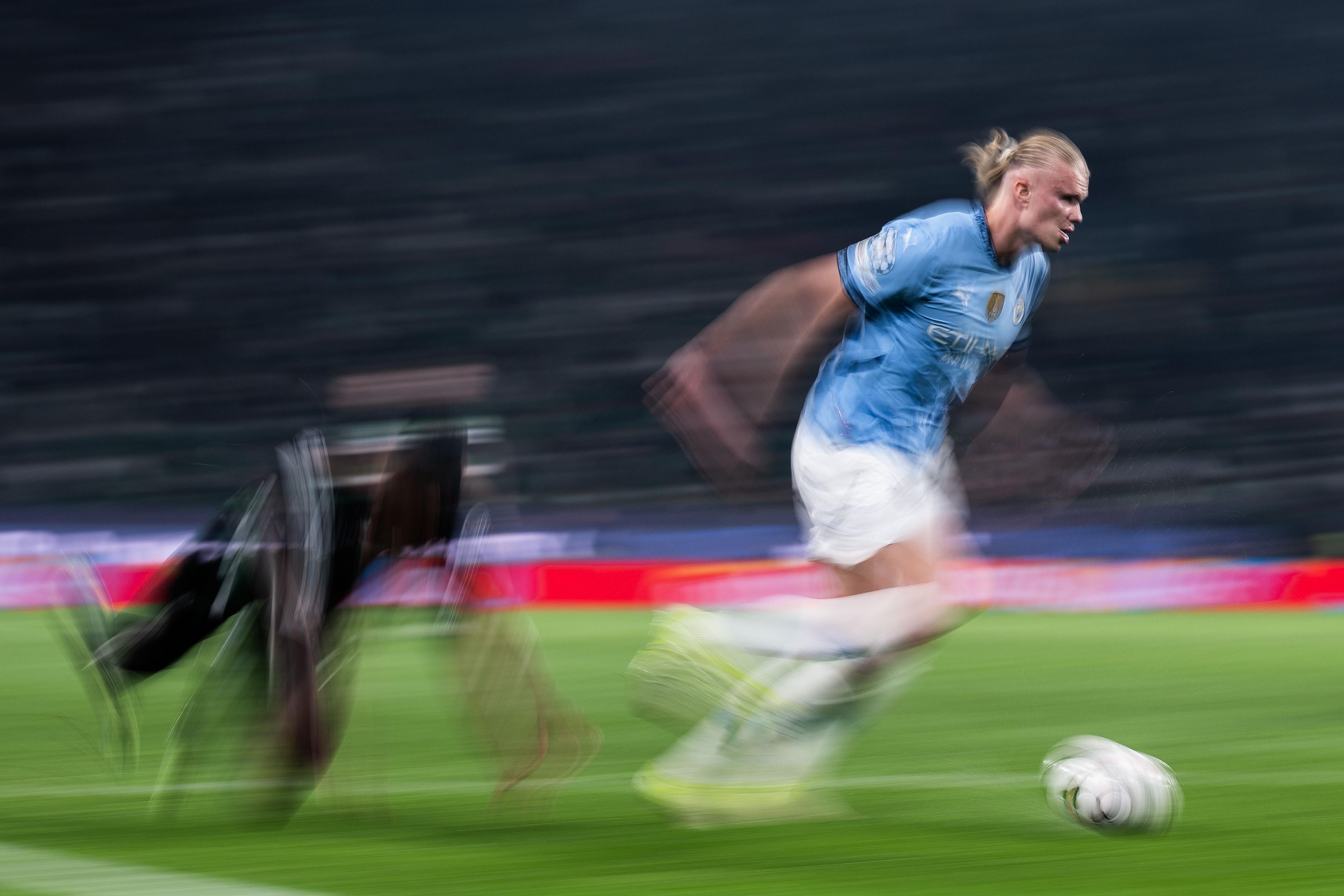
Watch Erling Haaland break into an open-field gallop, and the visual defies traditional athletic symmetry. His torso leans forward at an aggressive tilt, knees drive skyward with violent torque, and his 6-foot-4 frame devours pitch space like an Olympic sprinter dropped into a tactical chess match. A technical analysis from the nytimes.com Report details how Haaland balances raw physical mass against calculated trajectory adjustments, differentiating his sprints from the classical winger archetypes who rely purely on linear foot speed.
Yet the aesthetic of Haaland's running form often sparks intense debates between track purists and tactical analysts. Social feeds frequently dissect his lunging strides and asymmetric arms, questioning whether his locomotion represents peak biomechanical efficiency or an injury-prone physical anomaly. Separating football myth from physiological reality reveals a forward whose running style is stripped of wasted energy and engineered specifically to shatter elite defensive lines.
📌 Key Takeaways:
- The Velocity Threshold: Haaland's measured 35.5 km/h sprint peak places him within the upper tier of European forwards, though his true lethality lies in acceleration over the first 15 meters rather than sustained terminal speed.
- Off-Ball Geometry: His mastery of curved runs off the ball and relentless targeting of center-backs' blind sides creates separation without requiring superior foot race metrics over 40 meters.
- Defensive Bottlenecks: Deep low-block defenses compress spatial runways, dampening his stride extension and forcing Manchester City to alter his delivery angles.
The Biomechanics Behind the 35.5 km/h Sprint
Haaland’s sprint biomechanics resemble those of a power-based short sprinter rather than an endurance-oriented footballer. At roughly 90 kilograms, the Norwegian generates immense ground reaction forces through his initial drive phase. Track and field coaches often point to his stride length and frequency as an unusual pairing for an athlete of his height. Most tall strikers exhibit slower turnover rates; Haaland sustains high stride cadence while opening his hips to capture maximum ground coverage per cycle.
His foot-strike mechanics favor mid-foot contact rather than the energy-sapping heel strikes seen in fatigued players late in ninety-minute matches. His forward trunk inclination during the initial drive phase mirrors an elite 60-meter sprinter clearing track blocks. This forward lean lowers his center of gravity, making him virtually impossible to shoulder off balance once he reaches second gear.
The violent arm carriage that pundits routinely mock serves an essential stabilizing function. His wide, pumping arms counteract the massive rotational torque produced by his hips and pelvis during explosive acceleration. Without those exaggerated upper-body levers, his core would leak kinetic energy, slowing down his transition into top speed.
Decoupling Top Speed from Explosive Acceleration
Top-end velocity produces dramatic television graphics, but football matches rarely offer 50-meter clear paths. Erling Haaland top speed clocks consistently around 35.5 km/h, placing him among the Premier League fastest players, yet several fullbacks and wingers record higher peak radar figures. The critical discriminator is the time required to reach 90% of maximum velocity.
Haaland reaches high acceleration bands in three to four strides. His first five meters produce rapid ground displacement, giving him an immediate half-yard advantage before an opposing center-back pivots their hips. Manchester City sprint stats show that his most lethal running bursts average between 8 and 18 meters in distance.
This condensed acceleration profile transforms contested fifty-fifty balls into clear-cut shooting lanes. Premier League central defenders possess high straight-line speeds, but their reaction latency combined with Haaland’s rapid burst creates a consistent spatial deficit. He does not beat defenders by sustaining top gear down the touchline; he destroys their defensive positioning before they complete their transition step.
Tactical Movement: Curved Runs and Blind Side Infiltration
Raw kinetic output means little without elite pitch spatial awareness. Thierry Henry made a career out of curving away from markers, whereas Cristiano Ronaldo attacked the blind side of isolated fullbacks. Haaland synthesizes these approaches through sophisticated football sprint mechanics executed entirely without the ball.
Instead of running straight toward goal, Haaland frequently angles his sprint trajectory outward before slicing diagonally across a defender's recovery angle. This curved run prevents the defender from utilizing physical contact to slow his run. It forces the center-back to turn their neck, breaking visual alignment with both Haaland and the midfielder delivering the pass.
The blind side movement is calculated with surgical precision. Haaland positions his body directly behind the defender's shoulder blade during the buildup phase. The moment Kevin De Bruyne, Phil Foden, or Bernardo Silva shifts balance to strike an incisive pass, Haaland initiates an explosive drive from the defender’s unseen peripheral sector. By the time the marker turns their head, Haaland has already crossed their defensive line at top speed.

Haaland vs Mbappe Speed and Premier League Benchmarks
Debates over modern football's ultimate physical force regularly pit Erling Haaland against Kylian Mbappé. While public narratives frame this as a direct sprint comparison, tracking data reveals fundamentally divergent physical profiles and running demands across domestic leagues and the UEFA Champions League.
| Player Metric | Erling Haaland | Kylian Mbappé | Positional Benchmark (EPL) |
|---|---|---|---|
| Peak Velocity Range | 35.2, 36.2 km/h | 36.5, 38.0 km/h | 33.8, 34.8 km/h |
| Average Sprint Length | 12, 16 meters | 20, 28 meters | 14, 19 meters |
| Primary Sprint Phase | Initial acceleration (0, 15m) | Flying sprint / Top gear | Mid-phase transitional |
| Running Role | Central box crashing, blind runs | Channel carries, wide isolations | Pressing, channel occupation |
Mbappé operates with an elite sprinter's glide, capitalizing on wider open spaces on the left wing to reach top gear over 30 meters. Haaland's output is optimized for central traffic. The Haaland vs Mbappe speed dynamic is not an indictment of either player's physical ceiling; it reflects distinct spatial realities. Mbappé relies on sustained top-end speed to bypass back-lines from deep, while Haaland relies on rapid deceleration and redirection within congested 18-yard boxes.
Structural Vulnerabilities Against Low-Block Defenses
Disciplined defensive systems recognize the threat of Haaland's running form and adapt their spatial spacing to neutralize it. When teams like Arsenal or Real Madrid establish a compressed low block, the vertical runway required for his stride extension vanishes.
Without 15 meters of open green pitch behind the line, his top-speed metrics become irrelevant. Low blocks deny him the blind side by assigning one central defender to grapple with him physically while another sweeps the pocket directly behind. This dual coverage takes away his forward lean momentum, forcing him into back-to-goal hold-up play where explosive running mechanics cannot be expressed.
Furthermore, running at maximum velocity while carrying a heavy, muscular frame introduces substantial deceleration stress. Stopping abruptly after an 18-meter blind-side sprint puts immense eccentric load on the hamstrings, patellar tendons, and adductor muscle groups. When elite defenders compress the zone, Haaland must brake violently in tiny spaces, limiting his ability to turn and strike in a single continuous movement.
Preserving the Machine: Load Management and Longevity
Pep Guardiola’s management of Haaland’s running metrics centers around high-efficiency exertion. Early in his Borussia Dortmund tenure, Haaland sprinted aggressively across the defensive third to press goalkeepers, a high-octane style that contributed to frequent muscular strains. Manchester City's tactical model strictly curtails unnecessary runs.
Haaland now spends long stretches of a match walking or jogging at low intensity, frequently recording the fewest overall touches of any player on the pitch. This is not disinterest; it is physiological conservation. By preserving glycogen stores and keeping his central nervous system fresh, he ensures that when an opportunity presents itself, his sprinting output remains explosive.
This deliberate energy rationing directly counteracts the wear and tear of a grueling domestic and European calendar. The physical forces involved in accelerating a 90-kilogram frame to 35.5 km/h require pristine muscle elasticity. City's medical and conditioning staff monitor his sprint volume down to the single meter, ensuring his running capacity remains lethal through the final stretch of title races.
Frequently Asked Questions (FAQ)
Q1: What is Erling Haaland's official top speed in competitive matches?
Haaland has registered top speeds reaching 35.5 km/h (22.06 mph) in the Premier League, with occasional Champions League tracking data recording peaks near 36.2 km/h during deep transition sprints.
Q2: Why does Haaland look unusual when he sprints compared to other players?
His sprint mechanics feature an unusually heavy forward lean, a wide arm carriage to stabilize his 6-foot-4 frame, and high ground reaction forces. This aesthetic differs sharply from traditional upright, fluid wingers, but it maximizes propulsion for his body mass.
Q3: How do elite teams prevent Haaland from using his running speed?
Defenses employ deep defensive low blocks, keeping their back-line within 10 to 15 meters of the penalty box. This setup denies Haaland the open vertical runway required to achieve stride extension and execute blind-side curved runs.
The Evolution of Haaland’s Off-Ball Blueprint
Erling Haaland's running style dismantles the traditional dichotomy between brute strength and sprinting efficiency. By combining the acceleration mechanics of a track power runner with intelligent curved movements off the ball, he consistently manipulates the spacing of the world's most disciplined defenses.
As tactical trends push defensive lines deeper to deny him open pitch space, Haaland's running game will continue to evolve toward shorter, lateral bursts and sharp double-move cuts inside the six-yard box. He does not need to be the fastest player over 100 meters to dominate top-flight football; he simply needs to generate overwhelming power across the first five steps, leaving defenders chasing shadows in the spaces they thought they had secured.