The 2026 Skin Tone Chart Revolution: From Basic Swatches to Smart Optical Scanners
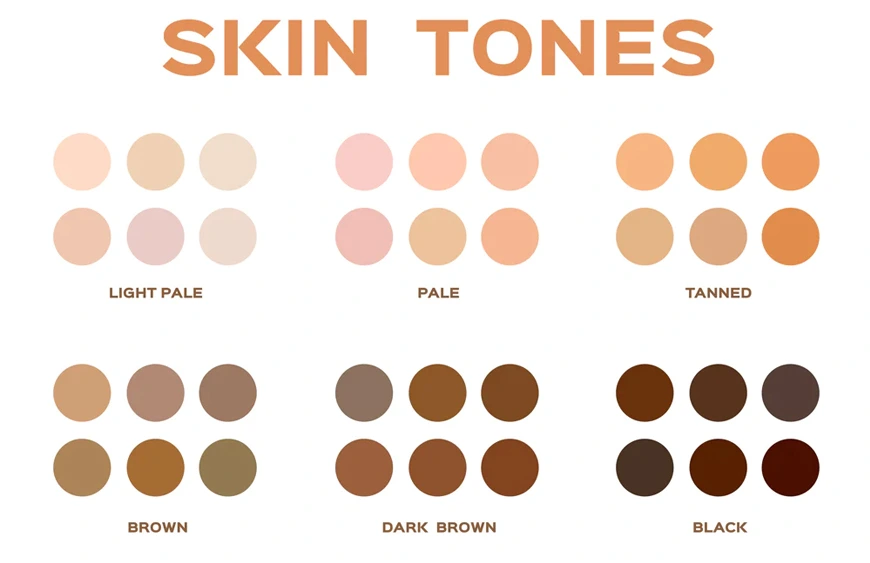
Beauty retail counters once relied on paper swatch books and harsh overhead fluorescents to guess a customer's complexion. Today, that guesswork is being systematically phased out. According to the perfectcorp.com Report, advanced digital diagnostics and machine learning frameworks have turned skin shade classification into a high-precision science. Shoppers are no longer willing to tolerate foundations that oxidize into a pumpkin hue three hours after application, prompting cosmetic chemists and software engineers to completely redesign the humble skin tone chart from scratch.
📌 Key Takeaways:
- The Diagnostic Shift: Static six-level reference charts have been superseded by 10-to-40-point multidimensional scales that separate surface redness from subcutaneous melanin density.
- Algorithmic Color Matching: Mobile optical skin scanner technology and machine-learning diagnostics now correct for ambient lighting distortions in real time, curbing a historic 35% e-commerce return rate on liquid foundations.
- Subtle Undertone Integration: Nuanced classifications, most notably detailed olive undertone charts and adaptive mature skin foundation matching, are forcing cosmetic houses to rethink base pigments.
The Structural Collapse of the Six-Tier Fitzpatrick Model
For half a century, the dermatological default was the Fitzpatrick scale. Created in 1975 by Harvard dermatologist Dr. Thomas B. Fitzpatrick, the system was designed for an entirely different purpose: assessing skin cancer risk and UV photosensitivity. It divided human complexions into six rigid Roman-numeral buckets, running from Type I (pale white, always burns) to Type VI (deeply pigmented, never burns).
When mass-market cosmetics adopted Fitzpatrick as a foundation shade finder, structural errors became immediately apparent. The scale clustered the vast majority of global populations, spanning South Asia, the Mediterranean, the Americas, and the African diaspora, into just two broad, ill-defined categories (Types V and VI). It completely ignored undertones, light scattering, and regional variations in skin chemistry.
By early 2026, cosmetic testing labs had largely phased out the legacy system in favor of the Monk Skin Tone (MST) scale. Developed by Harvard sociologist Dr. Ellis Monk and backed by major technology firms, this 10-point scale provides an open-source, non-eurocentric framework. It decouples sunburn probability from visual appearance, giving computer vision models and cosmetic chemists a balanced continuum. Instead of forcing deep complexions into a flat "dark espresso" corner, modern charts account for the full melanin pigmentation index, capturing subtle shifts in chromophore distribution that older charts ignored.
Decoding Complexion Color Theory: Surface Tone Versus Undertone
The single greatest cause of mismatched cosmetics is the confusion between surface tone and undertone. Surface tone represents the variable, volatile color visible to the naked eye. It changes constantly due to sun exposure, rosacea, windburn, hormonal breakouts, and seasonal shifts. Undertone, by contrast, is structural. It is determined by the concentration of carotene, hemoglobin, and melanin situated beneath the epidermis.
Traditional diagnostic tools split buyers into three rigid camps: warm, cool, and neutral. This crude division breaks down the moment a customer steps outside a European color profile. The classic olive undertone chart, for example, illustrates why standard algorithms fail. Olive complexions feature a distinct greenish cast caused by a high concentration of yellow-toned carotene combined with cool-blue vascular undertones. When an olive-skinned individual buys a typical "warm" foundation, the excess peach and red pigments create a jarring orange mask. If they buy a "cool" shade, the pink pigments turn ashen gray on their jawline.
Modern color theory treats skin as a semi-translucent optical filter. When light strikes the stratum corneum, some wavelengths bounce immediately off the surface, while others penetrate deeper, bouncing off vascular structures and melanin clusters before exiting back to the observer. Modern colorimetrics rely on tristimulus values (L*a*b* color space), tracking luminance (L), red-green balance (a), and yellow-blue balance (b) across a continuous matrix rather than a static list of color swatches.
The Evolution of Complexion Analysis: 2018 to 2026
The transition from manual counter consultations to high-throughput spectral analysis has dramatically altered how brands formulate, catalog, and dispense makeup pigments.
| Analytical Metric | Manual Counter Era (2018, 2021) | Algorithmic Optical Era (2024, 2026) |
|---|---|---|
| Color Scale System | Fitzpatrick phototypes (I, VI) | Monk Skin Tone Scale (10 levels) + L*a*b* coordinates |
| Undertone Granularity | 3 general tracks (Warm, Neutral, Cool) | 7 dynamic axes (including Deep Olive, Peachy Neutral, Golden Red) |
| Lighting Calibration | Uncorrected department store fluorescents (CRI 60, 75) | Auto-calibrating spectral reference targets & mobile neural correction |
| Sampling Zone | Single manual swipe on back of hand or wrist | Multi-zone scanning (jawline, clavicle, forehead) to average delta-E |
| Average E-Commerce Returns | 32%, 38% return rate for complexion products | 11%, 14% return rate across verified AI scans |

How AI Shade Matching Solves Swatch Lighting Distortions
Every beauty shopper has experienced metamerism failure. A foundation looks completely seamless in the warm, diffused boutique mirror. Thirty minutes later, in natural sunlight or under cold workplace LED fixtures, the shade morphs into an entirely mismatched mask.
Natural daylight sits at roughly 5,500 to 6,500 Kelvin with a Color Rendering Index (CRI) of 100. Standard retail bulbs hover between 2,700 and 4,000 Kelvin, often with a CRI below 80. These artificial light sources emit spikes in yellow and blue wavelengths while under-representing deep red, masking surface flaws and skewing human perception during a physical swatch test.
Modern AI shade matching technology resolves this through automated white balancing and multi-spectral normalization. Using a smartphone camera, the software identifies a reference white or reads subtle reflection values from surrounding skin to compute the ambient illumination profile. The algorithm extracts the user's spectral reflectance curves, computationally stripping away the room's color cast. Instead of assessing skin from a single point, the software samples thousands of facial coordinates across the jawline, neck, and chest, preventing the common mistake of matching a foundation to localized facial redness rather than structural body tone.
Mature Skin and the Physics of Light Scattering
Matching complexion products for mature skin involves optical mechanics that static charts completely overlook. As reported by The Independent in their comprehensive field tests of mature-skin formulations, selecting the right foundation requires balancing pigment density against micro-texture and hydration loss.
As skin ages, structural changes reshape how light behaves across the face:
- Epidermal cell turnover slows down, leaving an uneven layer of dead skin cells that scatter light diffusely, creating a dull, slightly gray cast.
- The dermis loses collagen and elastin, accentuating fine lines and creating localized shadows that conventional sensors often mistake for deep pigmentation.
- Capillaries become increasingly fragile, producing localized telangiectasias (spider veins) and chronic low-grade erythema on the cheeks and nose.
When an automated or manual system relies on old-school charts, it often over-indexes on this superficial surface redness. The customer gets matched with a heavy, high-pink foundation that emphasizes lines and looks synthetic. Modern digital diagnostic software accounts for skin volume and subsurface scattering, isolating surface redness from the true underlying baseline. Formulations are adapting in parallel, utilizing silicone-free emollient binders, micronized iron oxides, and light-refracting silica spheres that mimic youthful internal glow rather than blanketing the skin in opaque, chalky talc.
Frequently Asked Questions (FAQ)
Q1: Why does my foundation oxidize and turn darker or orange throughout the day?
A1: Oxidation occurs when foundation pigments, primarily iron oxides and titanium dioxide, react with natural facial oils, atmospheric oxygen, and the skin's individual pH balance. This chemical process alters the refractive index of the makeup film as it dries down. Modern optical scanners account for this by calculating expected dry-down drift, typically recommending a half-shade lighter or a more neutral undertone than a freshly swatched wet sample would suggest.
Q2: Can I determine my true undertone by looking at the veins in my wrist?
A2: The classic "vein test" (blue veins meaning cool, green meaning warm) is notoriously unreliable. Skin thickness, dermal depth, and natural yellow pigments in the stratum corneum can make blue veins appear green even on individuals with neutral or cool subcutaneous layers. A more reliable diagnostic involves checking how your skin looks next to pure white versus off-white fabric in indirect natural midday light, or using an optical smartphone scan calibrated to the Monk Skin Tone scale.
Q3: How does the Monk Skin Tone scale differ from standard digital color pickers?
A3: Standard digital color pickers use RGB values that treat all hues equally across an artificial 8-bit digital spectrum. The Monk Skin Tone scale is an anthropologically and optically validated 10-step reference framework. It specifically maps the biological spectrum of human skin, ensuring that deep, medium, and light complexions are represented with proportional step increments, eliminating the compression of darker tones that historically plagued algorithmic shade matching.
Reframing Complexion Science for the Next Decade
The evolution of the skin tone chart marks a broader transition away from arbitrary beauty categorizations toward genuine optical physics. For decades, the industry treated foundation matching as a subjective counter service, tolerating high return rates, chalky residue, and persistent mismatches across non-European complexions. The convergence of computational colorimetry, standardized inclusive scales, and high-CRI digital diagnostics has permanently exposed the limits of static paper swatches. As multi-spectral imaging expands into everyday consumer tech, base makeup is finally shedding its hit-or-miss legacy in favor of precise, individual calibration.


