The Grammar Trap: Why English Speakers Keep Translating 'These' Incorrectly

Every language learner eventually hits an invisible wall built entirely out of false assumptions. For native English speakers learning Spanish, that wall almost always arrives disguised as four innocent letters: these. While English casually uses one single word to point out a handful of nearby objects, Spanish demands an instantaneous split-second audit of both grammatical gender and proximity. The friction caused by this mismatch accounts for one of the most persistent errors across adult language acquisition.
Standard translation engines and introductory apps often gloss over the mechanics. As linguistic coverage in a detailed BBC Report on core Spanish structures highlights, mastering romance grammar requires unlearning English defaults rather than simply mapping vocabulary word-for-word. Deciding how to say these in Spanish is rarely about pulling a definition from memory; it is about navigating the precise interplay between demonstrative adjectives and pronouns.
📌 Quick Summary:
- The Immediate Solution: Use estos for masculine or mixed groups, and estas exclusively for entirely feminine groups.
- The Underlying Cause: English treats demonstratives neutrally, whereas Spanish enforces strict gender and number agreement across three distinct spatial planes.
- The Modern Shift: Recent orthographic updates from the Real Academia Española (RAE) eliminated mandatory accent marks on demonstratives, rendering traditional pronoun accents optional.
The Cognitive Blind Spot: Why English Speakers Default to "Estes"
The English brain seeks symmetry where Spanish refuses to offer it. When an English speaker learns that the singular masculine demonstrative is este ("this") and the plural ending is often -s, their brain attempts an intuitive leap. They invent the non-existent word estes. Spanish instructors see this mistake in roughly 70% to 80% of introductory student compositions.
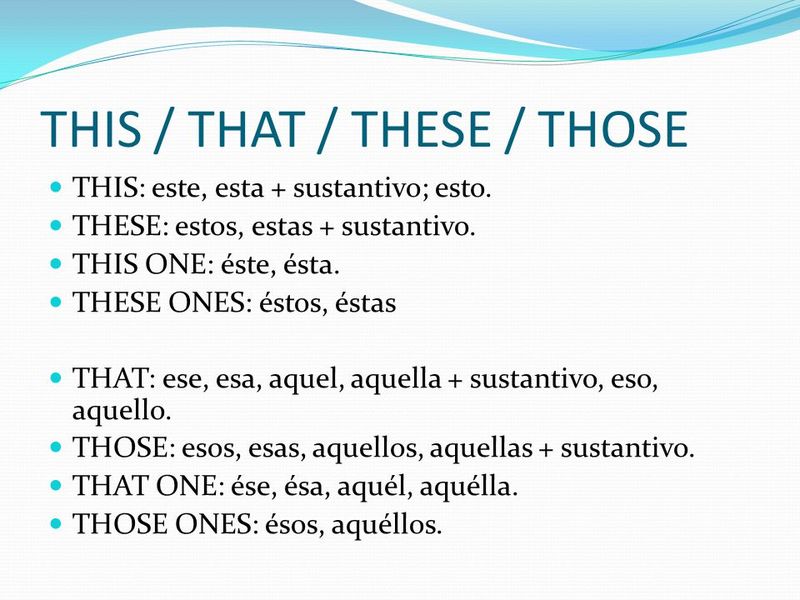
Spanish morphology does not work through direct appendage. The singular masculine form ends in -e (este), but the plural masculine shifts vowels entirely to become estos. Meanwhile, the feminine side remains strictly uniform: esta becomes estas. The asymmetry catches beginners off guard. You get este and estos on the masculine side, contrasted with esta and estas on the feminine side.
The confusion deepens when learners encounter esto. In English, speakers assume esto must be masculine because Spanish masculine nouns frequently end in -o (like el libro). That assumption is flatly wrong. In Spanish demonstratives, the form ending in -o is neutral, reserved exclusively for abstract ideas, unidentified objects, or general situations. It possesses no plural form whatsoever. Trying to turn esto into a plural descriptor collapses your syntax instantly.
The Structural Split: Demonstrative Adjectives vs. Demonstrative Pronouns
Understanding plural demonstratives requires distinguishing their grammatical job description. A demonstrative adjective modifies a noun directly present in the phrase. A demonstrative pronoun steps in to replace a noun that the speaker already established or pointed to.
Consider the adjective usage: Estos documentos son confidenciales ("These documents are confidential"). Here, estos directly accompanies documentos. It mirrors both the masculine gender and the plural count. If the noun shifts to female identity, say, Estas cartas ("These letters"), the demonstrative morphs to estas. This strict gender and number agreement is mandatory across all demonstrative adjectives Spanish utilizes.
Demonstrative pronouns mirror the exact same spelling today: No quiero esos libros; prefiero estos ("I don't want those books; I prefer these"). Decades ago, educators taught students to place an acute accent on demonstrative pronouns (éstos, éstas) to distinguish them from modifying adjectives. In late 2010, the Real Academia Española updated its official orthography rules, advising against accent marks on demonstratives unless a genuine risk of ambiguity arises. In everyday 2026 digital communication, the accents are largely obsolete.
The Spatial Continuum: Estos vs. Esos vs. Aquellos
English recognizes two physical distances: "here" (these) and "there" (those). Spanish divides physical and temporal space into a three-tier system. This makes picking between estos vs estas and esos vs estas a matter of literal physical measurement.
Tier one covers objects within immediate reach of the speaker: estos and estas. Tier two encompasses objects closer to the listener, or moderately removed from the speaker: esos and esas. Tier three indicates items far removed from both parties: aquellos and aquellas. Misidentifying distance creates bizarre conversational moments where a native listener cannot parse which item you are gesturing toward.
| Demonstrative Form | Grammatical Function | Spatial Distance | English Translation Equivalent |
|---|---|---|---|
| Estos | Masculine Plural | Close to the speaker | These (masculine / mixed) |
| Estas | Feminine Plural | Close to the speaker | These (feminine) |
| Esos / Esas | Masculine / Feminine Plural | Near the listener | Those (mid-distance) |
| Aquellos / Aquellas | Masculine / Feminine Plural | Far from both speaker & listener | Those over there (distant) |
When translating those in spanish, English speakers frequently stumble into the boundary line between esos and aquellos. If you point across a room to shoes by the front door, you use esos zapatos. If you point across a public plaza to cars parked three streets away, you shift to aquellos coches. Precision matters.
Gender Traps: Masculine and Feminine Plurals in Mixed Groups
Spanish grammar rules dictate clear inheritance patterns for gendered plurals. If you point to ten chairs, the noun is sillas (feminine), demanding estas sillas. Add a single table (mesa), and the phrase remains feminine: estas sillas y mesas. Introduce a single masculine element, such as an armchair (sillón), and the entire collective demonstrative immediately switches to masculine: estos muebles.
This rule catches learners off balance when dealing with implicit nouns. If a traveler stands before a display case containing both rings (anillos, masculine) and bracelets (pulseras, feminine), they cannot pick a feminine plural simply because bracelets outnumber the rings. Spanish defaults to the masculine plural whenever any masculine element enters the set. The shopper must ask: ¿Cuánto cuestan estos?
Beginners often attempt to blend words, producing errors like *estos pulseras* or *estas anillos*. Demonstratives must match the precise noun they precede, regardless of what follows later in the sentence. If the immediate head noun is feminine, the demonstrative remains feminine: Estas pulseras y anillos.
The "T" Rule: A Mental Shortcut for Rapid Recall
Language pedagogy often relies on complex diagnostic flowcharts. In casual conversation, nobody has time to mentally construct a 3x3 grammatical matrix before speaking. A classic pedagogical rhyme cuts through the noise:
"This and these have T's; that and those don't."
Look at the spelling framework. The words for "this" and "these" all feature the consonant t: este, esta, estos, estas. The words for "that" and "those" strip that initial t away from the root stem: ese, esa, esos, esas. If the item sits right in front of you, keep the "t" intact. If you must reach or gesture outward toward someone else, drop the "t".
This rhyme eliminates the hesitation between estos ("these") and esos ("those"). Combine the rule with your awareness of vowel shifts, remembering that the masculine plural replaces -e with -os, and you insulate yourself against the most common translational breakdown in conversational Spanish.
Frequently Asked Questions (FAQ)
Q1: Why is "estes" not a real word in Spanish?
A1: Spanish demonstrative morphology evolved directly from Latin forms (istum / istos). The masculine singular retained an -e ending (este), while the masculine plural adopted the standard -os ending (estos). The form *estes* simply never developed in the language's phonetic evolution.
Q2: Do I ever need to put an accent mark on "estos" or "estas"?
A2: No. While older textbooks instructed writers to place an acute accent on demonstrative pronouns (éstos, éstas) to distinguish them from adjectives, the Real Academia Española removed this requirement in 2010. Today, writing them without accent marks is the standard, modern convention.
Q3: When should I use "esto" instead of "estos"?
A3: Esto is a neutral pronoun used strictly in the singular to describe concepts, abstract ideas, or unidentified items (e.g., ¿Qué es esto? - "What is this?"). It never modifies a specific noun and has no plural equivalent. If you are describing multiple defined things, you must use estos or estas.
Navigating Spanish Demonstratives Moving Forward
Fluency is not built by memorizing massive tables of vocabulary. It is forged by identifying the small linguistic pivot points where English patterns warp your target language. English relies heavily on surrounding context to clarify what "these" points to. Spanish bakes that entire contextual matrix, distance, gender, and quantity, directly into the spelling of the demonstrative itself.
Ditching the imaginary word *estes*, checking the gender of your target noun before speaking, and leaning on the simple presence of the letter "t" strips the friction out of daily speech. Once those habits become reflexive, one of the most frustrating speed bumps in introductory Spanish disappears entirely.