The Hidden Catch Behind Costco Car Battery Warranties: Are Drivers Getting Shortchanged?
Costco members have long treated the warehouse refund desk like an ironclad financial shield, expecting no-questions-asked refunds on everything from half-eaten sheet cakes to ten-year-old blenders. That legendary goodwill hit a wall across automotive aisles, sparking heated friction between unsuspecting motorists and warehouse managers. Drivers hauling dead Interstate batteries to the return desk are discovering that the club's generous return framework no longer functions the way viral internet folklore suggests, an issue underscored by a recent Yahoo Finance Report tracking widespread consumer confusion around store return rule shifts.
The disconnect stems from a cocktail of outdated assumptions, subtle policy rewrites, and the logistical realities of warehouse retail. Shoppers routinely mistake standard satisfaction guarantees for lifetime mechanical protection. When an automotive power cell dies in year four, expectations shatter against strict warranty limits.
📌 Key Takeaways:
- The Warranty Reality: Costco eliminated its legacy 100-month prorated warranty policy, replacing it with a strict 36-month limited replacement warranty on Interstate batteries that ties replacements to the original purchase date.
- The Labor Gap: The Costco Tire Center does not provide car battery installation service; buyers must handle physical replacement, terminal cleaning, and battery group size verification on their own.
- Value Calculus: Costco retains an upfront price advantage of $40 to $70 on standard flood and AGM car battery units, but dedicated auto parts chains pull ahead on roadside convenience, diagnostics, and free curbside installation.
The Death of the 100-Month Prorate and the New 36-Month Reality
For over a decade, automotive forums and frugality blogs treated warehouse club batteries as an infinite power hack. Under the old system, Costco backed its Interstate lineup with a generous hybrid agreement: 36 to 42 months of free replacement, followed by a prorated warranty policy extending out to 100 months. If an engine failed to turn over at month 50, drivers received a partial credit calculated against the remaining lifespan, making replacement units remarkably cheap.
That era quietly vanished. Costco standardized its automotive battery terms into a flat 36-month limited replacement warranty. Under the updated language, if your battery fails diagnostic health tests within the first three years, the warehouse hands you a brand-new unit or credits back your original purchase price.
The catch catches members off guard on day 1,096. Cross the 36-month threshold by even forty-eight hours, and your remaining financial protection drops to exactly zero.
A replacement unit does not reset your warranty clock. If your initial battery fails at month 34 and Costco provides a brand-new replacement, that second battery does not carry an additional three years of coverage. Its protection expires two months later, pegged strictly to your original receipt date. For motorists accustomed to the rolling warranty cycles found at boutique mechanics or traditional auto parts chains, the warehouse rule feels uncomfortably rigid.
Where Warehouse Satisfaction Collides with Automotive Consumables
Costco built an empire of member loyalty on its celebrated 100% satisfaction guarantee, a policy with few codified exceptions beyond 90-day rules on consumer electronics, diamonds, and major appliances. Automotive consumables occupy an awkward middle ground that routinely triggers disputes at customer service counters.
Car batteries naturally deteriorate through heat, cold, and electrical abuse. Lead-acid plates sulphate over time; short commutes drain charge; scorching summer asphalt cooks internal acid baths. When an owner brings back an Interstate battery after four years claiming they are simply "dissatisfied" with its lifespan, warehouse clerks increasingly decline the return under normal membership benefits, routing the driver straight to the limited battery warranty instead.
This tension sparked widespread debate on consumer forums. Warehouse staff verify cold cranking amps using in-house digital load testers before processing refunds. If the battery passes the voltage and conductance tests, desk clerks often refuse to issue either cash or store credit, telling customers the battery simply requires an external recharge. Motorists expecting the rapid, no-questions-asked refund policy applied to dry goods find themselves arguing over cold cranking amps and internal resistance beside the exit doors.
AutoZone vs Costco Battery Economics: The True Cost of DIY Installation
Assessing whether Costco offers real value requires looking past shelf sticker pricing. While a high-crank Interstate AGM car battery runs significantly cheaper at warehouse clubs than equivalent units at commercial auto retailers, that price gap reflects missing garage services.
Traditional competitors build hands-on customer support into their overhead. AutoZone, O'Reilly Auto Parts, and Advance Auto Parts maintain diagnostic scanners at the counter, test alternators right in the parking lot, and send technicians out with hand tools to swap the unit under the hood at no added charge.
| Service & Warranty Metric | Costco Wholesale (Interstate) | AutoZone (Duralast Gold/Platinum) |
|---|---|---|
| Average Price Range (Standard Flooded) | $110, $140 | $180, $220 |
| Average Price Range (AGM Battery) | $170, $210 | $240, $290 |
| Free Replacement Warranty Window | 36 Months (Tied to original receipt) | 36 Months (Network-wide tracking) |
| On-Site Installation Service | None (Cash-and-carry only) | Free installation on most standard vehicles |
| Alternator & Diagnostic Testing | Bench testing only (Tire Center counter) | Free in-vehicle charging system checks |
| Store Footprint & Hours | ~600 U.S. Warehouses; limited weekend hours | 6,000+ Locations; open early, late, and holidays |
Costco Tire Centers focus exclusively on mounting wheels, balancing rubber, and repairing punctured treads. They do not offer car battery installation service under any circumstances. If your vehicle requires removing an intake duct, resetting battery monitoring sensor (BMS) software through an OBD-II port, or unbolting a wheel well liner to reach the battery tray, you must handle that mechanical heavy lifting in your driveway.
Paying an independent mechanic $50 to $100 for labor immediately erases the upfront savings Costco offers over dedicated auto retailers.

The Core Charge Refund Friction and Warehouse Logistics
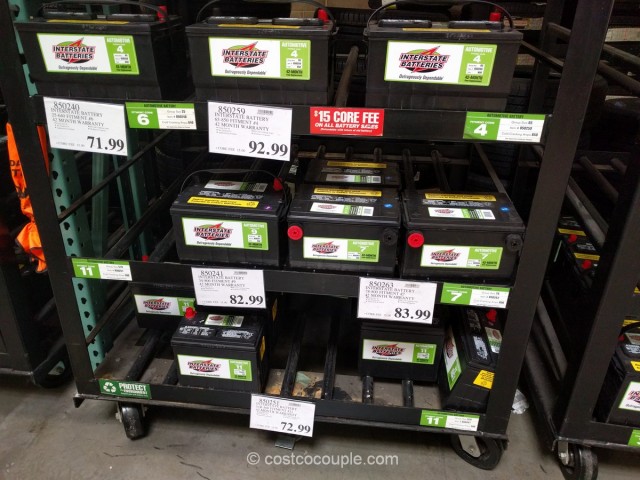
Purchasing an automotive power cell at Costco requires dealing with the standard regulatory core fee, an environmental deposit running between $15 and $20 per unit depending on your state jurisdiction. The process should be simple: bring back your exhausted lead-acid core, show proof of purchase, and collect your core charge refund.
In practice, the transaction is often inconvenient. Costco does not stock batteries inside the main Tire Center waiting rooms; they sit inside the warehouse warehouse floor near the motor oil racks or behind the tire service desk.
Returning a depleted core demands hauling a heavy, greasy, 40-pound block of lead and sulfuric acid through the warehouse entrance doors, past the greeter, and up to the service counter.
Tire Centers frequently direct members back to the main customer service queue, where shoppers returning clothes or groceries wait alongside motorists carrying hazardous components. Keep your paper slip: while warehouses store purchase histories digitally on member cards, reclaiming a core deposit months after buying requires pulling up the exact transaction code, adding extra steps to what should be an open-and-shut transaction.
Navigating Battery Group Size and Cold-Weather Demands
Costco stocks the most widely driven fitments, specifically standard group sizes like Group 24, 35, 48 (H6), 49 (H8), and 94R (H7). If you drive a mainstream pickup, a Toyota RAV4, or a Honda Civic, you will likely find an Interstate match on the pallet.
Owners of niche vehicles face clear limitations:
- Hybrid systems running specialized auxiliary batteries rarely find correct drop-in replacements.
- Older European sports sedans with trunk-mounted vent fittings often lack required hardware in warehouse aisles.
- Heavy diesel platforms demanding matched dual batteries may struggle to find twin units with identical production date codes on the rack.
Matching Cold Cranking Amps (CCA) is critical. Interstate units manufactured for Costco feature reliable cold-weather output ratings, often matching original equipment manufacturer (OEM) specs. However, shoppers need to verify cold-weather performance themselves. Warehouse stock sits on static display racks without dedicated technical advisors to cross-reference alternator draw against secondary stereo amplifiers or winter winch accessories.
Check the stamped production date code on the plastic casing before loading a battery into your flatbed cart. A battery resting uncharged on a retail pallet for longer than four months slowly loses charge and degrades before installation.
Strategic Realities for Drivers
Buying an Interstate battery at Costco remains one of the best raw-material bargains in the automotive aftermarket for drivers comfortable turning their own wrenches. You receive a well-built power cell at a wholesale discount, backed by three years of straightforward cash-or-replace protection.
The arrangement falls short for motorists seeking full-service automotive support. If your car dies on a Sunday evening in an unfamiliar neighborhood, a warehouse club cannot assist. There are no mobile jump-start trucks, no technicians offering curbside tool support, and no warranty service after warehouse doors lock at 6:00 p.m. on weekends.
Understanding what the warehouse battery return policy actually guarantees, and what it deliberately leaves out, prevents messy confrontations at the membership desk and keeps your vehicle running without unexpected out-of-pocket costs.
Frequently Asked Questions (FAQ)
Q1: Does Costco replace your car battery if it dies within the 36-month warranty?
A1: Yes, provided the battery fails an automated conductance diagnostic test performed by warehouse personnel. If the unit is legitimately dead, Costco provides a direct replacement or credits the purchase price. The replacement does not start a new 36-month term; it only carries coverage through the end of the original purchase's 36-month timeframe.
Q2: Why won't the Costco Tire Center install a battery I just bought in the warehouse?
A2: Costco Tire Centers operate strictly as tire-fitting operations and are not licensed, insured, or equipped as general automotive service garages. Their technicians lack the scan tools needed to re-register Battery Management Systems (BMS) on modern vehicles, so the warehouse sells batteries on a purely cash-and-carry basis.
Q3: How do I get my battery core deposit back from Costco?
A3: Bring your old car battery to the warehouse customer service counter or Tire Center along with your original receipt or membership card. Once an employee verifies the core, they immediately refund the $15 to $20 deposit back to your original payment method.


