Why 8 Divided by 2 Is Breaking the Internet Again: The Math Problem Nobody Can Agree On
Why 8 Divided by 2 Is Breaking the Internet Again: The Math Problem Nobody Can Agree On
A single line of elementary school arithmetic keeps derailing social media feeds around the globe. The expression 8÷2(2+2) looks deceptively simple, yet it reliably splits millions of commenters into two entrenched camps: those who calculate 16, and those who arrive at 1. When the equation first went viral, mainstream newsrooms stepped in to investigate the mass confusion, with networks like 9News bringing in professional mathematicians to settle the public argument.
The controversy persists because this is not a basic computational failure. It is a fundamental clash over mathematical grammar, historical typography, and the hidden assumptions programmed into everyday pocket calculators.
📌 Key Takeaways:
- The Dual Outputs: Working strictly from left to right yields 16, while prioritizing implied multiplication by juxtaposing the 2 against the bracket yields 1.
- The Core Fault Line: Modern arithmetic curricula follow a strict left-to-right convention for operations of equal priority, but older academic traditions and specific scientific calculators treat implicit grouping as higher priority.
- The Expert Consensus: Professional mathematicians consider the equation intentionally malformed; real-world working mathematics relies on unambiguous fraction bars rather than obelus division signs.
How a Basic Arithmetic String Became a Global Flashpoint
The viral math problem gained traction when users posted screenshots showing competing answers calculated on identical brands of hardware. A Texas Instruments handheld from one generation returned 16, while an older Casio or mobile app generated 1. Comment sections immediately turned hostile, with users accusing each other of failing fifth-grade math.
Everyone agrees on step one. The brackets or parentheses demand immediate attention: 2 + 2 = 4. That reduces the string to 8 ÷ 2(4).
From here, common ground evaporates. One group evaluates the division first: 8 divided by 2 equals 4, which is then multiplied by 4 to yield 16. The opposing camp insists that the 2 outside the parenthesis is glued to the bracketed 4, meaning you must multiply 2 by 4 first to get 8, leaving 8 divided by 8 to produce 1. Both groups believe their approach is backed by ironclad textbook rules.
The Acronym Collision: Breaking Down PEMDAS and BODMAS
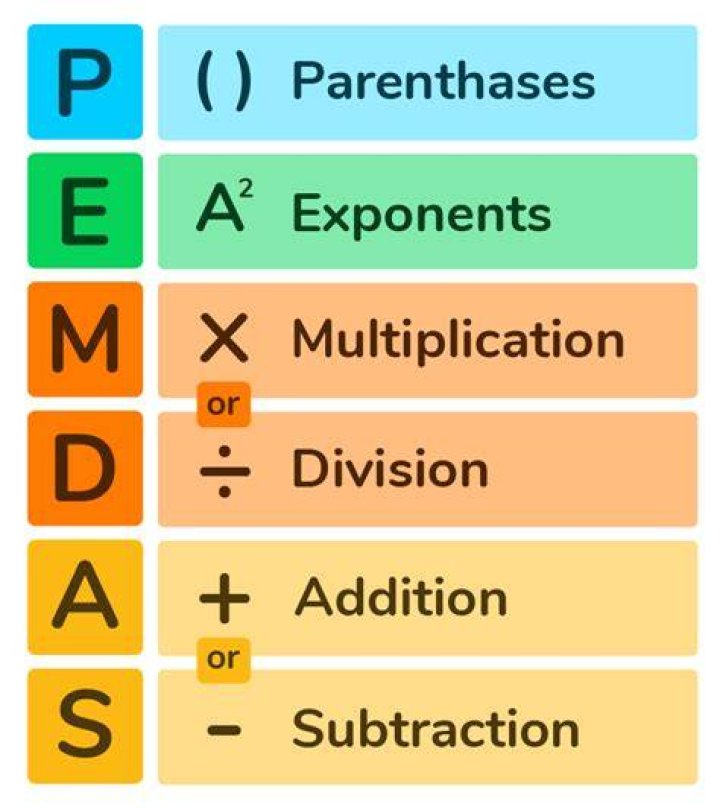
School systems across the English-speaking world teach mnemonic devices to help children memorize the order of operations. In North America, students learn PEMDAS (Parentheses, Exponents, Multiplication, Division, Addition, Subtraction). In the United Kingdom, India, and Australia, students learn BODMAS (Brackets, Orders, Division, Multiplication, Addition, Subtraction).
These acronyms introduce a misleading visual hierarchy. Many students leave school believing multiplication must always precede division under PEMDAS, or that division must precede multiplication under BODMAS. In formal arithmetic, multiplication and division share equal priority. Neither outranks the other.
To break a tie between operations of equal ranking, the standard convention instructs the user to calculate strictly from left to right. Under that standard modern convention, 8 ÷ 2 × 4 requires evaluating the division first. That produces 4 × 4, cementing 16 as the answer prescribed by modern elementary syllabi.
The Hidden Logic of Implied Multiplication
Why do millions of mathematically literate adults, including engineers and physics majors, instinctively arrive at 1? The answer lies in implied multiplication, also known as multiplication by juxtaposition.
In algebra, writing 2a conveys a different relationship than writing 2 × a. If an algebra problem presents 8 ÷ 2a where a equals 4, most working scientists intuitively read the entire term 2a as the denominator. They evaluate the expression as 8 divided by the product of 2 and 4, producing 1.
Historical style guides and physical science publications, including legacy guidance from the American Physical Society and older editions of the Royal Society of Chemistry guides, historically favored giving implied multiplication precedence over explicit division. When a number sits flush against an opening parenthesis without a multiplication symbol, human intuition treats it as a single cohesive unit.
| Calculation Method | Operational Step Sequence | Result | Primary Adoption Base |
|---|---|---|---|
| Modern Left-to-Right Convention | 8 ÷ 2 × 4 → 4 × 4 | 16 | Modern K, 12 schools, Google Search, Python, TI-84 Plus CE |
| Historical Juxtaposition Priority | 8 ÷ [2(4)] → 8 ÷ 8 | 1 | Older academic textbooks, legacy Casio fx models, physical sciences |
Why Pocket Calculators Disagree With Each Other
The confusion is not limited to human debaters; consumer hardware displays the exact same split. Computational engines must parse input strings using internal operator precedence algorithms, and those algorithms have shifted over time.
Texas Instruments made this exact architectural shift across product generations. On an older TI-82 or TI-83 running early firmware, typing 8/2(2+2) produces 1 because the device's internal parser gave implied multiplication higher priority than standard explicit multiplication and division. Beginning with the TI-83 Plus and continuing through modern TI-84 Plus CE models, engineers revised the logic: multiplication by juxtaposition now shares equal precedence with division, returning 16.
Casio calculators experienced similar divergence across product lines. Models such as the fx-991ES PLUS treat implied multiplication as a higher-priority binding operation, producing 1, whereas other software parsers default straight to left-to-right execution. When software engineers do not share a single universal grammar, computing engines provide conflicting outputs for identical text strings.
The Mathematician View: Poor Syntax, Not a Real Equation
Ask a professional research mathematician to solve 8÷2(2+2), and they will rarely take a side between 1 and 16. Instead, they will reject the premise of the problem entirely.
The expression suffers from deliberate typographical ambiguity. In practical research, academic papers, and applied engineering, mathematicians almost never use the obelus symbol (÷). The symbol is discarded after elementary arithmetic precisely because it creates confusion when paired with inline horizontal text.
Clear mathematical writing relies on a horizontal fraction bar (a vinculum). A writer intending for 16 to be the answer would format the problem as a distinct fraction: (8 / 2) × (2 + 2). A writer intending 1 would place the entire expression in the denominator: 8 / [2(2 + 2)]. The viral problem strips away clear visual grouping to manufacture an artificial debate.
Frequently Asked Questions (FAQ)
Q1: Is the correct answer 16 or 1?
Under strict modern conventions taught in secondary education, the answer is 16 because division and multiplication share equal priority and are evaluated left to right. However, historical publishing standards and older algebraic parsing traditions treat implied multiplication as binding, which produces 1. Because the expression lacks clear grouping symbols, both interpretations stem from recognized operational rules.
Q2: Why doesn't PEMDAS mean multiplication comes before division?
PEMDAS is an acronym, not a strict linear hierarchy. Multiplication and division exist on the exact same tier of operational precedence. When both appear in a single expression without explicit brackets dictating otherwise, they are resolved sequentially from left to right.
Q3: How do computer programming languages handle 8÷2(2+2)?
Most modern programming languages, including Python, C++, and JavaScript, do not allow implied multiplication at all. Typing 8 / 2(2 + 2) triggers a syntax error. A programmer must explicitly write 8 / 2 * (2 + 2), which strictly follows standard operator precedence from left to right and evaluates to 16.0.
What the Ongoing Debate Tells Us About Mathematical Communication
Mathematics is often described as an absolute language free of subjective interpretation. While mathematical truths are universal, the symbols humans invent to write them down are governed by social conventions and editorial style guides.
The viral debate over 8÷2(2+2) demonstrates what happens when an expression is engineered to bypass clear notation. It highlights the subtle gap between classroom mnemonics and practical applied math. In real-world software engineering, finance, and physics, leaving an equation open to competing interpretations can introduce critical computational bugs. The real lesson of this viral arithmetic riddle is simple: when writing an equation, precision matters, and a clear set of brackets is always better than ambiguous notation.


