Why Traditional Belly Rings Fail: The Secret Power of Floating Navel Jewelry

For decades, clients walked into studios asking for a classic belly button piercing, only to face two frustrating outcomes: flat-out rejection from a conscientious piercer or a painful, migrating scar after an unqualified artist forced the needle through. As body-modification coverage accelerated, captured early on when outlets like the Popsugar Report spotlighted the visually striking, gravity-defying look of floating navel projects, the piercing community reached an overdue reckoning. The issue was rarely bad aftercare or thin skin. The culprit was standard jewelry geometry colliding violently with human biology.
The standard curved barbell found on wholesale displays features a heavy 6mm to 8mm decorative bead seated at the bottom and a smaller 4mm ball resting on top. When someone with a folding stomach sits down, that heavy bottom sphere has nowhere to go. It is pushed upward, torquing the piercing channel and initiating a slow crawl toward rejection. Floating navel jewelry completely upends that mechanical failure.
📌 Key Takeaways:
- The Mechanical Culprit: Standard navel jewelry fails on folding stomachs because a large bottom gem acts as a lever when seated, forcing the channel outward.
- The Floating Alternative: Replacing the bottom sphere with a low-profile flat disc or a tiny bead shifts the decorative weight to the top, eliminating pressure inside the navel cavity.
- Long-Term Viability: Piercers report that matching custom anatomy piercing techniques with implant-grade metals cuts rejection rates significantly on complex anatomies.
The Mechanics of Collapsing Navel Anatomy and Rejection
Every torso bends, but not every navel maintains an open cavern while sitting. In roughly 40% to 50% of piercing clients, the navel forms a horizontal slit or "winks" shut when the hips flex forward. Piercing artists refer to this as collapsing navel anatomy. If an artist places a traditional curved barbell inside a collapsing belly button, the abdominal folds clamp directly onto the bottom sphere every time the client slouches, drives, or ties their shoes.
That pressure creates continuous mechanical leverage. Instead of resting motionless in the tissue, the jewelry tilts backward at the base and shoves the upper entry hole forward. Tissue responds to sustained localized force through pressure necrosis. Capillaries constrict, cells thin out, and the body treats the barbell as an invasive splinter to push outward. Belly piercing rejection is not an infection. It is an irreversible mechanical eviction that leaves behind a dense stripe of purple scar tissue.
Navel fold irritation begins long before the bar surfaces. Friction inside a compressed navel traps sweat, sebum, and lymph. The trapped moisture quickly softens the freshly healing channel, generating persistent hypertrophic bumps that many people mistake for permanent keloids. Without addressing the jewelry profile, no amount of saline soak resolves the swelling.
Engineering the Fix: Flat Disc Backings and the J-Curve Barbell
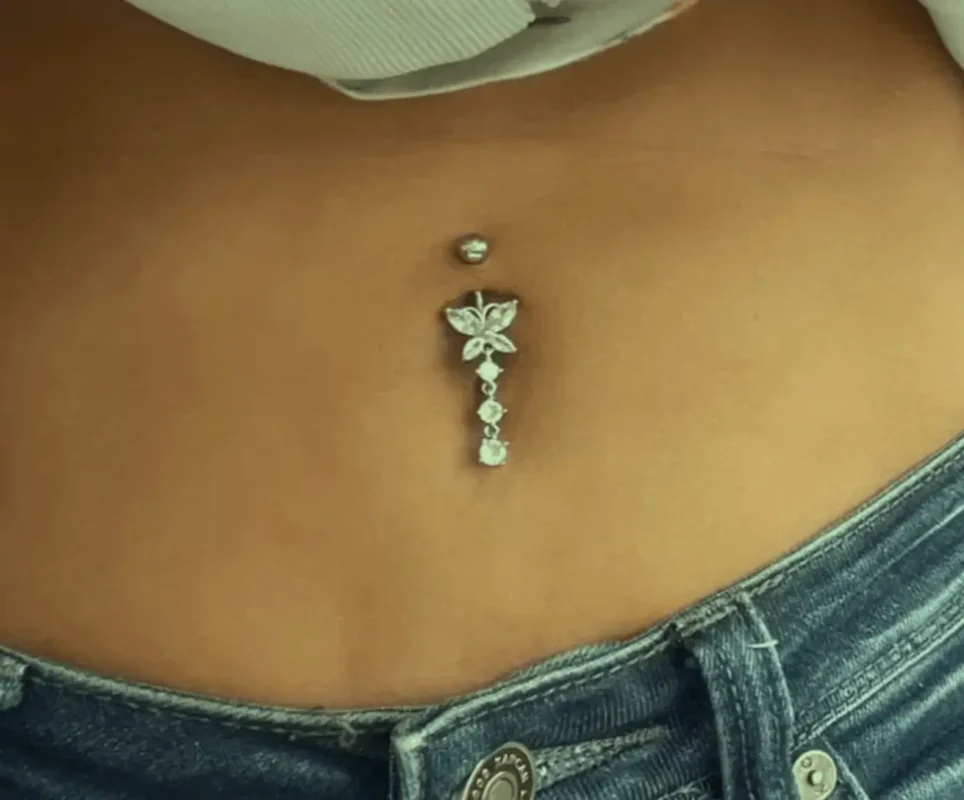
The innovation behind floating navel jewelry centers on redistributing mass. Rather than placing a bulky gemstone or claw-set crystal inside the interior pocket, the piercer installs a small flat disc backing or a diminutive 3mm plain ball. The visual centerpiece moves entirely to the upper rim, featuring elaborate clusters, pear-cut gems, or marquise fans that appear to hover cleanly above the crease.
Because the bottom component sits flush against the back or bottom wall of the cavity, the folding abdomen simply closes over it without dislodging the barbell. In deep navel healing situations where the tissue shelf is thick or angled unusually inward, piercers often employ a J-curve barbell. Shaped like a hockey stick or the letter J, this specialized post delivers an extended horizontal leg that seats the bottom flat disc firmly against the deep floor while curving gracefully up through the tissue exit.
Material selection remains just as critical as architectural shape. Piercers universally mandate an implant grade titanium curved barbell (conforming to ASTM F136 specifications) or biocompatible solid 14k/18k gold. Titanium eliminates the risk of nickel sensitization, weighs roughly half as much as surgical steel, and accommodates mirror-like hand polishes that prevent micro-abrasions along delicate fistula walls.
Traditional Curved Barbell vs Floating Navel: A Structural Comparison
Understanding which setup protects tissue health requires a direct comparison of physical dimensions, load points, and anatomical demands.
| Hardware Feature | Traditional Curved Barbell | Floating Navel Setup |
|---|---|---|
| Bottom End Profile | Large 6mm, 8mm gem or sphere | Flat 3mm, 4mm disc or 2.5mm plain bead |
| Primary Decorative Point | Inside the navel depression | Above the superior skin ridge |
| Mechanical Torque on Seated Fold | High; bottom gem levers channel outward | Negligible; folds safely flat |
| Ideal Anatomical Match | Open, deep cups that stay round when seated | Collapsing creases, shallow floors, flat planes |
| Standard Healing Timeline | 6, 12 months (frequent flare-ups) | 6, 9 months (stable track) |
| Average Studio Cost Range | $60, $120 (basic titanium) | $90, $220 (custom threading/clusters) |
Piercing Bump Prevention and Deep Navel Healing Protocols
Healing any navel piercing demands patience. Tissue in the lower abdominal wall is poorly vascularized compared to lip or earlobe tissue, making oxygen delivery slow and wound stabilization tenuous. When dealing with deep navel healing, managing the immediate micro-environment determines whether the fistula stabilizes or triggers an angry piercing bump.
Piercing bump prevention relies entirely on stopping movement and banishing excess moisture. Clients should spray the area twice daily with a sterile 0.9% sodium chloride saline solution and gently dry the edges using a disposable lint-free paper towel or the cold setting on a hair dryer. Navel pockets naturally accumulate sweat. Leaving saline or shower water pooling inside a collapsing crease will quickly soften the healing fistula, causing moisture bumps to erupt around the bottom disc.
Downsizing is the next mandatory milestone. Initial piercings are fitted with a longer post, typically 7/16-inch or 1/2-inch, to compensate for post-procedure inflammatory swelling. Once the initial tissue thickens and settles around week 6 to 8, clients must return to their studio to swap the post for a snug 5/16-inch or 3/8-inch barbell. Wearing an excessively long bar past the two-month mark invites snagging on high-waisted denim and reintroduces the very torque the floating design was created to avoid.
Custom Anatomy Piercing: Assessing Your Navel at Rest and Seated
Piercing is not a one-size-fits-all procedure. An ethical practitioner performs a rigorous assessment before touching a sterile pen or needle. Evaluating suitability requires observing the navel in two distinct positions: standing fully upright and sitting relaxed with shoulders slumped forward.
During the seated evaluation, the piercer checks for several distinct physical markers:
The Fold Check: Does the upper lip of the navel sink into the bottom floor, creating a tight horizontal line? If yes, traditional jewelry will fail within months, and a floating navel setup is mandatory.
The Shelf Depth: Does the superior rim have a distinct, defined flap of tissue for the needle to pass under? A true navel piercing must enter the cavity beneath the ridge and exit directly through the surface above. If the abdomen is completely flat without a distinct ridge, the modification is categorized as a surface piercing. Surface belly piercings carry rejection rates exceeding 70%, regardless of the jewelry chosen.
Clients who are told they lack the anatomy for a traditional piercing do not always have to give up on body art. A professional experienced in custom anatomy piercing can often find an alternative path forward. However, if a piercer determines that there is no structural shelf to support even a floating disc, the safest choice is to accept the verdict rather than risk permanent scarring.
Frequently Asked Questions (FAQ)
Q1: Can I switch to a traditional curved barbell once my floating navel heals?
A1: Rarely. If your navel collapses when sitting, that anatomical reality does not change once the channel heals. Inserting a heavy bottom gem months or years later will simply revive irritation, promote angle migration, or cause the channel to reject entirely.
Q2: Does getting a floating navel piercing hurt more than a standard belly piercing?
A2: The pain level is identical. The piercing needle passes through the exact same ridge of tissue on the upper rim of the belly button. The only functional difference is the jewelry style installed immediately after the needle is withdrawn.
Q3: Why is floating navel jewelry usually more expensive than basic belly rings?
A3: Traditional belly rings are mass-produced with generic glued gems and cast metals. Floating setups require threadless or internally threaded components made from verified ASTM F136 titanium or solid gold, featuring specialized flat discs, J-curves, and high-end decorative clusters designed specifically for anatomical fit.
Navigating Navel Modifications in 2026
The standard piercing catalog is giving way to biologically informed customization. Rejection is no longer seen as bad luck or poor aftercare; it is recognized as a design mismatch between standard factory jewelry and dynamic human anatomy. Piercers who understand structural movement look past mass-produced stock in favor of tailored hardware.
Floating navel jewelry resolves an anatomical dilemma that frustrated clients and artists for years. By removing mass from the cavity and anchoring decorative elements where they can rest undisturbed, this setup turns an anatomy-based rejection into a safe, sustainable piercing. If your navel folds when you sit down, seek out an experienced, certified piercer who understands how to work with your body's natural movement.


