Ahead of Its Time: Visual Evidence Proving Why Mad Max Still Outshines Modern Open-World Releases

September 1, 2015, was a brutal day to launch an ambitious sandbox title. Warner Bros. Interactive shipped Avalanche Studios' Mad Max on the exact day Konami unleashed Metal Gear Solid V: The Phantom Pain. Buried under Kojima's hype cycle, Max Rockatansky's journey through the Great White was dismissed by early reviewers as a repetitive map-clearing exercise. Yet over a decade later, the title commands a massive cult following, routinely outperforming contemporary open-world releases on visual weight, atmospheric intensity, and kinetic satisfaction.
Recent industry rankings reflect this staying power. As highlighted in a Loot and Grind Report spotlighting gaming's most visceral combat experiences, players consistently return to Avalanche's wasteland because modern open worlds have softened their edges. While modern engines lean on procedural generation and ray-traced reflections, few games replicate the pure, tactile violence of rust, nitro, and tearing sheet metal that Avalanche perfected a decade ago.
📌 Key Takeaways:
- The Visual Benchmark: Avalanche Studios' custom particle systems and dynamic sandstorms deliver a level of atmospheric dread that modern Unreal Engine 5 sandboxes struggle to match.
- Mechanical Friction: Wasteland survival physics prioritize vehicle weight, tire traction, and mechanical inertia over arcade handling, making every car collision feel dangerous.
- The Modern Contrast: Where contemporary open worlds dilute danger with endless fast travel and inconsequential clutter, the 2015 title treats resource scarcity and vehicular combat mechanics as urgent survival tools.
The 2015 Shadow Launch and the Fury Road Crossfire
The launch timing was disastrous, but the creative climate was white-hot. George Miller's Mad Max: Fury Road had dominated global theaters four months prior, resetting pop-culture expectations for post-apocalyptic visual spectacle. Warner Bros. Interactive greenlit Avalanche Studios to build a separate narrative universe rather than a direct movie tie-in. The studio cast Max as a broken drifter hunting warlord Scabrous Scrotus, a monstrous son of Immortan Joe, after Scrotus steals Max's iconic Interceptor.
Avalanche refused to make a lightweight movie clone. Instead, they adapted their proprietary Apex Engine, previously used for the chaotic destruction of the Just Cause series, to simulate dry air, heat distortion, and metal stress. Critics in 2015 fixated on the traditional open-world checklist of balloon outposts and scrap scavenging. They missed the core achievement: Avalanche had captured the authentic Fury Road aesthetic not through cinematic cutscenes, but through dynamic, systemic car combat gameplay.
Volumetric Fury: Why Sandstorms Outshine Modern Climate Engines
Weather in modern open-world titles is often an aesthetic filter. Rain falls, roads turn glossy, and lighting shifts tone, but the actual gameplay footprint remains unchanged. In Mad Max, the open-world sandstorm effects represent an existential threat that fundamentally changes survival conditions.
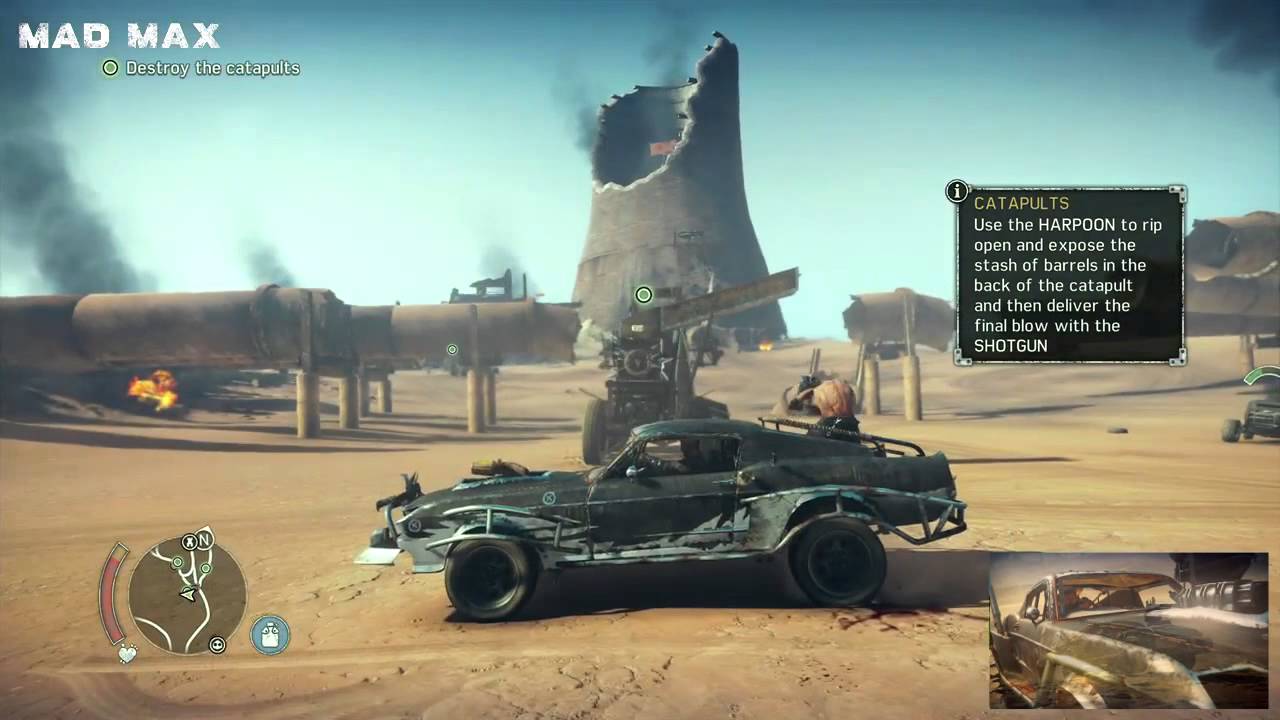
When a storm siren rolls across the wasteland, the horizon simply ceases to exist. Avalanche built their storms using volumetric particle densities that cast real-time shadows, stripping away draw distance down to three feet. Flying scrap crates tear across the flats at 90 miles per hour, capable of shearing off armor plates or crushing Max instantly outside his ride. Lightning arcs through red clouds, ionizing the dust and igniting spilled fuel. Survival demands immediate tactical triage: shelter behind a collapsed rock shelf, track salvage crates through the blinding grit with a harpoon, or risk losing everything to the wind.
Weight, Steel, and Torque: Wasteland Survival Physics
Every vehicle handles like a four-thousand-pound collection of salvage held together by coarse welds. Avalanche rejected the featherweight, sticky physics common to open-world urban driving. In this game, driving on deep sand produces tangible drag; climbing a steep ridge demands low-gear torque, and slamming into a war rig transfers real recoil back into your chassis.
At the center of this physical simulation is the Magnum Opus customization loop. Starting from a rusted frame found in a cave, you construct your dream war wagon alongside Chumbucket, a hunchbacked blackfinger mechanic who rides on the rear deck. Every modification carries an explicit mechanical penalty:
- Heavy Ramming Grills: Devastating against enemy engines, but they crush your front suspension and make cornering sluggish.
- Reinforced Armor Plating: Absorbs sniper rounds and shotgun blasts, but adds immense mass that reduces top acceleration.
- V6 to V8 Engine Swaps: Delivers raw speed across open flatbeds, but increases wheel spin and burnouts on loose shale.
- Rear-Mounted Harpoons: Operated manually by Chumbucket, ripping off enemy wheels, doors, and exposed fuel tanks in full motion.
This design creates an ongoing engineering trade-off. Build a light, agile interceptor, and Scrotus's armored convoys will grind you into dust. Build an iron fortress, and fast-moving raider buggies will out-maneuver your firing arcs.
Systemic Comparison: 2015 Benchmark vs Modern Sandboxes
Looking at modern releases from 2023 through 2026 reveals a strange regression. While polygon counts and texture resolutions have spiked, the physical responsiveness of driving and environmental hostility has largely stalled. The following technical breakdown demonstrates where Avalanche's 2015 systems pull ahead.
| Gameplay Dimension | Mad Max (2015 / Apex Engine) | Standard Modern Sandboxes (2023, 2026) |
|---|---|---|
| Weather System | Volumetric sandstorms with physical flying debris, lighting ionization, and terminal vehicle damage. | Screen-space shader overlays, reduced visibility cones, minimal physical danger to player. |
| Vehicle Destruction | Component-level stripping: tires, doors, bumpers, and drivers yanked via harpoon in motion. | Universal health bars, scripted panel detachment, uniform explosion animations. |
| Driving Inertia | Dynamic suspension compression, center-of-gravity shifts based on installed armor tiers. | Arcade-style rail cornering, auto-correcting traction, negligible mass divergence. |
| Resource Integration | Canteen water refills health; gasoline fuels both vehicles and offensive flame throwers. | Regenerating health bars; unlimited fuel tanks with purely decorative economy loops. |
Bone-Cracking Violence: The Brutal Melee Combat System
When Max exits the Magnum Opus, the game pivots into bare-knuckle violence. Avalanche took the rhythmic counter-mechanics established by Rocksteady's Batman: Arkham series and stripped away the superhuman elegance. Max is not a ninja. He is a starving, desperate brawler who throws wildly off-balance haymakers, snaps limbs over his knee, and drives shivs into throats.
The sound design turns every punch into an impact event. Combat encounters inside Scrotus's camps force you to manage space against War Boys hopped up on chrome spray and paint fumes. Parrying an overhead axe attack leads to visceral dismemberments or Max disarming an attacker and driving his own weapon back into his ribs. When the "Fury" meter fills, Max's strikes speed up, landing with audible concussive shockwaves that send enemies flying into corrugated iron walls. It is ugly, exhausting, and completely synchronized with the cruel tone of the wasteland.
Desolate Realism: Post-Apocalyptic World Design
Most developers panic when faced with empty space. They fill maps with radiant markers, roadside comedy routines, and collectibles every fifty feet to prevent boredom. Avalanche understood that the wasteland derives its narrative power from dead emptiness.
The map is divided into regions that tell silent histories of global collapse. The Great White is an evaporated seabed. Max drives through towering coral formations bleached white by the sun, weaves between sunken oil tankers balanced on sandstone ridges, and clears camps built inside rusted shipping containers. There is no artificial whimsy. The water in your canteen is scarce, maggots plucked from rotting corpses serve as essential food, and fuel requires deliberate management. The presence of Chumbucket, acting as Max's mechanical priest and engine-worshipping companion, supplies the world's twisted spiritual core without breaking the game's grim immersion.
Frequently Asked Questions (FAQ)
Q1: Is the 2015 Mad Max game directly connected to the Fury Road movie?
A1: No, the game features an original standalone story. However, it takes place within the broad continuity established by George Miller's universe, using character designs, factions, and environmental language that mirror Fury Road, including appearances by Scabrous Scrotus, one of Immortan Joe's sons.
Q2: How does the game run on modern PC hardware and current-gen consoles?
A2: Outstandingly well. Thanks to Avalanche Studios' engine optimization, the PC version easily hits high framerates at 4K resolution on modern hardware without requiring upscaling tech like DLSS. On modern consoles (PlayStation 5 and Xbox Series X/S), the game runs at stable frame rates via backward compatibility, benefiting from Xbox's FPS Boost feature.
Q3: Is the game too repetitive by modern open-world standards?
A3: While clearing minefields and scrap camps follows standard mid-2010s map design formulas, the deep satisfaction of the vehicular combat mechanics and the dynamic nature of high-speed convoy battles keep the action compelling throughout its 30-to-40-hour campaign.
The Lasting Blueprint for Open-World Action
Avalanche Studios produced an open-world design that aged gracefully because it prioritized physical consequence over cosmetic visual layers. Modern development teams routinely produce massive maps, yet their vehicles drive like plastic toys across frictionless asphalt. Weather events arrive as harmless skybox swaps. Combat encounters feel like calculated hit-point exchanges rather than life-or-death struggles for drinking water.
By rooting Max's journey in the heavy weight of the Magnum Opus and the terror of zero-visibility sandstorms, Avalanche built an experience that feels sharper today than it did in 2015. It remains an essential masterclass in vehicular combat, environmental hostility, and pure kinetic world design.


