As Clocks Spring Forward, Here Is the Real Meaning of AM and PM Explained
What AM and PM Actually Mean: The Astronomy, History, and Clock Shift Confusion Behind 12-Hour Time
Twice a year, millions of electronic devices quietly reset themselves while people sleep, rekindling a bitter public debate over temporal architecture. As autumn arrives and regional coverage from outlets like the detroitnews.com Report tracks when clocks fall back across the country, household schedules collide with the quirks of the 12-hour clock system. Commuters check their dashboards, shift workers recalculate payroll hours, and travelers scramble to adjust their itineraries as standard time returns.
Yet few people stopping to squint at a flashing oven display understand the astronomical mechanics governing those two small letters: AM and PM. Rooted in ancient solar geometry and preserved through centuries of mechanical tradition, the 12-hour convention remains a daily utility that creates regular administrative confusion.
📌 Key Takeaways:
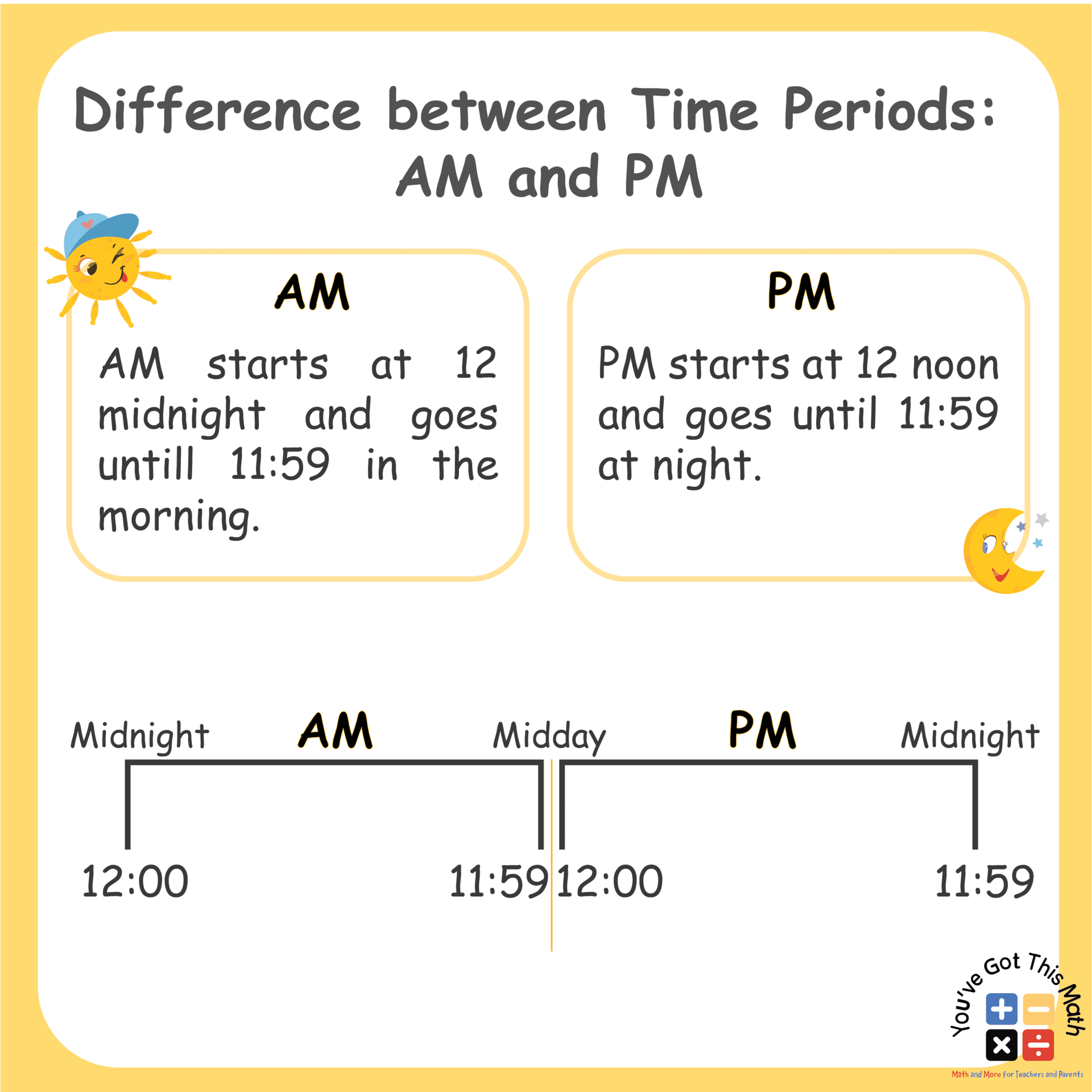
- Core Definition: AM stands for ante meridiem (Latin for "before midday") and PM stands for post meridiem ("after midday"), both referencing the celestial meridian line.
- Historical Origin: The 12-hour division originated with ancient Egyptian base-12 counting systems and Roman sundials, long before the invention of mechanical gear trains.
- The Modern Ambiguity: Technically, noon and midnight are neither AM nor PM; standards bodies designate 12:00 PM as noon and 12:00 AM as midnight solely to prevent legal and computational errors.
The Latin Roots of Ante Meridiem and Post Meridiem
The abbreviations AM and PM trace directly to classical Latin astronomical terminology. AM represents ante meridiem, translating to "before noon" or "before midday." PM stands for post meridiem, meaning "after noon."
The operative Latin word is meridies, which combines medius (middle) and dies (day). In astronomy, this refers to the local meridian line: an imaginary great circle projected across the sky from true north to true south, passing directly overhead through the observer's zenith. When the sun crosses this celestial meridian at its highest daily elevation, an observer experiences true solar noon.
Any instant before the sun touches that overhead arc falls under the label ante meridiem. The second the sun slips past that invisible axis, the day enters post meridiem. The system is essentially an ancient solar tracking formula preserved in modern digital code.
Why Seasonal Clock Shifts Highlight Modern Scheduling Headaches
The persistent friction of AM and PM surfaces most visibly during seasonal transitions. In late autumn, public attention pivots toward standard time adjustments. Recent regional reports from the Cincinnati Enquirer and the Knoxville News Sentinel highlight persistent voter and consumer fatigue as states re-evaluate whether jumping between daylight saving time and standard time still serves a modern economy. When clocks fall back by one hour at 2:00 AM, the local timeline repeats the 1:00 AM, 1:59 AM hour twice in a single night.
For automated flight manifests, freight logistics, and hospital charts, this repetition creates serious data integrity hazards. A patient administered medicine at "1:30 AM" during a fall-back shift could have received the dose at two entirely distinct chronological moments separated by sixty minutes. When digital platforms log time using simple 12-hour tags without unambiguous time zone designators or UTC offsets, database records frequently corrupt.
The shift also brings stark daylight changes. Coverage from the FL Times-Union notes how early sunrises and sudden late-afternoon darkness immediately alter consumer behavior and municipal energy consumption. The disorientation experienced during these clock changes lays bare how artificial our split daylight markers actually are.
From Ancient Sunshadows to Mechanical Bells: The 12-Hour Origin
The division of daylight into 12 units dates back to ancient Egypt, roughly 1500 BCE. Ancient civilizations used duodecimal counting systems based on the three finger joints of four fingers on one hand, excluding the thumb. This counting system favored 12 over 10 because it divided cleanly into halves, thirds, and quarters.
Egyptian astronomers monitored the passage of 12 distinct stars across the night sky, known as decans, effectively segmenting nighttime into 12 parts. During the day, primitive shadow clocks marked 10 core hours of sunlight alongside two twilight periods, creating a symmetrical 12-hour daylight block. However, these seasonal hours varied in length: summer daylight hours were long, while winter hours shrank.
The shift to fixed, equal-length hours occurred centuries later with the spread of European mechanical clocks in the 14th century. Early public church clocks lacked minute hands or illuminated dials; they relied on large cast-iron bells that struck every hour to regulate agricultural workers and monastic prayers. Ringing a church bell 24 consecutive times at midnight would wake whole villages and wear down mechanical strike trains. Dividing the day into two 12-stroke sequences solved the acoustic and mechanical constraints of the era, locking the Western world into an AM/PM paradigm.
The 12:00 Paradox: Resolving the Noon and Midnight Impasse
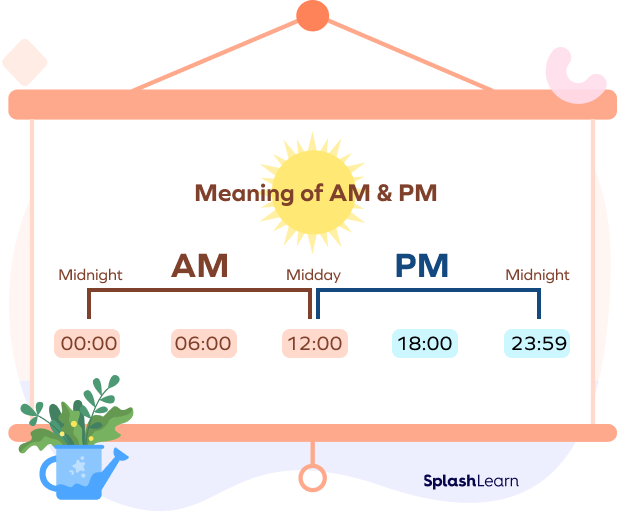
The most persistent point of confusion in the 12-hour system occurs at the precise middle and boundaries of the day: 12:00. Strictly speaking, neither 12:00 noon nor 12:00 midnight can be labeled AM or PM.
At exact solar noon, the sun sits directly on the meridian line. It is neither before the meridian (ante) nor past it (post). The moment is purely meridiem. Similarly, midnight sits precisely twelve hours removed from the midday meridian, acting as the neutral boundary separating one calendar day from the next.
Because everyday software requires binary classification, international organizations had to impose pragmatic standards:
- The National Institute of Standards and Technology (NIST) maintains that using "12:00 AM" or "12:00 PM" creates inherent ambiguity. NIST recommends that formal contracts, transportation rosters, and legal documents explicitly write out 12:00 Noon or 12:00 Midnight.
- The U.S. Government Publishing Office (GPO) Style Manual specifies that 12:00 PM designates noon and 12:00 AM designates midnight.
- In legal underwriting, insurance policies and binding contracts frequently bypass "12:00 AM" altogether by writing "11:59 PM" or "12:01 AM" to eliminate any doubt about which date the contract takes effect.
12-Hour vs. 24-Hour Time Conversion and Everyday Ambiguity
Global logistics, military command structures, and industrial operations avoid the pitfalls of AM and PM entirely by adopting the 24-hour time standard. Below is an operational breakdown detailing conversions across critical checkpoints and highlighting common failure points in consumer systems.
| 12-Hour Notation | 24-Hour Notation | Astronomical Reference | Primary Operational Risk |
|---|---|---|---|
| 12:00 AM (Midnight) | 00:00 (or 24:00) | Nadir / Solar Midnight | Date assignment errors on travel tickets |
| 6:00 AM | 06:00 | Morning / Ante Meridiem | Minimal; daylight visual confirmation |
| 11:59 AM | 11:59 | Terminal Ante Meridiem | Last unambiguous daytime morning tag |
| 12:00 PM (Noon) | 12:00 | Zenith / Solar Noon | Misinterpreted as midnight by end-users |
| 1:00 PM | 13:00 | Early Post Meridiem | Accidental setting of phone alarms for AM |
| 11:59 PM | 23:59 | Terminal Post Meridiem | Deadline ambiguities in assignment submissions |
Digital Formatting Protocols and Global Architecture
The English-speaking world remains one of the few zones where the 12-hour system dominates daily life. The United States, Canada (excluding Quebec), Australia, and the United Kingdom continue to print rail timetables and broadcast listings in 12-hour format, even as continental Europe, Latin America, and East Asia run almost universally on 24-hour notation.
International standard ISO 8601 was established to eliminate these regional differences. Under ISO 8601, time follows a strict hierarchy from largest to smallest unit: YYYY-MM-DDThh:mm:ss. A scheduled delivery set for 8:30 PM on November 15 writes out as 20:30:00. This structure removes human error from relational databases, server logs, and aviation software.
In high-stakes environments like hospital intensive care units, nursing handoffs rely exclusively on 24-hour logs. A medication charted for "7:00" without an explicit AM or PM notation can prove fatal; entering 07:00 versus 19:00 leaves no room for interpretation.
Frequently Asked Questions (FAQ)
Q1: Does 12:00 AM belong to the day that just ended or the day just beginning?
A1: In digital clock systems and civil standards, 12:00 AM marks the initial second of a new day. For instance, 12:00 AM on Friday occurs the precise moment Thursday night ends. To avoid missed flights or missed deadlines, specify "11:59 PM Thursday" or "12:01 AM Friday."
Q2: Why are AM and PM capitalized differently across different publications?
A2: Formatting comes down to competing editorial style guides. The Associated Press (AP) mandates lowercase letters with periods (a.m. and p.m.). The Chicago Manual of Style accepts small capitals (AM and PM) or lowercase periods. Technical standards generally use capital letters without periods (AM and PM) for clear legibility on digital displays.
Q3: Why doesn't the United States switch completely to the 24-hour clock?
A3: Resistance is cultural rather than technical. Analog clocks and wristwatches are physically built around a 12-hour circular face. Because children learn to read time on 12-step dials, changing public infrastructure, broadcast nomenclature, and consumer habits would require massive effort for an everyday convention that people already manage instinctively.
The Enduring Geometry of Divided Days
Civilization has developed far more sophisticated measures of time than the shadows cast across an Egyptian sundial. Atomic clocks managed by NIST calculate time using the steady vibration of cesium-133 atoms, measuring seconds down to billionths of a tick. Our communication systems synchronize continuously against global satellite grids.
Yet our daily language remains tied to the arc of the sun. As long as our alarm clocks ring before breakfast and our calendars schedule evening dinners, the Latin markers ante meridiem and post meridiem will continue to divide the day. They serve as an enduring reminder that even in an automated world, our concept of time began with looking up at the sky to see where the sun stood over the horizon.


