Beginner's Guide to 'Let Us LARP': Rules, Immersion Etiquette, and How to Find Your First Game
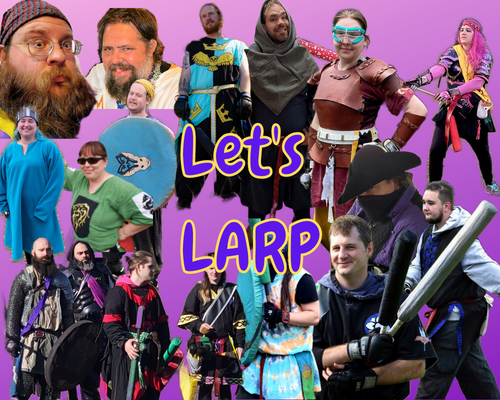
Every weekend, thousands of adults abandon their monitors, strap on closed-cell foam armor, and step into rain-soaked clearings to swing padded swords or negotiate high-stakes political treaties. What once lived strictly in niche hobbyist basements has expanded into an international movement spanning high-contact boffer battlegames, weekend-long post-apocalyptic survival simulations, and deeply psychological Nordic blackbox theaters. As documented in a personal exploration from a Scientific American Report, stepping into an embodied persona often unlocks dormant emotional resilience, agency, and social confidence that passive media simply cannot replicate.
The transition from casual interest to your first live event can still feel daunting. You are confronted with distinct rulebooks, arcane safety jargon, costume minimums, and strict codes of physical conduct. Entering the hobby successfully does not require an investment of thousands of dollars or decades of fencing training. It requires an operational understanding of how roleplay translates into real-world physical space, how communities protect bodily safety, and how to pick the specific game format that matches your goals.
📌 Key Takeaways:
- Format Diversity: Live action role-playing splits across distinct sub-genres, from high-impact sports like Amtgard to emotionally focused Nordic LARP experiences.
- Safety Primacy: Universal calls such as "Hold" supersede all narrative immersion instantly to prevent physical injury.
- Entry Costs: Basic thrifted garb and loaner gear allow beginners to start for under $50, while specialized campaigns can scale past $500 for historical kit.
From Dice Rolls to Physical Footwork: The Tabletop to LARP Transition
Sitting around a table rolling twenty-sided dice provides an emotional buffer. Your character sheet acts as an intermediary; if an orc swings a greataxe, you calculate armor class and subtract hit points. In live action role-playing, that distance collapses. When an opponent lunges with a foam-padded blade, your actual physical reaction time, stance, and spatial awareness determine the outcome.
This tabletop to LARP transition requires adjusting two major assumptions. First, social charisma is no longer an abstracted stat on paper. You must speak the words, hold eye contact, and pitch your voice across an active campsite. Second, physical endurance matters. Trudging through dense brush in wool cloaks for 14 consecutive hours taxes the body in ways no tabletop campaign ever will. Beginning players thrive by managing their expectations: build characters who match your physical baseline rather than trying to perform acrobatic combat feats on day one.
Deciphering Boffer Combat Rules and Calibration
Combat-focused games rely on boffer weaponry, fiberglass or carbon fiber cores wrapped in marine-grade foam and covered in ripstop cloth or specialized plastidip. Rules systems calibrate force differently, dividing the hobby into two clear philosophies.
Battlegames like Belegarth or Dagorhir use full-force combat. Fighters strike with maximum athletic power, and hits are binary: a solid strike to a limb disables that limb, while a torso hit eliminates the combatant. By contrast, narrative campaigns like Nero or Dystopia Rising enforce light-touch mechanics. In light-touch systems, weapons need only graze the opponent with minimal kinetic impact, accompanied by verbal damage calls like "Three Normal" or "Pierce."
Head strikes, neck strikes, and groin shots are almost universally prohibited across all Western rulebooks. Shield kicks, grappling, and charging depend strictly on local organizational waivers. Before swinging any weapon, every participant must pass a mandatory weapon safety check conducted by game marshals, who inspect foam density, core breakdown, and tip flexibility.
The Four Major Styles of Modern Play
Selecting the wrong game format accounts for the majority of first-timer attrition. A player seeking deep collaborative drama will feel alienated in a competitive parking-lot sparring guild, while an athlete looking for full-contact medieval combat will quickly tire of a parlor vampire game focused on whispering in drawing rooms.
| LARP Style | Combat System | Typical Kit Budget | Primary Focus |
|---|---|---|---|
| Battlegame (Amtgard, Belegarth) | Full-contact or high-speed boffer | $40, $120 | Martial skill, tournament rankings, team tactics |
| Chronicle/Campaign (Dystopia Rising) | Light-touch combat with callouts | $150, $350 | Continuous economic survival, community progression |
| Theater/Parlor (World of Darkness) | Stat cards, rock-paper-scissors | $50, $200 | Political negotiation, intrigue, secret agendas |
| Nordic LARP | Narrative agreement / slow-motion consent | $200, $600+ | Deep emotional immersion, transformative narrative |
Battlegames run primarily in public parks on weekends without fees. Weekend-long camp-out campaigns charge registration tickets running between $60 and $160 per event to cover site rentals, camp insurance, and prop logistics. Nordic LARP mechanics dispense with conventional leveling systems entirely, focusing on collaborative storytelling workshops and post-game debriefs designed around singular, curated artistic experiences.
Safety Calls, Psychological Bleed, and Boundary Systems
Immersion breaks down quickly if players feel unsafe. The hobby relies on non-negotiable safety calls and boundaries that override the ongoing fiction instantly. The most critical word across all English-speaking systems is "Hold."
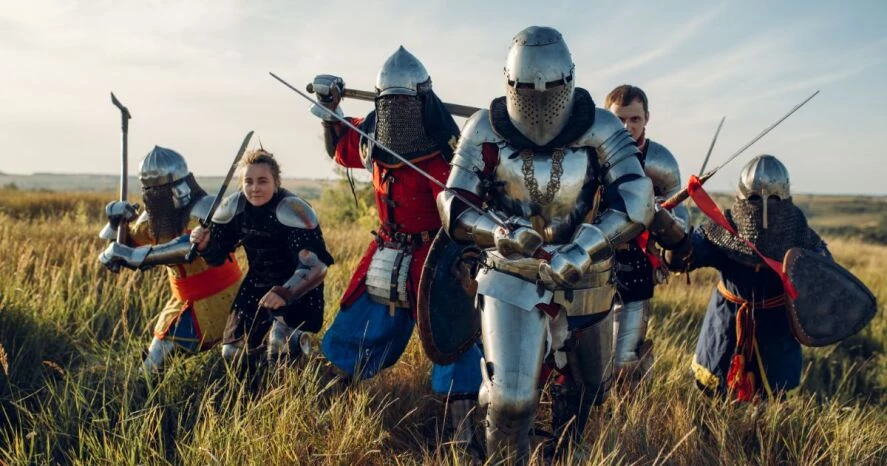
When any participant shouts "Hold!", whether due to a twisted ankle, a broken weapon core, or a non-player pedestrian wandering onto the field, every single person must freeze in place, drop their weapon tips to the earth, and echo the call. Narrative play halts entirely until marshals resolve the physical hazard. Other modern safety systems include the traffic-light mechanic: saying "Red" terminates an interaction, "Yellow" asks a player to dial down intensity without breaking scene, and "Green" consents to escalations in dramatic pressure.
Equally critical is managing psychological bleed in roleplay. Bleed occurs when the emotions of your fictional character slip into your actual psyche, or vice versa. Feeling genuine grief over a dead fictional ally or taking an in-game political betrayal personally are standard examples of bleed. Veteran organizers mandate post-game decompression circles, providing structured debriefs where participants strip off their costuming and state their real names out loud to re-establish healthy boundaries.
Costume and Garb Guidelines: Building Kit on a Budget
Costume requirements intimidate beginners more than any set of rule mechanics. Many fear they need bespoke chainmail or screen-accurate leather doublets before showing up. In reality, most games operate on a basic "no modern logos, no blue jeans" rule for newcomers.
Start from the ground up, prioritizing your feet. Hiking boots or leather work shoes in neutral tones are universally accepted because safety on slick terrain always trumps historical authenticity. From there, assemble natural-fiber base layers: linen or cotton tunics, drop-crotch canvas trousers, and leather belts. Thrift stores are prime hunting grounds for simple wool sweaters, plain scarves, and oversized trench coats easily modified with scissors and fabric dye.
Garb serves a functional game purpose: it signals your character’s faction, wealth, and station to others across a crowded field. Add distinctive accessories, a battered leather pouch, a talismanic necklace, or weathered bracers, to give other participants easy visual hooks to strike up conversation without asking out-of-character questions.
Finding Local Groups and Mastering Out-of-Character Rules
The simplest pathway to entering the scene is searching regional directories or community platforms. Organizations like Amtgard, the Darkon Crown Lands, and the Society for Creative Anachronism (SCA) maintain active park finders. Regional Discord servers and Facebook groups announce open-invite workshops and training sessions weekly.
When attending your initial gathering, master the basic out of character rules immediately. Signify that you are temporarily non-present in the game world by placing a hand or weapon flat atop your head, or wearing an orange headband. Never linger in active game areas while chatting about real-world sports, careers, or politics; doing so breaks the hard-earned immersion of the players around you. Instead, locate designated "OOC" (out-of-character) camp zones to rest, hydrate, and ask marshals technical questions about game rules.
Frequently Asked Questions (FAQ)
Q1: Do I need to buy weapons and armor before my first game?
A1: No. Almost all established clubs keep a "weapons cache" of loaner gear specifically set aside for beginners. Contact organizers a few days ahead of your arrival so marshals can inspect and allocate loaner swords, shields, or tabards for your run.
Q2: What happens if I am not athletic or have physical limitations?
A2: Modern games offer dozens of non-combat pathways. Crafting systems, economic trading, intelligence gathering, alchemy, and diplomatic roles drive storylines just as heavily as frontline combatants, allowing players of all physical abilities to participate meaningfully.
Q3: Is LARPing dangerous?
A3: When rules are enforced, injury rates are comparable to low-impact recreational soccer or flag football. Sprained ankles and minor bruises are the most common issues, prevented largely through proper footwear, mandatory weapon inspections, and strict adherence to strike-zone restrictions.
Stepping Onto the Field in 2026
Live-action roleplaying has evolved into a sophisticated, multi-tiered medium for physical play, social exploration, and complex collaborative storytelling. The mechanics exist not to gatekeep players, but to establish a shared canvas where everyone feels physically secure and emotionally permitted to experiment with unfamiliar facets of themselves.
Pack a pair of sturdy boots, carry plenty of drinking water, and reach out to a local chapter marshal before this weekend. Once the horn blows and the first line of shields locks together in the field, the theoretical hesitation falls away, leaving only the immediate, shared reality of the game.


