Deus Misereatur Nostri: The 400-Year-Old Sacred Masterpiece Dominating Concert Halls
Deus Misereatur Nostri: The 400-Year Sacred Masterpiece Captivating Modern Audiences
Concert halls across London, New York, and Utrecht have spent recent seasons witnessing an unexpected musical phenomenon: secular audiences packing auditoriums to hear seventeenth-century sacred psalm settings. At the center of this movement sits Deus misereatur nostri, the Latin setting of Psalm 67. Its layered counterpoint and sweeping plea for universal blessing have traversed four centuries intact. As documented in a WQXR Report covering The Psalms Experience, thematic presentations of historic psalm cycles have moved decisively past insular academic circles, attracting listeners drawn to acoustic purity and dense polyphonic drama.
📌 Key Takeaways:
- Living Choral Heritage: Psalm 67 has transitioned from early monastic recitation to a cornerstone of international choral concert repertoire.
- Landmark Notation: The 400th anniversary of Samuel Scheidt’s 1624 Tabulatura Nova spotlights the historical shift in organ tablature and Baroque polyphony that redefined Latin psalm settings.
- Liturgical Adaptability: Adopted as an evening canticle within the Book of Common Prayer, the text bridges Renaissance motet traditions and modern secular performance.
The Architecture of Psalm 67 from Liturgy to Concert Stage
The text of Psalm 67 opens with a direct invocation: "Deus misereatur nostri, et benedicat nobis" ("God be merciful unto us, and bless us, and cause his face to shine upon us"). Unlike the penitential self-reproach found in the Miserere mei of Psalm 51, Psalm 67 carries an expansive, communal warmth. It asks for divine favor not merely for personal absolution, but so that spiritual equity might reach every nation across the earth.
That balance made the text an indispensable fixture across competing Christian traditions. In sixteenth-century England, the compilers of the 1552 Book of Common Prayer designated the psalm as an alternate liturgical canticle to the Nunc Dimittis during Evening Prayer. When sung at Evensong, the canticle balanced solemn confession with communal assurance. Meanwhile, across continental Europe, Roman Catholic masters saw the Latin psalm settings as a flexible canvas for expansive vocal textures. Composing for five, six, or eight independent parts, Renaissance polyphonists exploited the psalm's recurring refrains to create intricate echo effects and sudden harmonic shifts that filled cathedral vaults.
Samuel Scheidt, 1624, and the Organ Tablature Breakthrough
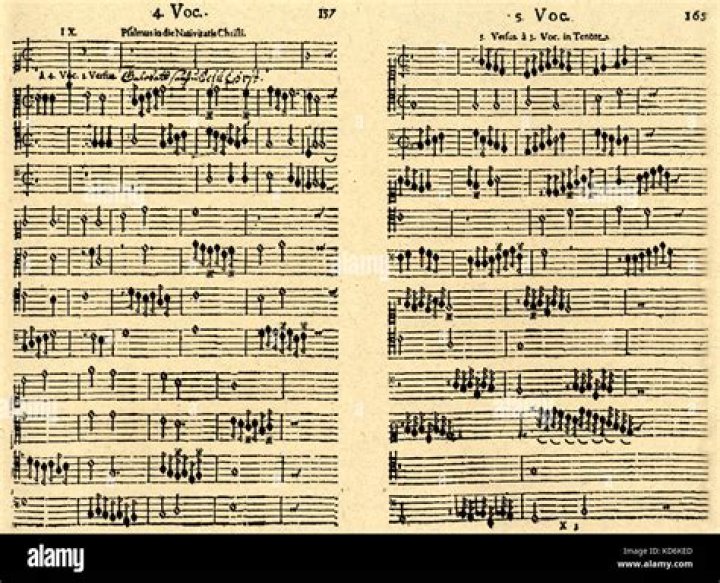
The technical evolution of sacred choral music took a permanent leap forward four centuries ago. In 1624, German organist and composer Samuel Scheidt published his monumental collection, Tabulatura Nova, in Hamburg. Marked by global commemorations and historical retrospectives, including recent coverage from Indiana Public Media marking its 400-year legacy, Scheidt's three-volume magnum opus fundamentally reshaped European music notation.
Before Scheidt's intervention, German keyboardists relied on old letter tablature, an arcane shorthand of letters and rhythmic flags that obscured voice-leading. Scheidt did something revolutionary. He transcribed keyboard and sacred vocal works onto open score: four or five distinct horizontal staves, giving each vocal line its own visual track. This notation laid bare the inner mechanics of Baroque polyphony. Organists could now clearly read the cantus firmus and shape every imitation line with vocal precision.
Scheidt applied this crystalline discipline to sacred counterpoint, providing the harmonic framework that supported civic choirs throughout northern Germany. His treatment of psalm tunes demonstrated that keyboard counterpoint could match the expressive agility of the human voice. The ripples of his publication transformed how conductors, organists, and singers approached sacred polyphony for the next three centuries.
From Renaissance Motet to Baroque Polyphony: A Structural Evolution
The musical treatment of Psalm 67 evolved alongside church architecture and print technology. Late Renaissance composers prioritized smooth, overlapping vocal lines where text entered in cascading imitative points. By the onset of the seventeenth century, composers infused that foundation with dramatic metrical contrasts and concerted instrumental accompaniments.
| Era & Style | Prominent Composers | Structural Innovations | Primary Performance Context |
|---|---|---|---|
| High Renaissance (1550, 1600) | William Byrd, Orlande de Lassus | Continuous modal counterpoint; Latin motet settings for 5, 8 unaccompanied voices. | Cathedral chapels and private Catholic household recitals. |
| Early German Baroque (1610, 1650) | Samuel Scheidt, Heinrich Schütz | Standardized staff tablature via Tabulatura Nova; vertical chordal punctuation against running voice parts. | Civic Lutheran churches, court chapels, and organ services. |
| English Evensong Era (1662, 1920) | Thomas Attwood Walmisley, C.V. Stanford | Homophonic clarity; alternating verse and full-choir sections supported by pipe organ. | Daily liturgical canticle within the Book of Common Prayer. |
| Modern Choral Revival (2010, 2026) | Arvo Pärt, contemporary choral arrangers | Spatial distribution, extended vocal techniques, tintinnabuli layers, dynamic acoustic immersion. | Secular concert halls, choral festivals, and multi-day masterwork series. |
The Psalms Experience and the Secular Audience Renaissance
How did centuries-old liturgical music transition into a headlining ticket across modern cultural capitals? The answer lies in projects like The Psalms Experience. Conceived by the Netherlands Chamber Choir and exported to major stages such as New York's White Light Festival, this multi-day initiative brought together world-class ensembles, including the Choir of Trinity Wall Street and the Tallis Scholars, to perform all 150 psalms setting-by-setting across twelve curated thematic programs.
Conductors organized the repertoire around universal human impulses rather than doctrinal rubrics: justice, abandonment, joy, and faith. When audiences experienced Psalm 67 within these curated narratives, the liturgical barrier vanished. Listeners discovered an unvarnished examination of community and resilience. The clarity of early counterpoint functioned as an acoustic refuge from heavily processed modern music. Live ticket tallies and streaming numbers confirmed the demand: unadorned human voices navigating acoustic spaces remain uniquely arresting.
Curating Deus Misereatur for Contemporary Ensembles
For music directors building choral concert repertoire, programming Deus misereatur nostri requires deliberate technical decisions. The score presents distinct logistical choices that can either illuminate or obscure the counterpoint.
Directors must first decide between pure historic tuning and modern equal temperament. When performing a Renaissance motet version a cappella, adopting mean-tone or just intonation yields striking third-intervals that make the text's petitions ring clean. Introducing modern organ accompaniment, however, forces subtle compromises to prevent dissonance against fixed pipes.
Vocal weight presents another crucial hurdle. Operatic vibrato smudges the tightly spaced imitative entrances pioneered by composers like Byrd or Scheidt. The most compelling modern performances rely on focused, straight-tone production with expressive dynamic swelling on key Latin syllables. This transparent vocal placement lets listeners follow individual lines without sacrificing the choir's collective impact.
Frequently Asked Questions (FAQ)
Why is Psalm 67 titled Deus Misereatur Nostri on concert programs?
Sacred choral compositions frequently take their titles from the incipit, the opening Latin words of the text. Because early polyphonic masterworks were written for the Latin liturgy, the title Deus misereatur nostri became the universal identifier for Psalm 67 settings across international music catalogs.
What is the connection between Samuel Scheidt's Tabulatura Nova and choral psalm settings?
Published in 1624, Samuel Scheidt’s Tabulatura Nova replaced confusing letter tablature with open, multi-stave notation. This enabled organists and choirmasters to read all individual voice parts simultaneously, fundamentally clarifying how contrapuntal lines interacted in both organ works and choral psalm arrangements.
Can non-religious audiences appreciate Deus Misereatur Nostri?
Yes. Modern concert presentations like The Psalms Experience demonstrate that historical psalm settings resonate widely as masterpieces of vocal counterpoint, poetry, and acoustic balance, independent of personal religious conviction.
The Living Horizon of Early Sacred Choral Music
The enduring popularity of Deus misereatur nostri proves that early sacred choral masterworks are not museum pieces. Their survival relies on real acoustic and emotional substance. When a multi-voiced choir launches into the opening measures of Psalm 67, the music strips away ambient modern noise and commands total focus.
As anniversary milestones like Samuel Scheidt's four-century legacy draw fresh scholarship, early Baroque polyphony is finding an expanded home in performance halls. Far from fading into academic silence, this ancient text continues to fill the world's most resonant spaces, carrying an ageless call for human grace into the modern ear.


