Element with Symbol Sr Explained: Atomic Number, Properties, and Uses
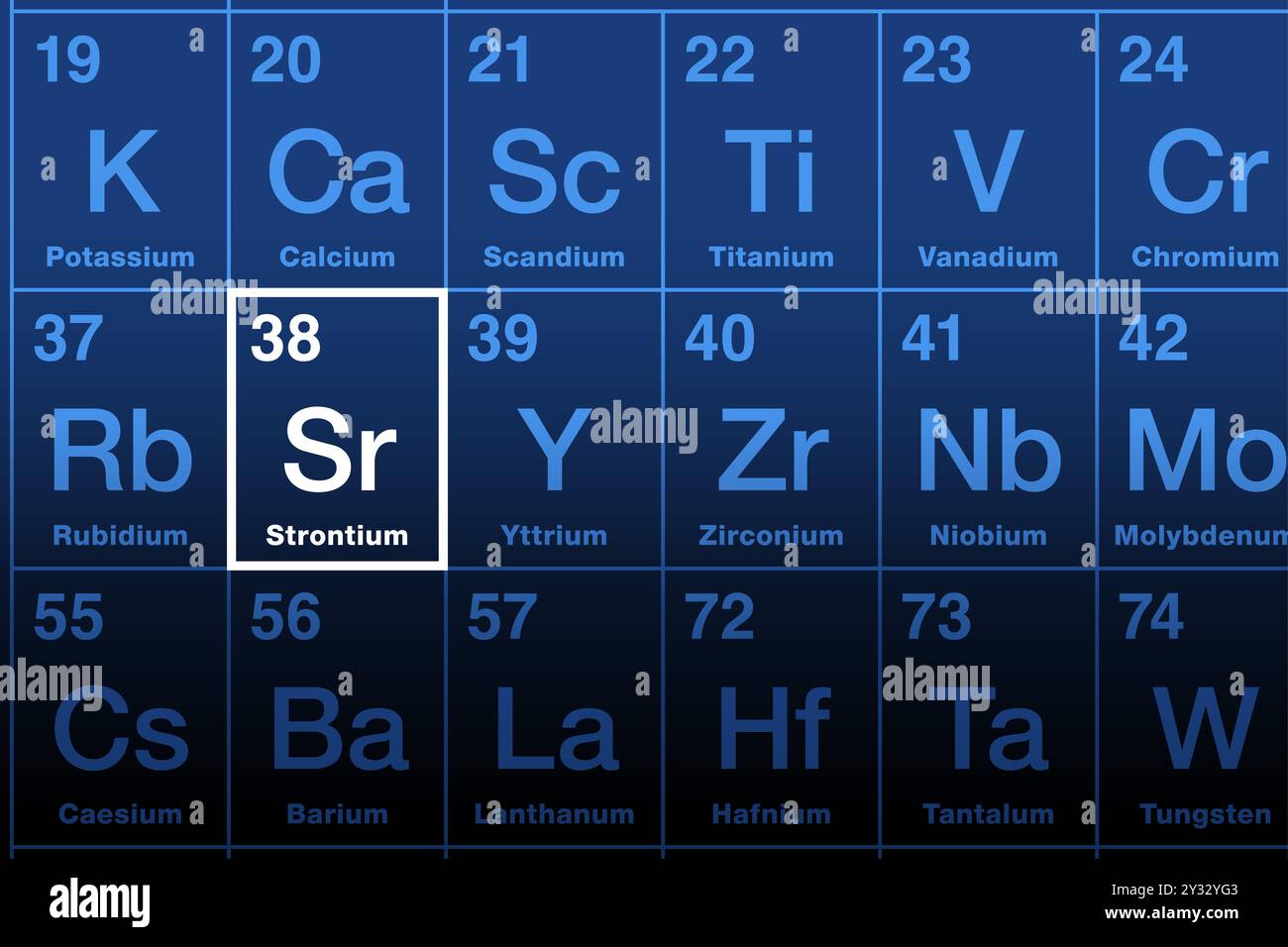
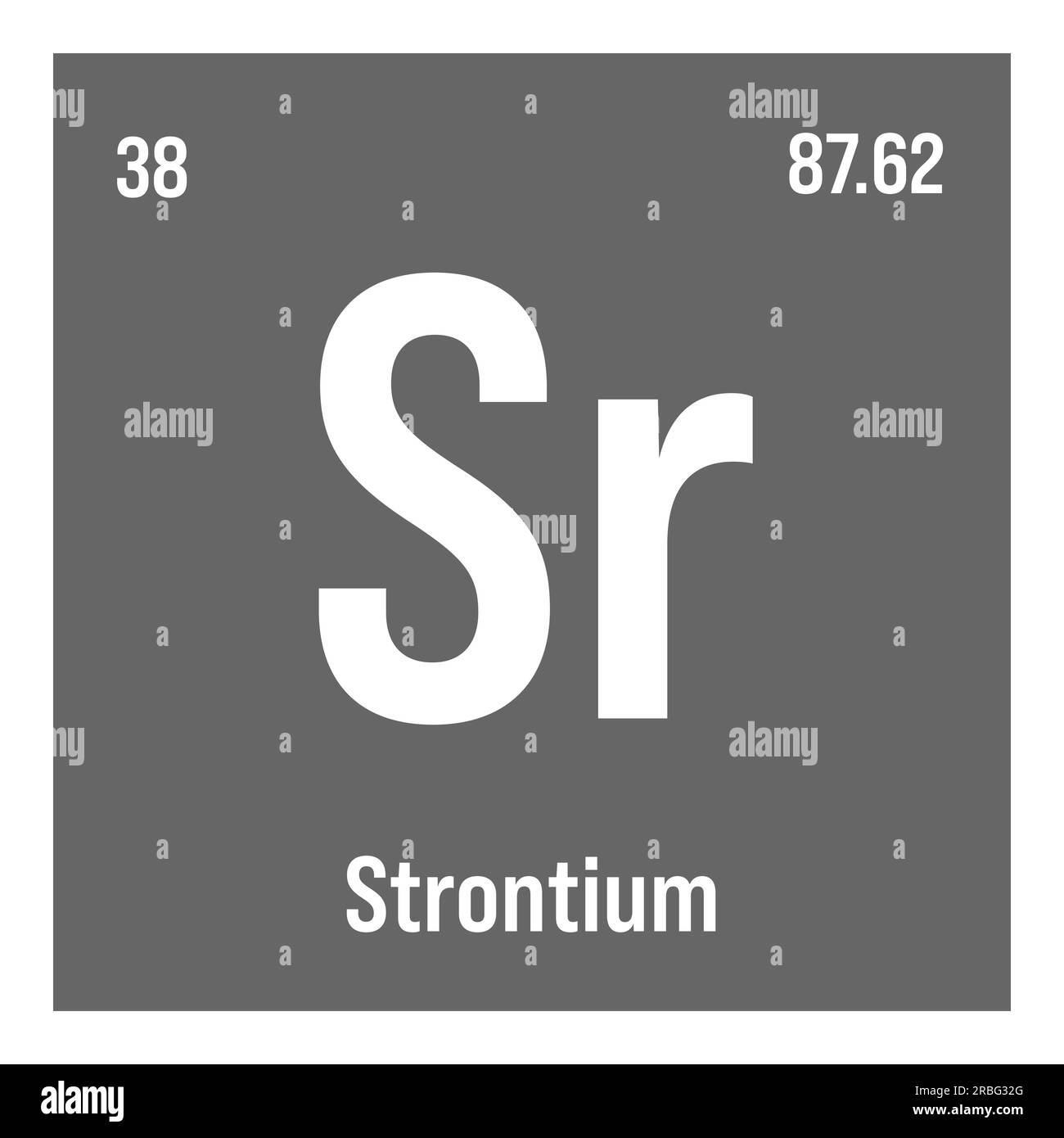
Every Fourth of July display and roadside emergency flare relies on a single chemical trigger hiding in plain sight on the periodic table. Search for the elemental symbol Sr, and you encounter strontium: a soft, silvery-yellowish alkaline earth metal sitting squarely at atomic number 38. With a standard atomic mass of 87.62 u, this reactive element bridges the gap between lightweight calcium and dense barium, functioning as both an industrial workhorse and a cornerstone of quantum metrology.
Periodic table classifications documented across analytical compendiums like the ThoughtCo Report show how group assignments govern physical reality. In Strontium's case, its Group 2 pedigree dictates explosive reactions with water, vivid optical emissions, and an uncanny biological mimicry that once altered the course of Cold War public health policy.
📌 Key Takeaways:
- Core Identity: Strontium (symbol Sr, atomic number 38) is an alkaline earth metal with an atomic mass of 87.62 and an outer electron configuration of [Kr] 5s².
- Primary Applications: Commercial manufacturing consumes thousands of tons of strontium carbonate annually as a vivid pyrotechnic colorant and ferrite magnet stabilizer.
- Scientific Frontiers: While its notorious isotope strontium-90 remains a radioactive hazard in nuclear waste, ultra-stable neutral strontium atoms now power optical lattice atomic clocks accurate to one second in 30 billion years.
From a Scottish Lead Mine to Group 2 of the Periodic Table
The discovery of strontium began not in a sterile research lab, but inside the wet granite shafts of Strontian, a remote mining village in the Scottish Highlands. In 1790, Irish physician Adair Crawford and chemist William Cruickshank analyzed a mineral specimen labeled as barium carbonate. Crawford noticed distinct crystallographic quirks and an unusual dissolution rate, asserting the rock contained a previously unrecognized earth metal. Two years later, Edinburgh chemist Thomas Charles Hope confirmed the finding when he demonstrated that the mineral turned a candle wick brilliant scarlet.
Sir Humphry Davy completed the puzzle in 1808. Isolating the pure element via electrolysis of a moist paste of strontium hydroxide and mercuric oxide, Davy generated a strontium amalgam, distilled away the mercury, and produced the pure metal. He named it after its Scottish discovery site. Strontium holds the distinction of being one of the few elements named directly for a Scottish municipality.
Core Chemical Profile: Electron Configuration and High Reactivity
Strontium sits in period 5, group 2 of the periodic table, classifying it as an alkaline earth metal. Its ground-state electron configuration reads [Kr] 5s², or in expanded notation, 1s² 2s² 2p⁶ 3s² 3p⁶ 3d¹⁰ 4s² 4p⁶ 5s². That outermost shell holds two valence electrons, loosely bound by an effective nuclear charge shielded by 36 core electrons.
Because stripping those two outer electrons requires relatively modest energy, first ionization energy sits at 549.5 kJ/mol, second at 1064.2 kJ/mol, strontium operates exclusively in the +2 oxidation state in its stable compounds. Pure metallic strontium is softer than calcium and cuts easily with a kitchen knife. The moment fresh metal contacts ambient oxygen, it tarnishes into a dull, yellowish oxide film. Exposed to finely divided air, strontium dust ignites spontaneously. When dropped into liquid water, it reacts vigorously, releasing hydrogen gas and forming caustic strontium hydroxide:
Sr (s) + 2 H₂O (l) → Sr(OH)₂ (aq) + H₂ (g)
To prevent continuous decomposition, chemical supply houses store bulk strontium submerged beneath mineral oil or sealed in evacuated argon ampoules.
Strontium by the Numbers: Fundamental Physics and Isotope Profiles
Naturally occurring strontium consists of four stable isotopes. The most abundant, strontium-88, makes up roughly 82.58% of all natural deposits, followed by strontium-86 at 9.86%, strontium-87 at 7.00%, and strontium-84 at 0.56%. Strontium-87 provides geologists with an accurate isotopic clock: it forms continuously via the beta decay of rubidium-87, allowing researchers to track bedrock ages and pinpoint ancient human migration patterns by tracing groundwater isotopes trapped in fossilized dental enamel.
| Metric or Isotope | Classification / Value | Role & Significance |
|---|---|---|
| Atomic Number (Z) | 38 | Defines proton count in nucleus; establishes position below Ca and above Ba. |
| Standard Atomic Weight | 87.62 u | Weighted average across four terrestrial stable isotopes (⁸⁴Sr, ⁸⁶Sr, ⁸⁷Sr, ⁸⁸Sr). |
| Density & Melting Point | 2.64 g/cm³ | 777 °C (1050 K) | Relatively light density for a structural metal; boils at 1382 °C. |
| Strontium-88 (Stable) | 82.58% abundance | Dominant stable isotope used across industrial salts, ceramics, and optics. |
| Strontium-90 (Synthetic) | Half-life: 28.9 years | Fission byproduct; emits high-energy beta particles; accumulates in bone marrow. |
The Pyrotechnic Signature: Why Fireworks Rely on the Crimson Flame Test
If you have ever watched commercial fireworks burst into deep crimson over a city skyline, you have witnessed strontium de-excitation kinetics in real time. Metal salts produce characteristic colors when heated, but strontium delivers the cleanest, deepest red in pyrotechnic chemistry.
When technicians mix strontium carbonate (SrCO₃) or strontium nitrate [Sr(NO₃)₂] with an oxidizer and fuel, thermal energy kicks outer electrons into elevated quantum orbitals. As these electrons drop back to their ground state, they release photons at distinct wavelengths. In pyrotechnic flames, the active emitter is predominantly gaseous strontium monohydroxide (SrOH) and strontium monochloride (SrCl), which generate intense spectral lines between 600 and 680 nanometers. Without strontium salts, pyrotechnicians are restricted to muted pinks and washed-out oranges; barium provides green, copper supplies blue, and strontium guarantees deep red.
Beyond entertainment, this emission profile serves as an analytical identifier. In introductory laboratory work, the crimson flame test instantly distinguishes strontium from lithium (which yields a more carmine tint) and calcium (which presents a brick-red or orange cast).
The Double Edge: Nuclear Fallout vs. Quantum Precision
Strontium's biological behavior is shaped by its similarity to calcium. Because the ionic radius of Sr²⁺ (118 pm) closely mirrors that of Ca²⁺ (100 pm), human metabolic systems cannot easily differentiate between the two. Ingested strontium passes through intestinal walls, enters the bloodstream, and integrates directly into hydroxyapatite mineral matrices inside bones and teeth.
This biochemical mimicry proved tragic with the emergence of strontium-90, a major nuclear fission byproduct produced in atmospheric weapons tests during the 1950s and released during the Chernobyl disaster in 1986. Emitting potent 0.546 MeV beta particles with a half-life of 28.9 years, strontium-90 deposited on dairy pastures, contaminated milk supplies, and settled inside children's growing skeletal structures. Pathologists traced spiked rates of bone cancer and leukemia directly to its persistent beta irradiation of adjacent bone marrow. Public alarm over strontium-90 in baby teeth became a primary catalyst for the 1963 Partial Nuclear Test Ban Treaty.
Today, researchers use that same elemental identity for unprecedented measurement accuracy. Physicists at institutions like the National Institute of Standards and Technology (NIST) trap tens of thousands of neutral strontium atoms inside optical lattices formed by intersecting laser beams. By interrogating the transition frequency between quantum states in strontium-87 using ultra-stable lasers, these atomic clocks lose less than one second over astronomical timescales. Strontium has effectively transformed from a Cold War health hazard into the global benchmark for defining the future standard of the international second.
Frequently Asked Questions (FAQ)
Q1: What is the primary industrial use for strontium today?
A1: The largest commercial market for strontium compounds is the manufacturing of strontium carbonate used in pyrotechnics, flare cartridges, and ceramic ferrite magnets found in automotive loudspeakers and compact electric motors. Previously, vast tonnages blocked X-ray emissions in cathode-ray tube (CRT) television glass.
Q2: Is natural elemental strontium toxic to touch?
A2: Stable natural strontium is not poisonous in low ambient concentrations, and small amounts naturally exist in drinking water and vegetables. Handling pure metallic strontium requires care because the metal reacts vigorously with moisture on skin, releasing caustic heat and strontium hydroxide that can cause chemical burns.
Q3: How does strontium differ from calcium on the periodic table?
A3: Strontium sits directly below calcium in Group 2. It has an additional electron shell (period 5 vs. period 4), making its atomic radius larger and its valence electrons less tightly held. As a result, strontium is more reactive with water and oxygen than calcium, possesses a higher density, and emits a deep crimson flame rather than calcium's brick-red glow.
Strontium’s Path from Scottish Ore to Quantum Precision
From an accidental discovery in an 18th-century Scottish lead mine to the heart of quantum physics, strontium highlights how an element's position on the periodic table shapes its real-world impact. Its two valence electrons make it reactive enough to light the night sky with brilliant crimson flame, chemically similar enough to integrate into human bone, and stable enough in quantum traps to redefine timekeeping. Element 38 remains one of chemistry's most dynamic case studies in how subtle atomic structures drive transformative industrial and scientific progress.

