Polar vs. Nonpolar Chemistry Explained: Fact-Checking Common Misconceptions About Molecular Bonds

Introductory chemistry textbooks often present molecular polarity as a rigid, binary switch: a bond is either nonpolar covalent, polar covalent, or ionic. In laboratory practice and industrial chromatography, however, this model quickly falls apart. Recent analytical work tracking volatile congeners in aged spirits, detailed in a recent chromatographyonline.com Report, demonstrates how shades of polarity govern real-world chemical separation down to parts-per-billion thresholds.
Understanding polarity requires looking past oversimplified classroom categories. It demands examining how electrons actually move, how shapes cancel or amplify atomic pull, and how planetary environments challenge our basic rules of solubility and miscibility.
📌 Quick Summary:
- The Core Mechanism: Polarity arises when an electronegativity difference creates an asymmetrical charge distribution across a molecule, producing a measurable dipole moment.
- The Continuum Reality: Pure covalent and ionic bonds mark extreme ends of a single continuum rather than isolated, self-contained buckets.
- Practical Consequences: Molecular shape dictates physical behavior, driving everything from cellular protein folding to analytical chromatographic separation.
How Asymmetrical Charge Distribution Creates the Dipole Moment
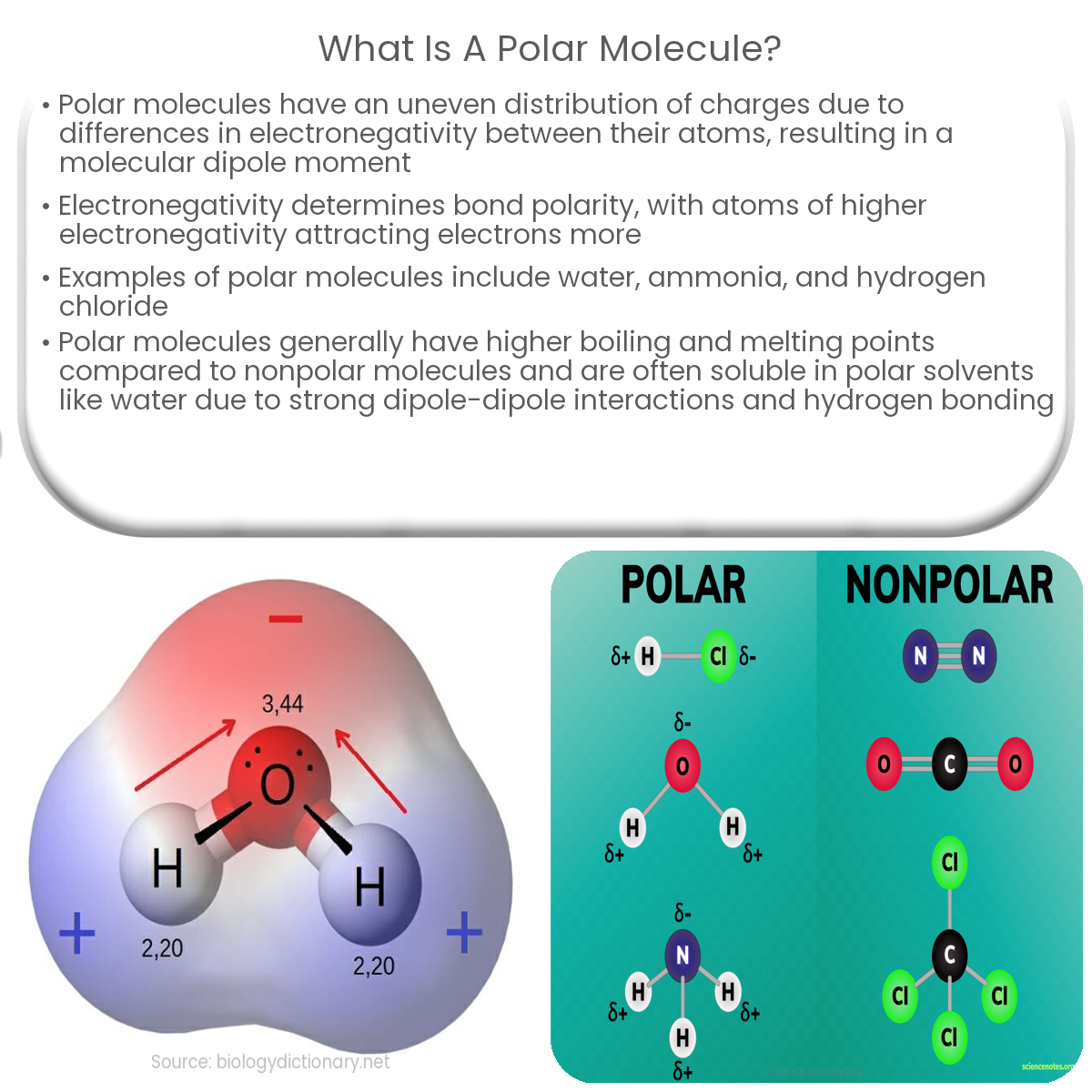
Polarity boils down to uneven sharing. When two bonded atoms lay claim to shared valence electrons, the atom with higher electronegativity pulls the electron density toward its own nucleus. This migration produces a partial electrical charge, designated as delta negative (δ−) on the hungry atom and delta positive (δ+) on the partner left behind.
These partial charges produce a bond dipole vector. We quantify this separation of charge across distance as a dipole moment, measured in debyes (D). When water forms, oxygen pulls hard on hydrogen's electrons. The electronegativity gap sits near 1.24 on the Pauling scale. Because water bends at an angle of roughly 104.5 degrees, those two polar covalent bonds combine into an overall molecular dipole moment of 1.85 D.
Symmetry changes the outcome completely. Carbon dioxide contains two highly polar carbon-oxygen double bonds, yet its overall dipole moment measures exactly 0.0 D. Carbon dioxide forms a linear molecular geometry at 180 degrees. The two individual dipoles pull in opposite directions with identical force, canceling each other out. A molecule can contain vigorously polar covalent bonds while remaining entirely nonpolar overall.
Fact-Checking the Arbitrary Border Between Covalent and Ionic Bonds
Classroom guides love tidy cutoffs. Thousands of students learn that an electronegativity difference below 0.4 is nonpolar, between 0.4 and 1.7 is polar covalent, and above 1.7 or 2.0 is ionic. Real chemistry does not respect these boundaries.
Bonds exist across a continuous gradient of percent ionic character. Hydrogen fluoride features an electronegativity difference of 1.78, placing it on the standard textbook line for ionic compounds. Yet hydrogen fluoride remains a gas composed of discrete covalent molecules that evaporate, compress, and interact via dipole forces.
Linus Pauling devised an empirical equation to demonstrate this exact reality: the fraction of ionic character increases smoothly alongside electronegativity difference. A difference of 1.7 reflects roughly 51% ionic character, meaning the bond still possesses 49% covalent character. Treating these thresholds as absolute physical laws leads researchers and students to miscalculate reaction mechanisms and solvent behaviors.
Predicting How Molecular Geometry Overrules Raw Electronegativity
Predicting polarity requires evaluating three-dimensional symmetry through Valence Shell Electron Pair Repulsion (VSEPR) theory. Raw electronegativity numbers only tell half the story.
Consider carbon tetrachloride and chloromethane. Carbon forms four bonds in a tetrahedral arrangement with bond angles of 109.5 degrees. In carbon tetrachloride, chlorine has an electronegativity of 3.16, while carbon sits at 2.55. Each carbon-chlorine bond is distinctly polar. The symmetrical tetrahedral frame pulls electron density equally toward four opposing corners, causing the vector sum to drop to zero. The compound behaves as a classic nonpolar solvent.
Replace one chlorine atom with hydrogen, and the balance breaks. In chloromethane, the carbon-hydrogen bond features minimal polarity, while the single carbon-chlorine bond creates a sharp, uncompensated vector pull toward chlorine. The molecule develops an asymmetrical charge distribution and a permanent dipole moment of 1.87 D.
| Compound & Formula | Molecular Geometry | Max Electronegativity Gap | Net Dipole Moment (Debye) |
|---|---|---|---|
| Water (H₂O) | Bent (~104.5°) | 1.24 | 1.85 D (Polar) |
| Carbon Dioxide (CO₂) | Linear (180°) | 0.89 | 0.00 D (Nonpolar) |
| Boron Trifluoride (BF₃) | Trigonal Planar (120°) | 1.94 | 0.00 D (Nonpolar) |
| Ammonia (NH₃) | Trigonal Pyramidal (~107°) | 0.84 | 1.47 D (Polar) |
| Carbon Tetrachloride (CCl₄) | Tetrahedral (109.5°) | 0.61 | 0.00 D (Nonpolar) |
When lone pair electrons occupy space on a central atom, they warp geometry and ruin symmetry. Ammonia maintains three hydrogen bonds and one lone pair. The lone pair pushes downward, creating a trigonal pyramidal structure with a net dipole moment of 1.47 D. Boron trifluoride, lacking a central lone pair, adopts a flat trigonal planar shape where three intensely polar boron-fluorine bonds cancel out to zero.
Intermolecular Forces in Polar vs Nonpolar Solvents
Polarity governs how molecules congregate in bulk liquid phases. The phrase "like dissolves like" summarizes the energetic interplay between polar vs nonpolar solvents, but the underlying mechanism involves competing intermolecular forces.
Hydrophilic molecules interact comfortably with water because they can participate in dipole-dipole attractions and hydrogen bonding. A hydrogen bond forms when hydrogen connects to tiny, highly electronegative atoms, principally nitrogen, oxygen, or fluorine. Water builds a dynamic, tightly cross-linked network held together by bonds measuring 10 to 40 kJ/mol in strength.
Nonpolar hydrocarbons like hexane rely on London dispersion forces, which generate transient, shifting dipoles with strengths often lower than 4 kJ/mol. When hexane encounters water, it cannot offer the energetic compensation required to break water's existing hydrogen bonds. Water molecules crowd inward, forcing nonpolar chains together to maximize their own internal bonding network. This interaction explains the familiar barrier between oil and water on Earth.
Astrophysical discoveries challenge whether these barriers hold universally. Reports published by Live Science and Universe Today analyzing data from Saturn's moon Titan reveal that surface conditions running at 94 Kelvin (−179°C) alter standard rules. Under high pressure and extreme cold, hydrocarbon systems of liquid methane and ethane interact with trace polar organics in ways that dissolve boundaries common to terrestrial chemistry. The thermodynamic penalties governing solubility shift when thermal kinetic energy plunges.
Chromatographic Separation and Real-World Applications
Analytical chemistry relies on fine distinctions in molecular charge. In high-performance liquid chromatography (HPLC) and gas chromatography, researchers use polar and nonpolar mobile and stationary phases to separate complex mixtures.
In reversed-phase chromatography, the stationary phase consists of nonpolar alkyl chains, typically octadecyl carbon chains (C18), bound to silica beads. Technicians pump a polar solvent mixture, such as water and acetonitrile, through the column under pressure.
Molecules separate according to their partitioning behavior:
- Highly polar, hydrophilic molecules pass quickly through the column, preferring the polar solvent.
- Nonpolar, hydrophobic compounds stick to the oily stationary phase.
- Analysts adjust the mobile phase's polarity over time to release bonded compounds at predictable intervals.
This process underpins modern drug purification, environmental water testing, and quality verification in spirits manufacturing, where volatile esters and higher alcohols separate along micro-gradients of polarity.
Structural biology shows similar dynamics. Research published in PNAS demonstrated how water molecules organize themselves precisely along the alternating polar and nonpolar surface domains of proteins. Cells fold enzymes based entirely on this balance, tucking nonpolar amino acid residues into core cavities while exposing polar side chains to interact with the aqueous cytoplasm.
Frequently Asked Questions (FAQ)
Q1: Can a molecule have polar bonds and still be completely nonpolar?
Yes. Carbon dioxide and carbon tetrachloride are textbook examples. Both feature individual bonds with substantial electronegativity differences. Because their molecular shapes are completely symmetrical, the directional dipole vectors pull against one another equally, resulting in a net dipole moment of zero.
Q2: Why is water a better solvent for table salt than ethanol?
Water features a dielectric constant near 80 at room temperature, alongside a strong dipole moment of 1.85 D. Ethanol carries a lower dielectric constant near 24. Water's small, dense dipoles surround sodium and chloride ions, forming stable hydration shells that weaken ionic attractions and dissolve the crystal grid far more effectively.
Q3: How does temperature affect molecular polarity?
Temperature does not alter a molecule's baseline chemical structure or intrinsic electronegativity values. However, studies published in Nature on nuclear magnetic resonance (NMR) demonstrate that rising temperatures expand average bond lengths and increase vibrational and rotational states. These shifts can alter effective dipole moments, weaken hydrogen bond networks, and shift solvent-solute interactions.
Molecular Polarity in Practical Science
Polarity is not a simple binary classification. It represents a fluid structural spectrum shaped by charge differentials, spatial geometry, and external thermodynamic pressures. The distribution of electrons across atomic bonds explains why water sustains living cells, how modern pharmaceuticals clear analytical columns, and why atmospheric chemistry behaves unexpectedly on distant planetary bodies.
Moving past arbitrary electronegativity cutoffs allows researchers, engineers, and analysts to predict molecular behavior with precision. Molecular shape consistently determines how compounds dissolve, bind, and separate across every level of chemical science.