Flower of Scotland Explained: Lyrics, Origins, Meaning, and FAQs

When sixty-seven thousand supporters at Murrayfield Stadium or Hampden Park drop from a roar into a hushed murmur, only for the bagpipes to cut out and leave the crowd singing completely acapella, the sound carries across Edinburgh and Glasgow. The song is "Flower of Scotland," an unassuming 1960s folk composition that became one of the most recognizable, politically charged sporting anthems in world culture. As detailed in the comprehensive GiveMeSport Report on Tartan Army chants and anthems, few songs evoke as much fierce regional pride, sporting hostility, and historical debate.
Yet behind the thundering refrain lies a nuanced story. It is not an ancient battle hymn passed down through medieval mists, but a mid-twentieth-century creation written on custom-built instruments by an Edinburgh art student turned folk musician. It balances sorrow with defiance, invoking a 14th-century slaughter to define 21st-century sporting identity.
📌 Key Takeaways:
- The Origins: Composed in the mid-1960s by Roy Williamson of the folk duo The Corries, the song was never intended as a state anthem.
- The History: The lyrics directly commemorate the 1314 Battle of Bannockburn, where Robert the Bruce defeated the English army led by King Edward II.
- The Sporting Adoption: The Scottish Rugby Union adopted the track during the 1990 Five Nations Grand Slam decider, while the Scottish Football Association made it official in 1997.
Flower of Scotland Verse Breakdown and Complete Lyrics
Most casual listeners only know the stadium cut. International sporting bodies typically restrict pre-match anthems to under two minutes, meaning crowds sing only the first and third verses. Sung in a blend of Scottish English and Lowland Scots, the full text consists of four verses that shift from quiet lamentation to forward-looking resilience.
Verse 1 (Standard Stadium Verse)
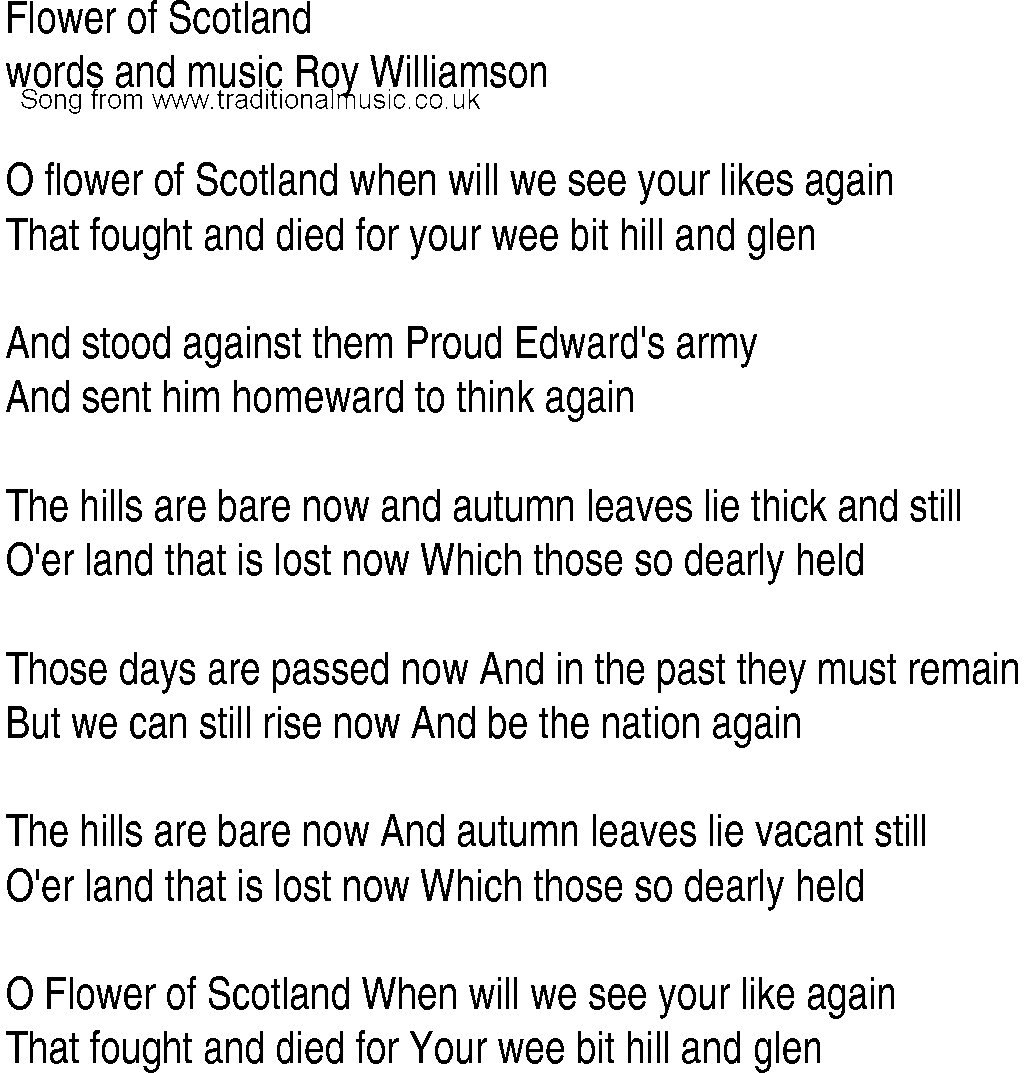
O Flower of Scotland,
When will we see your like again,
That fought and died for,
Your wee bit hill and glen,
And stood against him,
Proud Edward's army,
And sent him homeward,
Tae think again.
The "Flower" refers to the best and bravest of the nation's youth lost in defense of their sovereignty. In modern stadiums, Tartan Army chants insert crowd responses here. After "stood against him," fans scream "Against who?", followed by a thunderous "Bastard!" or "Wanker!" after "Proud Edward's army."
Verse 2 (Omitted at Matches)
The hills are bare now,
And autumn leaves lie thick and still,
O'er land that is lost now,
Which those so dearly held,
That stood against him,
Proud Edward's army,
And sent him homeward,
Tae think again.
This verse delivers the poem's melancholic heart. Williamson paints the depopulated Highlands and abandoned glens, nodding subtly to the centuries of Clearances and military defeats that followed early medieval victories.
Verse 3 (Standard Stadium Verse)
Those days are past now,
And in the past they must remain,
But we can still rise now,
And be the nation again,
That stood against him,
Proud Edward's army,
And sent him homeward,
Tae think again.
This stanza pivots from retrospective mourning to modern civic defiance. It urges listeners not to live purely in antiquity, but to channel that historical resolve into modern self-determination.
Verse 4 (Full Folk Arrangement)
The repeat of Verse 1 closes traditional folk performances, reinforcing the opening tribute to the fallen.
Roy Williamson and the Folk Roots of The Corries
The man behind the anthem never saw its peak international dominance. Roy Williamson, born in Edinburgh in 1936, formed The Corrie Folk Trio in 1962 alongside Ronnie Browne and Bill Smith. By the late 1960s, operating simply as The Corries, Williamson and Browne had developed into the standard-bearers of the Scottish folk revival.
Williamson wrote "Flower of Scotland" in 1965, though he initially kept it in his notebook, unsure of its reception. The Corries first performed the song publicly on BBC television in 1967. Williamson sang lead vocals while accompanying himself on the "combolin", a hybrid 28-string instrument he designed and crafted by hand, marrying a guitar, a Spanish bandurria, and sympathetic sitar strings.
The Corries released the first commercial recording on their 1974 album Live from Scotland Volume 1. Williamson was an understated, private figure who battled severe asthma and structural health complications throughout his adult life. He passed away from a brain tumor on August 12, 1990, at the age of 54, just months after hearing his ballad shake the concrete foundations of Murrayfield.
The Battle of Bannockburn and the Fall of Proud Edward
To decode the lyric "sent him homeward tae think again," one must look at the events of June 23, 24, 1314. The Battle of Bannockburn stands as the defining clash of the First War of Scottish Independence.
Robert the Bruce, crowned King of Scots in 1306, had systematically dismantled English garrisons across Scotland. By early 1314, only Stirling Castle remained in English hands. King Edward II of England ("Proud Edward") marched north with an elite feudal army of roughly 13,000 to 25,000 men, including thousands of heavy cavalry and seasoned longbowmen.
Bruce met the invasion force south of Stirling near the Bannock Burn with an army roughly one-third that size, comprised largely of spearmen arranged in tightly packed, bristling defensive formations called schiltrons. Over two days of tactical maneuvering, Bruce drove the heavy English cavalry into marshland between the streams, neutralizing their charging power. The resulting rout shattered Edward's force.
Edward II fled the field, pursued aggressively by James Douglas, eventually reaching Dunbar Castle before taking a boat back to England. The psychological impact across the British Isles proved permanent. Scotland did not win formal independence that afternoon, that required the 1320 Declaration of Arbroath and the 1328 Treaty of Edinburgh, Northampton, but Bannockburn proved that an underdog force relying on discipline and terrain could turn back the military superpower of Western Europe.
From Murrayfield to Hampden: Crowning an Unofficial Anthem
For decades, British teams sang "God Save the Queen" across all home nations. Scottish crowds regularly booed or met the track with cold silence. The transformation of "Flower of Scotland" from a pub folk standard into a sporting staple was led not by politicians, but by rugby players.
During the 1974 British and Irish Lions tour to South Africa, Scottish winger Billy Steele popularized the tune among his squad mates. Scottish rugby players began singing it on team buses throughout the late 1970s and 1980s. The tipping point arrived on March 17, 1990. Scotland faced England at Murrayfield in the Five Nations Championship, with both teams playing for a Grand Slam title amid bitter political friction over Margaret Thatcher's Community Charge (the poll tax).
Scotland captain David Sole led his team out on an agonizingly slow, deliberate walk rather than the customary jog. The atmosphere was molten. For the first time, the Scottish Rugby Union sanctioned "Flower of Scotland" as the official pre-match anthem. Flanked by Ronnie Browne singing live, the crowd produced an acoustic wall that visibly unsettled the English squad. Scotland won 13, 7, clinching the Grand Slam and etching the song permanently into national sporting lore.
The Scottish Football Association lagged behind. Scotland's football side historically used "Scotland the Brave," an upbeat military march that Tartan Army supporters found generic and brass-heavy. Ahead of the 1998 FIFA World Cup qualifiers, the SFA held a formal supporter consultation in 1997. "Flower of Scotland" won by an overwhelming majority, replacing "Scotland the Brave" permanently at Hampden Park.
| Candidate Anthem | Origin / Composer | Primary Sporting Adoption | Cultural Strengths & Criticisms |
|---|---|---|---|
| Flower of Scotland | Roy Williamson (The Corries, 1965) | SRU (1990), SFA (1997), Commonwealth Games (2010) | Unrivaled emotional power in stadiums; criticized for anti-English sentiment and dirge-like tempo when played poorly. |
| Scotland the Brave | Traditional 19th-century pipe tune; lyrics by Cliff Hanley (1950s) | SFA (pre-1997), Commonwealth Games (pre-2010) | High tempo and martial energy; widely viewed as tourist-cliché music lacking gravitas. |
| Highland Cathedral | Ulrich Roever and Michael Korb (1982) | Ceremonial events, police & military parades | Stirring melody; criticized because it was composed by two German musicians for Highland Games in Germany. |
| A Man's a Man for A' That | Robert Burns (1795) | Opening of the Scottish Parliament (1999) | Universal egalitarian message; difficult for broad crowds to sing in sports stadiums. |
| Scots Wha Hae | Robert Burns (1793) | SNP conferences; historical civic rallies | Direct historical speech from Bruce at Bannockburn; archaic phrasing reduces casual adoption. |
The Debate Over Scotland’s Official Anthem Status
Legally speaking, Scotland has no de jure national anthem. As a constituent country of the United Kingdom, its sovereign state anthem remains "God Save the King." Yet in almost every civic, cultural, and athletic venue, "Flower of Scotland" functions as the undisputed de facto anthem.
The song remains a subject of domestic argument. Critics, including several prominent Scottish sports figures and political commentators, argue that the song anchors modern Scottish identity in grievance and Anglophobia. Former Scotland rugby head coach Jim Telfer argued in the 2010s that relying on an anti-English narrative holding court over a 700-year-old battle limits how modern Scotland views its place in the world.
Musical scholars periodically raise complaints about its structure. Because Williamson composed it around bagpipe scales, the melody is set in a mixolydian mode with a flattened seventh. When sung without accompaniment by tens of thousands of untrained voices, the song tends to drop in pitch and decelerate into a mournful dirge. Royal Scottish National Orchestra conductors have repeatedly pointed out how difficult it is to score for classical brass arrangements without draining its raw bite.
Efforts to replace it invariably collapse. When the Royal Scottish National Orchestra polled over 10,000 Scots on their preferred national anthem, "Flower of Scotland" secured 41% of the vote, beating out "Scotland the Brave" (29%) and "Highland Cathedral" (16%). In 2010, the Commonwealth Games Council for Scotland abandoned "Scotland the Brave" entirely, voting to play "Flower of Scotland" atop the podium in Delhi. The public consistently rejects polite, neutral alternatives in favor of raw narrative power.
Frequently Asked Questions (FAQ)
Q1: Why do fans shout "Against who?" during Flower of Scotland?
A1: The shout is an unofficial crowd call-and-response originated by Tartan Army and rugby supporters in the 1990s. After the line "And stood against him," the crowd shouts "Against who?", answering the next line ("Proud Edward's army") with an expletive directed at the historical English force.
Q2: Is Flower of Scotland the official legal national anthem of Scotland?
A2: No. The Scottish Parliament has never passed legislation designating an official national anthem. It is an unofficial national anthem that has been formally adopted by sporting bodies, including the Scottish Football Association, the Scottish Rugby Union, and Commonwealth Games Scotland.
Q3: Who was the "Proud Edward" mentioned in the lyrics?
A3: The song refers to King Edward II of England, who ruled from 1307 to 1327. He led the massive English army defeated by King Robert the Bruce at the Battle of Bannockburn in June 1314.
Q4: Why are only the first and third verses usually sung?
A4: International sporting federations such as FIFA, UEFA, and World Rugby enforce strict television broadcast protocols limiting pre-match national anthem ceremonies to 60, 90 seconds per country. Verses 1 and 3 are chosen because they deliver the core historical context and the forward-looking message of national resurgence.
Q5: Can you play Flower of Scotland on the Highland bagpipes?
A5: Yes. Roy Williamson specifically constructed the melody around the nine-note range and modal scale of the Great Highland Bagpipe chanter, which is why bagpipes can accompany the singing without key transposition.
The Cultural Endurance of Williamson's Ballad
A national anthem rarely succeeds because a committee chose it. It works when an entire population adopts it as their collective voice under pressure. "Flower of Scotland" bypassed civil servants, parliamentarians, and editorial boards entirely, earning its position on muddy terraces, packed supporters' buses, and high-stakes international pitches.
Whether Scotland ever formalizes a legal anthem through Holyrood remains secondary to what happens in the stands. The moment the brass sections silence their horns at Murrayfield or Hampden, leaving only human voices to carry the final line, "And sent him homeward, tae think again", the song accomplishes exactly what Roy Williamson set out to do in 1965: it forces an audience to listen to Scotland on its own terms.


