From Philly Twitter to Global Feeds: The Evolution of CTFU and Modern Slang

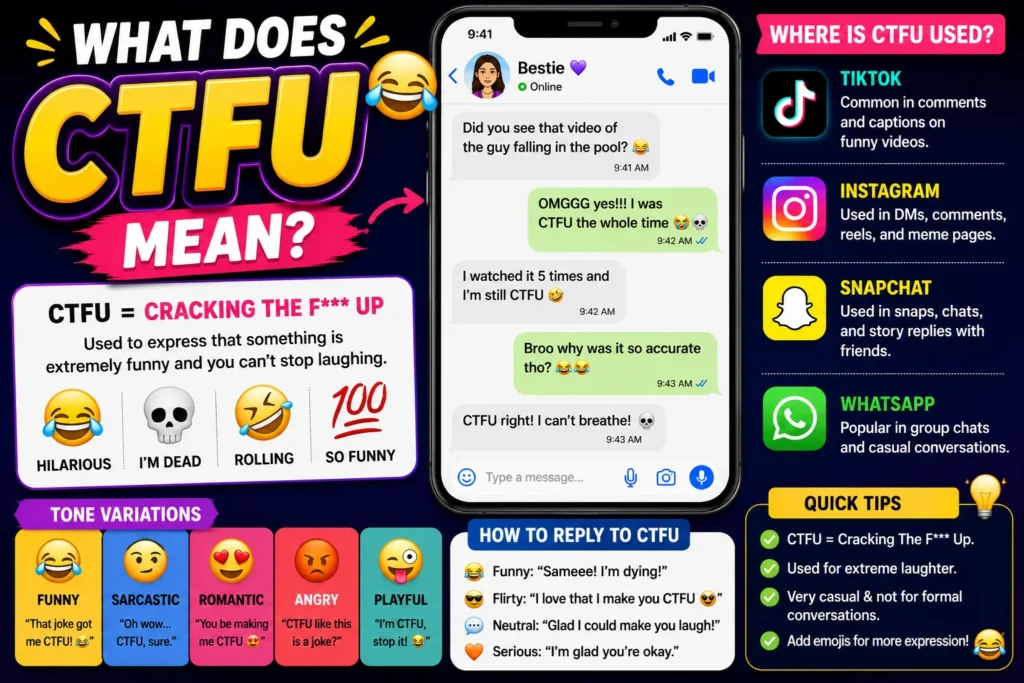
Anyone scrolling through group chats, TikTok comment sections, or X threads has encountered the four-letter acronym dropped after an unhinged video: CTFU. The abbreviation stands for "cracking the fuck up" (or the sanitized "cracking the freak up"). It signals intense, wheezing, uncontrollable laughter that standard internet initialisms can no longer convey. Digital culture constantly demands new ways to express authentic emotion because older expressions inevitably lose their punch. Just as mainstream audiences turn to television guides like The Mirror Report to decode high-intensity police operational codes, digital natives regularly dissect subcultural shorthand to understand what their peers are actually saying.
The journey of CTFU tells a broader story about language in the internet era. Long before it landed in group chats from London to Sydney, the phrase lived exclusively in the mid-Atlantic United States. It was forged in regional conversations, migrated onto early social media networks, and eventually secured its place in the global vocabulary of text slang abbreviations.
📌 Key Takeaways:
- Core Definition: CTFU stands for "cracking the fuck up," expressing sudden, convulsive laughter far more intense than a standard text reaction.
- Geographic Roots: The phrase originated as localized street slang and African American Vernacular English (AAVE) in Philadelphia before spreading via Black Twitter in the late 2000s.
- Linguistic Shift: CTFU serves as an antidote to semantic bleaching, stepping in where terms like "LOL" have degraded into passive punctuation.
The Raw Mechanics of Cracking the Fuck Up
In text messaging, tone is notoriously difficult to calibrate. When someone types "lol," they rarely crack a smile. Linguists refer to this process as semantic bleaching: over decades of casual misuse, an expression loses its original emotional charge until it means little more than "I acknowledge your message."
CTFU works differently. The phrase carries phonetic weight. "Cracking up" has described spontaneous laughter in American English since the mid-20th century, evoking the physical sensation of a person's composed facade breaking wide open. By inserting an expletive into the middle of the verb phrase, speakers amplify the suddenness of the reaction. It is loud. It is visceral.
Urban Dictionary recorded early entries for CTFU as early as 2005, 2007, long before algorithmic feeds turned local dialects into universal internet jargon. Unlike sanitized acronyms built for corporate workplace chat channels, CTFU retains an informal edge. When users type it in all-caps, they convey a reaction that knocked them off balance. It implies tears in the eyes, gasping for breath, or dropping a phone.
North Broad to Black Twitter: The Philadelphia Ground Zero
Every piece of viral slang comes from somewhere specific. While modern digital culture often flattens regional origins, CTFU belongs squarely to Philadelphia. Alongside staples like "jawn," "drawlin," and "bul," the phrase was woven into the everyday speech patterns of Black Philadelphians throughout the 1990s and 2000s.
The turning point arrived with the expansion of mobile broadband and Twitter between 2008 and 2011. As early adopters built localized social hubs, Philadelphia users brought their spoken vernacular straight into their timelines. Black Twitter served as an informal incubator and distributor. Regional hubs in Philly, Atlanta, Chicago, and the DMV (D.C., Maryland, Virginia) traded colloquialisms, sparking debates over whose regional slang held the most cultural cachet.
Because Philadelphia had a hyper-active Twitter user base during the platform's formative years, terms like CTFU caught fire across state lines. Users outside Pennsylvania initially questioned what the letters meant. Within eighteen months, college students up and down the East Coast were integrating the term into direct messages, Blackberry Messenger (BBM) pings, and public updates. The regional identifier gradually morphed into universal internet shorthand.
The Hierarchy of Digital Laughter: Comparing Modern Text Shorthand
Online messaging shorthand has fractured into distinct tiers based on intensity, irony, and social context. Understanding where CTFU fits requires looking at how digital laughter has shifted over the last three decades.
| Acronym | Era of Origin | Emotional Intensity | Primary Social Context |
|---|---|---|---|
| LOL | Late 1980s (Usenet/IRC) | Low (Passive acknowledgment) | Universal; often serves as conversational punctuation |
| LMAO / LMFAO | Early 1990s (BBS/Chatrooms) | Moderate to High | Casual peer-to-peer texting and social feeds |
| ROFL | Late 1980s, 1990s | Moderate (Dated perception) | Older forums, gaming communities; rarely used by Gen Z |
| CTFU | Mid-2000s (Philly / Black Twitter) | Very High (Sharp, convulsive) | Informal group texts, viral video reactions, peer chats |
| IJBOL | Early 2020s (K-Pop Fandoms) | High (Absurdist, impulsive) | TikTok, Stan Twitter, younger demographics |
When measuring CTFU vs LMAO, tone is the differentiator. LMAO has become default internet syntax, comfortable and broad. CTFU retains a sharper bite. It suggests genuine shock at how funny something was, functioning almost like an audible choke or sudden outburst.
AAVE, Urban Dictionary, and the Erasure of Origin
The arc of CTFU mirrors the broader pipeline of American youth culture. Sociolinguists have documented a recurring cycle: a term originates within African American communities, circulates across urban centers, gets cataloged by crowdsourced platforms like Urban Dictionary, and finally spreads across international feeds.
This dynamic often sparks friction. As phrases migrate from their original speech communities into algorithmic feeds, their context strips away. By 2014, 2016, major consumer brand accounts on Twitter were dropping CTFU under viral clips, attempting to mimic authentic consumer banter. The result was predictable: overexposure diluted the term's cultural cachet.
Despite corporate co-optation, the acronym survived because it remains deeply practical. In rapid-fire mobile communication, four letters do the work of an entire descriptive sentence. Users typing CTFU are not performing an elaborate linguistic dance; they are reaching for the fastest, most emphatic tool available to say that something made them lose their composure.
Texting Communication Trends: When to Use CTFU (and When to Skip It)
Linguistic etiquette shifts depending on platform and audience. While internet shorthand has relaxed across society, profanity-laced acronyms carry social risks if deployed in the wrong setting.
In casual environments, Discord channels, personal iMessage groups, and casual TikTok interactions, CTFU signals authentic amusement and peer camaraderie. It lands naturally when reacting to physical comedy, absurd voice notes, or hilarious public blunders.
Professional environments require caution. Because the acronym contains an explicit four-letter word, using it on corporate Slack channels, work emails, or client communications can trigger HR filters or offend colleagues unfamiliar with the initialism. In mixed professional contexts, standard text reactions, dedicated emojis (like the skull 💀 or crying-laughing face), or simple acknowledgments remain safer options. Context dictates everything: what reads as genuine enthusiasm among close friends reads as crude unprofessionalism on a project management thread.
Frequently Asked Questions (FAQ)
Q1: What does CTFU mean in text slang?
A1: CTFU stands for "cracking the fuck up." It is an internet initialism used to indicate sudden, intense, and uncontrollable laughter in response to something hilarious.
Q2: Is CTFU considered offensive or inappropriate?
A2: While the acronym contains an expletive ("fuck"), it is almost never used with malicious intent. It is an expression of joy or shock. However, because it contains profanity, it is inappropriate for professional, academic, or formal communication.
Q3: Where did the acronym CTFU come from?
A3: The phrase originated as localized regional slang and African American Vernacular English (AAVE) in Philadelphia. It gained national and international visibility during the late 2000s through the rapid growth of Black Twitter.
Q4: How does CTFU differ from LOL or LMAO?
A4: "LOL" has largely lost its emotional weight and often serves as a polite filler or conversational pause. "LMAO" indicates genuine humor but is widely generic. "CTFU" communicates a much sharper, more visceral, and convulsive burst of laughter.
The Fluid Future of Digital Slang
Language on the internet changes at an extraordinary clip. Acronyms that dominated IRC channels in 1998 look like relics today, and terms that ruled early Twitter frequently get replaced by newer, faster phonetic codes. Yet CTFU has managed to endure for over two decades without fading into obscurity.
Its staying power lies in its utility. While visual markers like the skull emoji (💀) and newer initialisms like IJBOL carve out their own niches among younger smartphone users, CTFU remains an anchor for millions of conversationalists. It is direct, expressive, and rooted in a specific street culture that valued raw authenticity over sanitized politeness. As long as people keep doing ridiculous things on camera, group chats will need a shorthand that conveys genuine, breathless laughter, and CTFU still does that better than almost anything else.


