Full Text and Line-by-Line Meaning: Deconstructing 'Footprints in the Sand'

Few pieces of modern spiritual literature have saturated homes, hospital waiting rooms, and memorial programs quite like "Footprints in the Sand." For over half a century, the 200-word allegory of a believer walking along a beach with God has functioned as an emotional anchor during bereavement, illness, and crisis. Its cultural grip reaches far beyond traditional church pews into modern secular and global culture; even dancehall group T.O.K. adapted the core motif into their international hit memorializing lost friends, as chronicled by a DancehallMag Report on music born from sudden loss.
Yet behind the millions of mass-produced framed prints lies an aggressive multi-decade intellectual property dispute, competing historical claims, and a theological mechanism that continues to captivate millions navigating personal trauma.
📌 Key Takeaways:
- Core Theological Pivot: The revelation "it was then that I carried you" shifts the reader's perspective from divine abandonment to unearned grace during life's lowest points.
- Authorship Controversy: Three primary claimants, Mary Stevenson, Margaret Fishback Powers, and Carolyn Joyce Carty, spent decades pursuing legal validation and trademark rights over competing origin stories.
- Biblical Foundation: While not a direct quote from the Holy Bible, the poem directly mirrors scriptural themes in Deuteronomy 1:31, Isaiah 46:4, and Psalm 23.
The Full Text of Christian Inspirational Poetry’s Most Famous Allegory
The standard, widely circulated version of the poem tells a complete narrative arc in five short stanzas. Its enduring power lies in its simplicity:
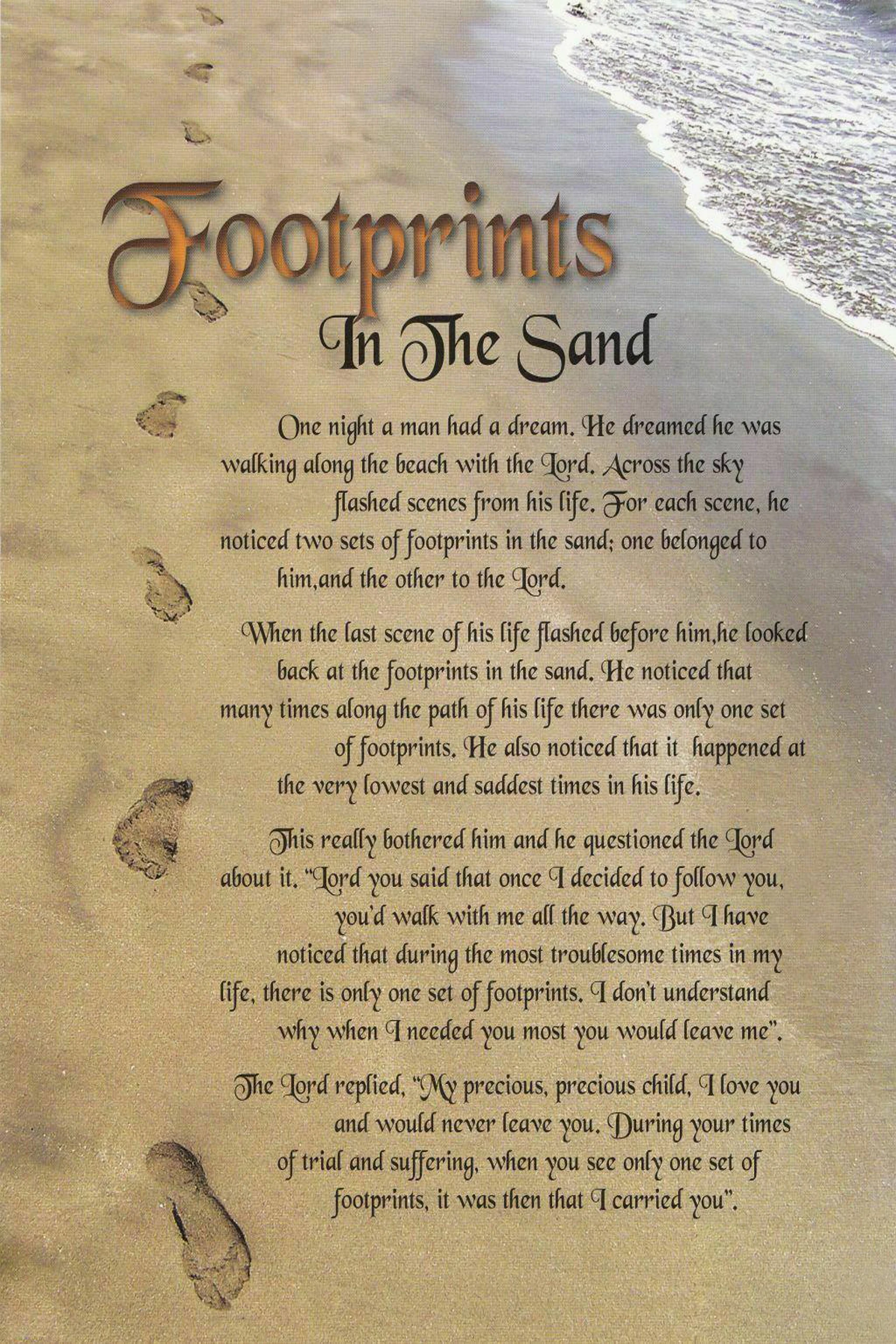
One night I dreamed a dream.
As I was walking along the beach with my Lord.
Across the dark sky flashed scenes from my life.
For each scene, I noticed two sets of footprints in the sand,
One belonging to me and one to my Lord.
After the last scene of my life flashed before me,
I looked back at the footprints in the sand.
I noticed that at many times along the path of my life, especially at the very lowest and saddest times,
There was only one set of footprints.
This really troubled me, so I asked the Lord about it.
"Lord, you said once I decided to follow you,
You'd walk with me all the way.
But I noticed that during the saddest and most troublesome times of my life,
There was only one set of footprints.
I don't understand why, when I needed You the most, You would leave me."
He whispered, "My precious child, I love you and will never leave you
Never, ever, during your trials and testings.
When you saw only one set of footprints,
It was then that I carried you."
Line-by-Line Meaning: Decoding the One Set of Footprints
The poem operates through an optical illusion. It begins with an assumption common to human experience: companionship is measured by visible evidence. The protagonist walks beside the divine figure across a shoreline, observing two parallel tracks. This setup establishes an egalitarian journey where faith feels direct, reciprocal, and trackable.
The turning point arrives in the second stanza. The narrator glances back across the full expanse of their biography. They observe a disturbing pattern: during periods of intense grief, illness, and despair, the second trail of tracks disappears. The human instinct is to equate silence with abandonment. The narrator accuses God directly of breaking a promise: "I don't understand why, when I needed You the most, You would leave me."
The closing resolution overturns the protagonist's sensory logic. The divine voice does not deny that only one set of footprints existed. Instead, it redefines the evidence entirely. The single line of steps was never the narrator walking alone; it was God carrying the narrator through the storm. The poem converts a moment of felt abandonment into proof of sustained preservation.
Biblical Meaning and Scriptures Anchoring the Shoreline Walk
While "Footprints in the Sand" does not appear in the biblical canon, its thematic framework draws straight from Old and New Testament pastoral imagery. Writers across Christian publications like Crosswalk emphasize that the text functions as an accessible midrash, a narrative illustration of core covenantal theology.
Three biblical passages provide the exact theological scaffolding for the poem's climax:
Deuteronomy 1:31: "There you saw how the Lord your God carried you, as a father carries his son, all the way you went until you reached this place." Moses delivers these words to the Israelites as they look back across four decades of wilderness wandering, using the exact metaphor of divine carriage across hostile terrain.
Isaiah 46:4: "Even to your old age and gray hairs I am he, I am he who will sustain you. I have made you and I will carry you; I will sustain you and I will rescue you." Isaiah presents God not as an indifferent observer who steps back during collapse, but as the active bearer of human weakness.
Matthew 28:20: "And surely I am with you always, to the very end of the age." The final words of Christ in the Gospel of Matthew provide the reassurance quoted almost verbatim in the poem’s opening lines.
The Bitter Authorship Controversy and Copyright Claims
The commercial explosion of "Footprints in the Sand" during the 1970s and 1980s turned an anonymous devotional piece into a multimillion-dollar licensing enterprise. Greeting cards, lithographs, plaques, and jewelry flooded Christian and secular retail chains. Because early prints circulated without an author attribution, a fierce three-way legal and public relations struggle erupted between claimants asserting intellectual property ownership.
| Claimant | Claimed Composition Date | Key Evidence & Publications | Legal & Commercial Status |
|---|---|---|---|
| Margaret Fishback Powers | 1964 | Authored the 1993 HarperCollins memoir Footprints: The True Story Behind the Poem; claimed she wrote it during a retreat in Ontario, Canada, and lost the original notebook. | Secured substantial international licensing agreements; registered Canadian copyrights; widely credited by mainstream trade publishers. |
| Mary Stevenson | 1936 | Claimed she penned the lines at age 14 in Chester, Pennsylvania, amid family hardship; produced carbon copies and typewritten drafts from vintage legal pads. | Granted U.S. Copyright Office registration in 1984 after forensic ink analysis supported the vintage of her family documents; widely accepted in U.S. markets. |
| Carolyn Joyce Carty | 1963 | Claimed she composed the piece at age 6, inspired by her great-great aunt; aggressively defended online rights and filed numerous intellectual property challenges. | Maintained continuous digital assertions and independent trademark filings, though struggled to secure court rulings invalidating Stevenson or Powers. |
The U.S. Copyright Office ended up granting registrations to multiple parties for distinct variations in phrasing, line breaks, and editorial framing. Literary historians note that nineteenth-century sermons, including an 1880 message by Charles Spurgeon describing God carrying weary pilgrims when their strength failed, had circulated identical metaphors throughout North American churches decades before any of the twentieth-century claimants were born.
Spiritual Comfort in Grief: Why Funeral Readings Rely on the Poem
Funeral directors and hospital chaplains frequently cite "Footprints in the Sand" as one of the three most requested readings for memorial services, alongside the Twenty-Third Psalm and Ecclesiastes 3. Its durability at funerals rests on psychological mechanics rather than complex theology.
Grief introduces acute isolation. Bereaved family members routinely report feeling completely separated from everyday life, unable to articulate the depth of their suffering. The poem validates that emotional state without shaming the mourner. The protagonist expresses anger and confusion directly to God, asking why protection was withdrawn when pain was sharpest.
By giving voice to doubt before delivering reassurance, the poem offers permission to grieve openly. It suggests that questioning divine presence is a natural response to catastrophe, while offering a tender reinterpretation: the absence of emotional stability does not equal the absence of support.
Cultural Adaptations from Gospel Anthems to Global Memorials
The visual metaphor of footsteps on a desolate shore translates across linguistic, political, and musical boundaries. Beyond traditional Christian retail markets, the concept has penetrated popular global music culture.
When Jamaican dancehall collective T.O.K. released their breakout single "Footprints," they transformed the beachside allegory into an urban lament for victims of violent crime. Built on an emotionally charged chord progression, the track adapted the poem’s theme of enduring spiritual presence amid tragic death. The song became a staple anthem across the Caribbean and international diaspora, played at funerals for young victims of inner-city violence.
Pop vocalists, country artists, and gospel choirs continue to adapt the text into studio albums. Its cinematic progression, a dream, a retrospective timeline, a dispute, and a whispered conclusion, fits naturally into three-act musical compositions. The image of lone footprints remains universal: a bare, unadorned mark left behind on shifting sands, representing both human frailty and the quiet grace that outlasts it.
Frequently Asked Questions (FAQ)
Q1: Who actually wrote "Footprints in the Sand"?
A1: The true single origin remains disputed. The primary claimants are Mary Stevenson (claiming 1936), Margaret Fishback Powers (claiming 1964), and Carolyn Joyce Carty (claiming 1963). Mary Stevenson secured a key U.S. Copyright registration in 1984, while Margaret Fishback Powers holds major Canadian copyrights and international publishing contracts with HarperCollins.
Q2: Is "Footprints in the Sand" directly in the Bible?
A2: No. The poem is not scripture. It is twentieth-century devotional poetry that illustrates themes found in passages like Deuteronomy 1:31, Isaiah 46:4, Psalm 23, and Matthew 28:20.
Q3: Why is the poem read so frequently at funerals?
A3: The poem directly addresses the feeling of abandonment and loneliness common in grief. Its narrative twist reassures survivors that during their darkest hours, they were carried rather than deserted.
Q4: Is the poem in the public domain?
A4: Because multiple variations exist and the exact original manuscript date remains subject to legal dispute, specific commercial editions are aggressively copyrighted by their respective claimants and publishers. However, earlier nineteenth-century sermon texts containing identical themes are in the public domain.
The Lasting Weight of Solace Across Generations
The longevity of "Footprints in the Sand" does not rely on literary prestige or academic acclaim. Critics frequently dismiss its prose as sentimental devotional verse. Yet it continues to outlast countless contemporary literary works precisely because it addresses a universal human vulnerability: the terror of walking through tragedy alone.
Whether framed on a hospice wall, recited beside an open grave, or reinterpreted in international music, the image of a single set of tracks offers a simple, enduring thesis. It reassures those facing deep loss that their survival through life's most crushing seasons was not an accident of solitary endurance, but the quiet result of being carried when their own strength gave out.


