How to Read Will Trent Books in Order: Publication vs. Chronological Fact-Check

Television adaptations frequently ignite renewed interest in long-running crime sagas, but few book catalogs carry the structural complexity found in the gritty Atlanta universe crafted by Karin Slaughter. As ABC broadcasts Season 4 of the television adaptation in 2026, fresh readers face an immediate hurdle when trying to track the Georgia Bureau of Investigation (GBI) special agent on the page. The sheer volume of material confuses newcomers: fifteen main novels, several short novellas, and a massive predecessor series that collides directly with Will’s personal life. Tracking every title across release schedules and fictional timelines requires understanding how Slaughter interlaces two separate book universes.
The confusion stems from how Slaughter built her bibliography. Will Trent does not exist in an isolated procedural vacuum. According to a parade.com Report examining Slaughter's interconnected bibliography, tracking the GBI agent accurately means understanding how prior character arcs directly fuel his core story. What appears on paper to be a straightforward detective series transforms midway through into a dual-protagonist saga that rewards readers who respect publication history over strict chronological timelines.
📌 Key Takeaways:
- Publication Sequence Wins: Following release dates prevents catastrophic narrative spoilers, particularly regarding traumatic character arcs originating outside the mainline series.
- The Grant County Predecessor: Slaughter's six-book Grant County series introduces pediatrician-coroner Sara Linton, whose backstory dictates the emotional stakes of Trent's third outing.
- Novellas Remain Optional: Mid-series novellas like Snatched and Busted offer sharp character sketches but do not alter the central case files.
The Grant County Collision: Why You Cannot Start in a Vacuum
Will Trent first appeared in 2006's Triptych. Slaughter introduced him as an intensely capable, severely dyslexic investigator working cold cases for the Georgia Bureau of Investigation alongside Amanda Wagner. Readers meeting Will in his debut novel or its 2008 follow-up, Fractured, usually assume they can march cleanly through the numbered series. That assumption shatters the moment they crack open the third novel, Undone (published as Genesis outside the United States).
In Undone, Slaughter executed an audacious literary merger. She introduced Dr. Sara Linton into the Atlanta medical examiner orbit. Linton was not a blank-slate newcomer; she had served as the beating heart of Slaughter’s six-book Grant County series, which began with Blindsighted in 2001 and concluded with the harrowing events of Beyond Reach in 2007. Linton carries devastating emotional trauma, unresolved grief, and deep cynicism when she crosses paths with Will and his partner, Faith Mitchell.
Readers who bypass the Grant County books miss the origin of Linton’s guarded emotional state. More dangerously, jumping into Undone or the subsequent novel Broken immediately spoils the catastrophic conclusion of the Grant County sequence. You do not strictly need all six Grant County books to understand how Will solves a crime scene. Yet treating Grant County as optional strips away the psychological weight that defines the second half of the entire saga.
Publication Order vs. Internal Chronology: The Case for Sticking to Release Dates
Online mystery forums frequently debate whether to read the series chronologically by setting date or strictly by publication date. Some readers attempt to construct an absolute timeline that places the prequel sequences of 2012's Criminal at the very front of the reading stack. Doing so is a major tactical mistake.
Criminal contains extensive flashbacks set in 1974. The novel documents a brutal era within the Atlanta Police Department, tracking Amanda Wagner and Evelyn Mitchell as rookie officers battling institutional misogyny while confronting a serial killer. Those flashback passages directly outline Will Trent's birth, his mother’s murder, and the secret reasons Amanda Wagner watches over him with fierce, prickly loyalty. Reading those historical segments before Triptych drains the emotional tension entirely. Will's childhood remains a raw, haunting mystery throughout his early novels; solving that mystery before he even works his first on-page case robs the narrative of its power.
Slaughter constructed the series with deliberate psychological reveals. She reveals Will's literacy challenges, his torturous on-and-off marriage to Angie Polaski, and his physical scars across successive novels. A strictly chronological re-sort damages character pacing that took years to cultivate.
The Complete Reading Order: Mainline Novels, Novellas, and Critical Crossovers
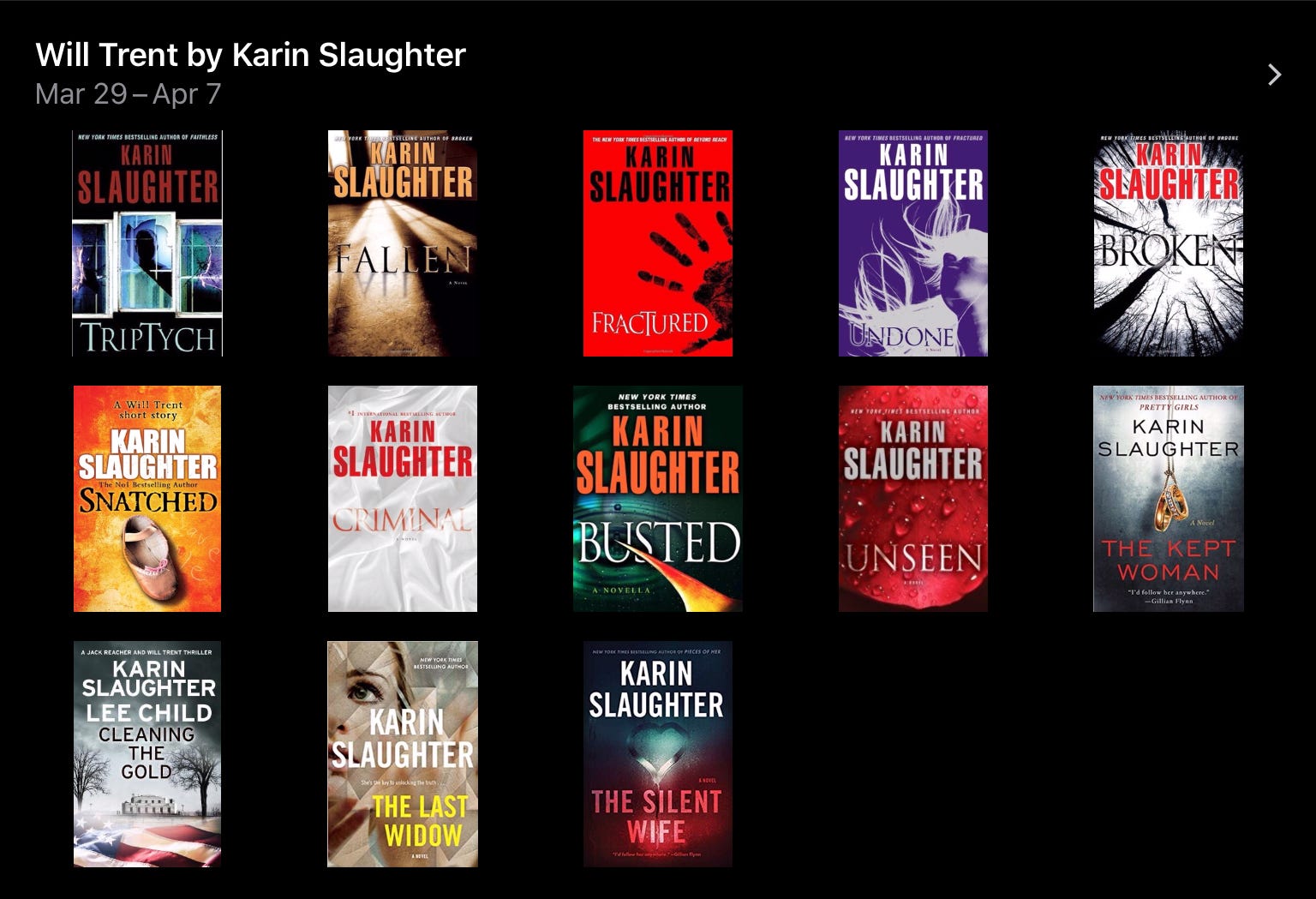
To navigate the sequence cleanly without spoiling prior developments, readers should prioritize the publication order of the main novels while inserting novellas at their natural points of entry. The table below details the canonical progression through the 2024 release This Is Why We Lied.
| Title | Release Year | Format & Universe Placement | Primary Focus / Core Arc |
|---|---|---|---|
| Triptych | 2006 | Will Trent #1 | Introduces Will Trent and Angie Polaski; serial killer hunt in Atlanta. |
| Fractured | 2008 | Will Trent #2 | Establishes the permanent investigative partnership between Will and Faith Mitchell. |
| Undone (aka Genesis) | 2009 | Will Trent #3 / Crossover | Sara Linton officially enters the Atlanta GBI investigative circle. |
| Broken | 2010 | Will Trent #4 / Crossover | Direct reckoning with Grant County history as Will conducts an inquiry on Sara's home turf. |
| Fallen | 2011 | Will Trent #5 | Hostage situation involving Faith Mitchell’s mother, former police captain Evelyn Mitchell. |
| Snatched | 2012 | Novella #5.5 | Short airport abduction case; highlights Will and Faith’s instincts under sudden pressure. |
| Criminal | 2012 | Will Trent #6 | Dual timeline: 1974 origins of Amanda Wagner paired with modern-day kidnapping cases. |
| Busted | 2013 | Novella #6.5 | Convenience store robbery that bridges personal storylines between major cases. |
| Unseen | 2013 | Will Trent #7 | Undercover drug cartel infiltration featuring Lena Adams from Grant County. |
| The Kept Woman | 2016 | Will Trent #8 | Investigation at an abandoned construction site uncovers ties directly back to Angie Polaski. |
| Cleaning the Gold | 2019 | Novella (Crossover) | Co-written with Lee Child; Will Trent goes undercover at Fort Knox and clashes with Jack Reacher. |
| The Last Widow | 2019 | Will Trent #9 | Domestic terrorism plot involving an explosive kidnapping at the CDC campus. |
| The Silent Wife | 2020 | Will Trent #10 | Prison riot forces a reinvestigation of an old serial predator case handled in Grant County. |
| After That Night | 2023 | Will Trent #11 | Sara confronts the traumatic assault from her medical school past via an emergency room case. |
| This Is Why We Lied | 2024 | Will Trent #12 | Isolated locked-room murder mystery during Will and Sara's honeymoon at remote McAlpine Lodge. |
Integrating the Will Trent Novellas: Essential Context or Skippable Extras?
Slaughter has penned three short works featuring Will Trent. These novellas trigger endless debates among readers trying to keep their digital libraries organized.
Snatched (2012) drops Will and Faith into an urgent kidnapping scenario at Hartsfield-Jackson Atlanta International Airport. It clocks in at under 100 pages. The piece functions primarily as a rapid-fire showcase of Will’s observational acuity. It does not introduce enduring plot threads that alter subsequent novels. Busted (2013) follows a similar formula, isolating Will during an ordinary convenience store stop that turns deadly.
The anomaly in the novella catalog is 2019's Cleaning the Gold. Slaughter collaborated with Lee Child to pit Will Trent directly against wandering vigilante Jack Reacher. Set at Fort Knox, the story relies on a classic misunderstanding trope: both men are working undercover for separate agencies and mistake each other for the criminal mastermind. It is a wildly entertaining piece of thriller fan service. You will not lose the thread of the mainline Atlanta continuity if you bypass it, but seeing Will try to psychoanalyze Reacher's immense physical footprint remains a high point for dedicated readers.
From Criminal to This Is Why We Lied: Managing the Late-Series Continuity
The later entries in the series mark a distinct tonal evolution. Slaughter shifted the narrative balance from purely horrific criminal puzzles to deep character preservation. By the time readers reach 2016's The Kept Woman, the toxicity of Will’s past with Angie Polaski comes to a head. Angie stops functioning as an occasional saboteur; she becomes an unavoidable linchpin in a sweeping murder inquiry that forces Amanda Wagner and Will to confront their shared history.
This emotional continuity peaks in the run from The Silent Wife through This Is Why We Lied. In After That Night (2023), Slaughter pulls Sara Linton’s formative college trauma into sharp focus. The case tests Will’s instincts not as an investigator, but as a supportive partner attempting to avoid crossing professional boundaries. Then, 2024's This Is Why We Lied strips away the familiar institutional resources of the GBI. By stranding Will and Sara during their honeymoon at an isolated, storm-battered mountain lodge in North Georgia, Slaughter delivers a classic locked-room setup that depends entirely on decades of earned character trust.
Approaching these later titles as standalone thrillers diminishes their impact. The plots hold up on their procedural merits, but the emotional tension relies on understanding fifteen years of cumulative psychological scars.
Frequently Asked Questions (FAQ)
Do I have to read the Grant County series before starting Will Trent?
Strictly speaking, no. You can enjoy Triptych and Fractured without knowing anything about Grant County. However, once you reach book three, Undone, Sara Linton joins the core cast. Reading Grant County first protects you from massive plot spoilers and gives Linton's personal trauma far more resonance.
How closely does the ABC television show follow the books?
The television series diverges significantly from Karin Slaughter's novels. The show alters character dynamics, changes Faith Mitchell's health profile, reimagines Amanda Wagner's demeanor, and completely excises Sara Linton from the initial seasons. Viewers coming from the television screen should treat the novels as an entirely separate, significantly darker universe.
Can I start the series with the 1970s backstory in Criminal?
Avoid doing this. While Criminal explores the historical events surrounding Will's birth in 1974, it weaves those flashbacks against a modern case. Reading it first ruins the structural mystery of Will's origins that Slaughter carefully preserves across the first five novels.
Are the novellas required reading to understand the main novels?
No. Snatched, Busted, and Cleaning the Gold serve as supplemental material. They supply sharp, entertaining character work, but skipping them will not leave you confused when picking up the mainline entries.
Navigating Slaughter's Atlanta Beyond the Screen in 2026
Television adaptations streamline messy realities to fit forty-minute procedural beats. Karin Slaughter’s written universe refuses that tidy simplicity. The Will Trent series endures because its protagonist carries lifelong physical and emotional scars that never magically vanish between chapters. Dyslexia remains an everyday friction point. Childhood trauma remains an open wound. Fractured relationships with Amanda Wagner and Angie Polaski do not resolve overnight.
If you want the fullest possible reading experience, start with Grant County's Blindsighted, push through to Beyond Reach, and then transition directly into Triptych. If time is limited, pick up Triptych directly and follow the mainline publication order through This Is Why We Lied without reordering the timeline. That sequence delivers the character reveals exactly as Slaughter intended, keeping the stakes high across two full decades of Atlanta crime fiction.


