‘If Not Friend, Why Friend-Shaped?’ The Evolutionary Science Behind Cute Memes
A 900-pound grizzly bear sits waist-deep in an Alaskan river, round belly floating softly against the current, blinking sleepy eyes at a remote trail camera. Within hours, screenshots cascade across digital feeds alongside four recurrent words: "If not friend, why friend-shaped?" It is a defining artifact of modern internet culture. As tracked across digital subcultures, from everyday feeds to franchise roundups like the Daily Star Trek News Report charting community meme cycles, our visual media has become thoroughly saturated with round, vulnerable interpretations of the wild world.
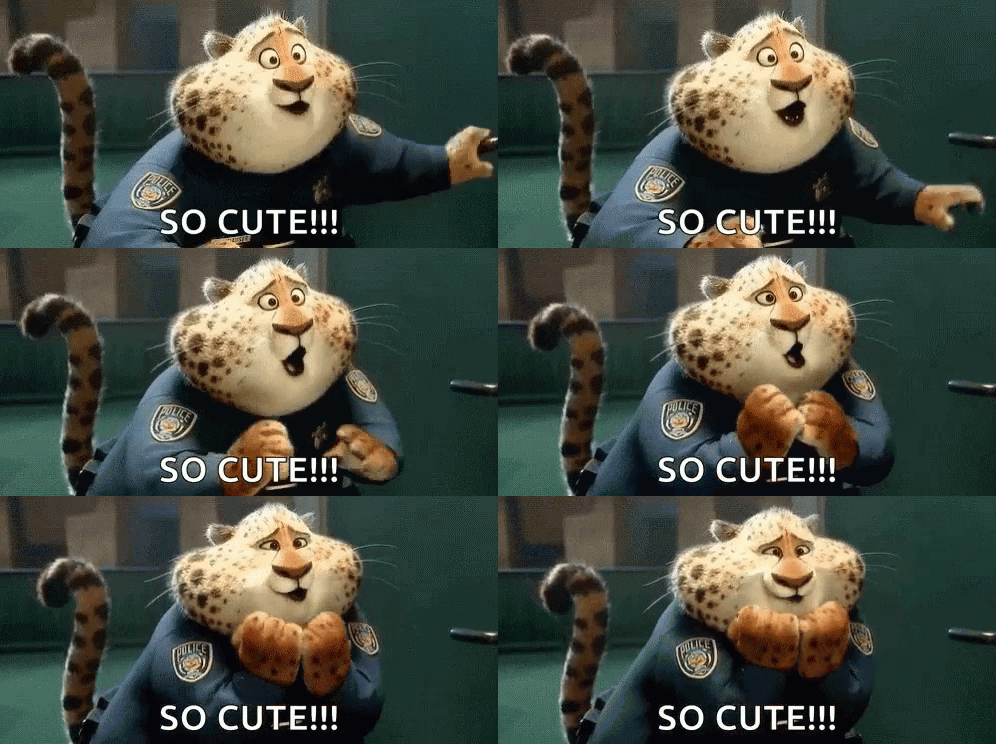
The urge to pet an apex predator is not mere digital irony. It reveals an evolutionary wiring error. When users share an intensely tender "so cute meme" showing a venomous blue-ringed octopus or an oversized manatee, their visual cortexes are falling prey to ancient evolutionary survival systems hijacked by contemporary screen habits.
📌 Key Takeaways:
- The Evolutionary Glitch: The viral "friend-shaped meme" phenomenon stems from baby schema (Kindchenschema), an ancient primate instinct that mistakes physical roundness and big eyes for harmless infants.
- The Brain's Defense: When a visual asset is overwhelmingly adorable, the brain triggers cute aggression, a psychological compensation mechanism that prevents cognitive paralysis by mixing nurturing instincts with violent impulses.
- The Escapism Economy: Cat memes virality and wholesome memes have transformed from casual distraction into an organized form of digital comfort culture, offsetting algorithmic anxiety and high-stress informational environments.
Konrad Lorenz and the Hardwired Hijack of Baby Schema
In 1943, Austrian ethologist Konrad Lorenz introduced the concept of Kindchenschema, or baby schema. Lorenz identified specific morphological markers: a disproportionately large head, a high protruding forehead, large eyes positioned below the midline of the face, chubby cheeks, and clumsy limbs. These traits trigger instinctive, unlearned parental care in humans.
Human infants are born altricial, meaning they are completely helpless. Our survival as a species depended entirely on an adult brain that rewarded close attention to those specific physical shapes. When sensory neurons register these proportions, the nucleus accumbens lights up, delivering an immediate dopamine trigger. The reaction is automatic. You do not decide to find an infant endearing; your neurochemistry enforces it.
Modern visual culture exploits this circuit with surgical precision. The internet psychology of reaction image templates relies on the instant capture of this neurological pathway. Social platforms have stripped Lorenz’s biological safeguard of its original context. When users encounter a seal pup or a Scottish Fold kitten staring into an iPhone lens, their reward systems register an infant in need of protection, regardless of the species staring back.
Why Lethal Apex Predators Look Intolerably Huggable
The friend-shaped meme works because nature frequently wraps lethal anatomical machinery in deceptively soft geometry. Pallas’s cats, native to Central Asia's cold grasslands, possess thick, spherical coats and wide-set, circular ears designed to resist sub-zero temperatures. Their bodies are optimized for stealth and thermal retention. To human eyes, they resemble overstuffed throw pillows.
Polar bears exhibit similar morphology: dense fat layers, round ears to prevent frostbite, and heavy, padded paws. The human brain interprets roundness as safety. Sharp edges, angular jaws, and erratic movement signal threat; circular contours, soft textures, and rolling gaits evoke mammalian cradles.
When digital users share images of wild hyenas, poison dart frogs, or waddling raccoons under the guise of an absurdly affectionate "so cute meme," their higher-order reasoning is engaged in a joke, but their subcortical processing is genuinely deceived. The incongruity between deadly reality and harmless appearance generates viral humor. The brain struggles to resolve a contradiction: the creature can kill you, yet every ancient aesthetic cue insists it wants a chin scratch.
Cute Aggression: Why Overwhelming Adorableness Provokes Hostility
You have seen a picture of an extraordinarily fluffy puppy and muttered, "I want to squish it until it pops," or found yourself clenching your jaw while viewing tiny animal paws. Psychological researchers call this dimorphous expression cute aggression.
A landmark 2015 Yale University study led by Oriana Aragón demonstrated that intense positive feelings occasionally express themselves through superficially aggressive behaviors. In 2018, neuroscientist Katherine Stavropoulos used electrophysiology to record brain activity in individuals looking at baby-schematic creatures. The results confirmed that both the brain's reward system and its emotional regulation networks activate simultaneously.
Cute aggression functions as an evolutionary circuit breaker:
- Sensory Overdrive: An image of a disproportionately round creature floods the mesocorticolimbic pathway with dopamine, creating a temporary state of emotional dysregulation.
- The Incapacitation Threat: If a caregiver becomes overwhelmed by affection for an infant, their ability to defend that infant from actual environmental threats drops to zero.
- The Regulative Rebound: The prefrontal cortex injects a flash of pseudo-aggressive tension, clenching teeth, curling fists, squeezing motions, to shock the brain back to an alert, functional state.
Online, this neurological counter-weight manifests in hyperbolic comment threads. Users post about wanting to "bite," "destroy," or "swallow whole" whatever animal currently graces their screens, translating a legitimate neurochemical balancing act into digital patter.

The Architecture of Cuteness: How Digital Comfort Culture Evolved
Internet humor did not stumble upon cuteness by accident. The phenomenon evolved systematically through shifts in visual communication, changing from early 2000s text-captioned animals into high-velocity emotional tools.
| Meme Era | Dominant Formats | Psychological Utility | Primary Visual Cues |
|---|---|---|---|
| 2006, 2012 | Lolcats, I Can Has Cheezburger, Early YouTube Pets | Novelty, mild amusement, nascent forum bonding | Impact font, broken syntax, low-resolution stills |
| 2013, 2019 | Doge, Smol Animals, Grumpy Cat, Wholesome Memes | Irony mitigation, emotional anchoring during political tension | Internal monologues, high-saturation photos, micro-narratives |
| 2020, 2026 | Friend-Shaped, Capybara TikTok, Loafing Cats, Binturong Reels | Social media escapism, autonomic regulation, radical coziness | Short-form vertical video, ambient audio, ultra-high frame rates |
This shift charts a clear path. Early animal humor relied on mocking the animal's interior life through anthropomorphized language. Today's formats strip away irony in favor of radical comfort. The popularity of the capybara across 2023, 2026 feeds reflects this desire: an unbothered, barrel-shaped rodent that sits placidly alongside pelicans, crocodiles, and house cats without flinching. It represents sensory grounding in a world marked by information overload.
Kawaii Aesthetics and the Industrial Mechanics of Cat Memes Virality
The viral power of animal imagery owes a significant debt to Japanese kawaii aesthetics, a design philosophy refined across five decades. Pioneered in commercial mascots like Sanrio's Hello Kitty, kawaii systematically isolates baby schema features: mouthless faces that mirror the viewer's emotions, large heads, flat profiles, and rounded extremities.
When Western social media expanded, it adopted these exact visual rules. Domestic cats became the undisputed engine of internet culture because they possess naturally neotenic facial structures: broad cheekbones, forward-facing predatory eyes, and small noses. A 2021 review by media analysts demonstrated that short-form videos featuring domestic cats consistently maintain retention rates up to 34% higher than comparable non-animal lifestyle content.
Algorithms favor these formats because they require zero translation. A human in Tokyo, an office worker in São Paulo, and an engineering student in Berlin share identical neurological reactions to a kitten falling asleep inside a coffee mug. Digital platforms prioritize this universal biological shorthand. The content evades language barriers, bypasses ideological fatigue, and reliably triggers a mild dopamine surge, guaranteeing high completion rates and widespread private sharing.
Social Media Escapism as a Physiological Calming Mechanism
The endless circulation of wholesome animal media is often dismissed as empty distraction. Sociological analyses suggest an alternate reality: it is a functional coping tool. In periods of high socio-economic volatility, users consistently migrate toward digital comfort culture.
Viewing small, harmless, or humorously round animals triggers the release of oxytocin and lowers salivary cortisol levels. This constitutes an accessible form of emotional management. Rather than disconnecting from screens entirely, users deploy cute media as an organic shield against negative algorithmic feeds. It provides an immediate emotional lift, counteracting constant alerts about climate volatility, economic strain, and social friction.
The "so cute meme" is not evidence of internet culture becoming simpler. It is an intentional, collective retreat toward primary biological comfort, using ancient parenting circuits to stay calm in an increasingly frantic world.
Frequently Asked Questions (FAQ)
Q1: Why do people call dangerous predators "friend-shaped"?
A1: The phrase originates from online absurdism, highlighting the contrast between an animal's fatal predatory capabilities (such as those of a bear, seal, or large cat) and its soft, rounded, baby-like physical traits. It points out how our evolutionary instinct to embrace round things clashes directly with basic survival logic.
Q2: Is cute aggression considered a mental health disorder?
A2: No. Cute aggression is a normal, healthy neurological reaction known as a dimorphous expression of emotion. It acts as an internal regulator, helping the brain regain emotional control when it feels overwhelmed by intense feelings of affection and care.
Q3: How does looking at cute memes change our day-to-day productivity?
A3: Research from Hiroshima University conducted by Hiroshi Nittono revealed that viewing images of baby animals actually improved participants' focus and motor control on subsequent tasks. The underlying maternal/paternal care circuit encourages careful, deliberate, and attentive behavior.
The Future of Digital Comfort Culture
The human appetite for neotenic, round creatures is neither an accident nor an internet fad. It is an enduring neurological instinct that survived millennia of human migration, only to find a home in our everyday digital platforms. As visual mediums push into hyper-realistic video generation and AI-curated feeds, the evolutionary demand for simple, soft companions will only grow stronger. Whenever daily feeds become overwhelming, the mind seeks refuge in basic forms: two wide eyes, a circular face, and a harmless posture reassuring an anxious brain that, despite everything, the world contains things worth protecting.


