Kings in the Corner Rules Fact-Check: Official Bicycle Standards vs. House Rules

Few pastimes create as many sudden arguments around the dining table as Kings in the Corner. Originating as a classic multiplayer solitaire variant, the game has traveled through generations by word of mouth, picking up conflicting local traditions along the way. Much like the disputes over chaotic set-piece setups documented in this Football365 Report on tactical corner controversies, tabletop competitions easily collapse into heated disagreements when family folklore collides with official documentation.
When one player insists that only a King can fill an open cross space while another begins transferring entire five-card stacks across the board, the game grinds to a halt. The official United States Playing Card Company documentation outlines a streamlined, balanced game. Unraveling decades of family house modifications reveals how the game was engineered to run.
📌 Key Takeaways:
- The Setup Standard: Each participant receives seven cards, and the dealer establishes four original foundation piles pointing North, South, East, and West around the draw pile and stock.
- The King Exclusivity: Diagonal corner slots belong exclusively to Kings, which establish four additional foundation piles to form an eight-space tableau.
- Open Space Freedom: According to Bicycle official card rules, an empty space within the primary cross can be filled by any card or legally built stack from a player's hand, not solely a King.
- Scoring Rigor: Penalty tallies penalize hoarders: players pay one chip per leftover card and ten chips per unplayed King caught in hand when someone goes out.
The Cross Layout Setup and Opening Mechanics
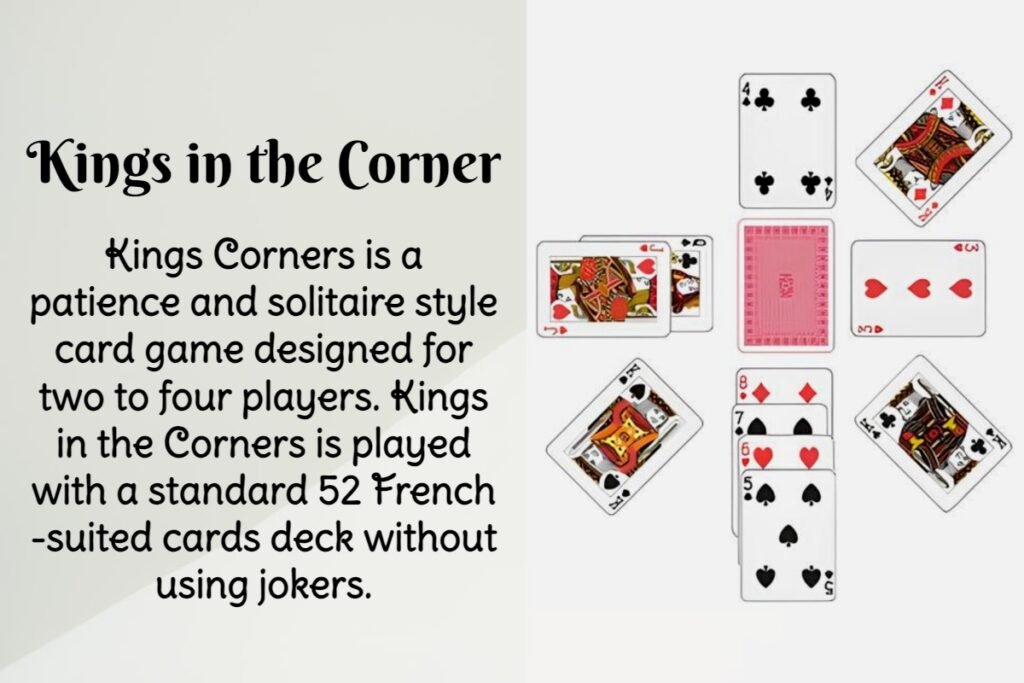
Preparation requires a standard 52-card deck without Jokers and a supply of gaming tokens or chips. The dealer distributes seven cards face-down to each participant in a two- to four-player game. Four cards are then drawn from the remaining deck and placed face-up in the center of the table, oriented at twelve, three, six, and nine o'clock. This cross layout setup establishes the active play area.
The remaining cards form the central draw pile and stock, resting face-down in the square formed by the four face-up cards. Four empty spaces remain at the diagonals. These diagonal slots remain vacant at the start of the match. They represent the corner King placement zones, which can only be activated once a King surfaces during active play.
Every player begins by tossing a pre-agreed buy-in, typically one chip, into the center pot. If any of the four initial layout cards is a King, it is slid diagonally into the nearest corner foundation, and a fresh card from the stock is flipped to replace its original cross position before the opening turn begins.
Turn Cadence, Descending Sequences, and Color Alternation
The player to the dealer’s left starts the game, establishing the clockwise card play order. Every active turn begins with an unskippable action: the player must draw the top card from the stock. Neglecting to draw before playing is one of the most frequent errors at amateur tables.
Once the card is drawn, the player may execute an unlimited number of legal moves. Kings Corners rules govern these movements through a strict descending card sequence and an alternating red and black suit requirement. A black seven must be placed on a red eight; a red Queen must sit atop a black King.
The Ace operates strictly as the lowest card in the game. It possesses a numerical value of one and sits only on a two. Wrapping around, such as playing a King onto an Ace, is prohibited under official standards. A turn ends only when the player declares they can no longer make a play or voluntarily chooses to stop, at which point play passes to the left.
Resolving the Stack-Transfer Controversy
The sharpest disagreement during family game night concerns the movement of pre-existing stacks. When a foundation pile’s bottom card matches the suit and sequence criteria of another pile's top card, can the player move the entire column?
Under official tournament and publisher rules, moving whole, correctly sequenced piles is legal. If Pile A shows an eight of diamonds topped by a seven of clubs and a six of hearts, and Pile B displays a nine of spades, the player may lift the entire three-card column from Pile A and merge it onto Pile B.
This move immediately vacates an active space on the board. Players who forbid stack transfers inadvertently drag out matches, inflating the draw pile and stock until the game stagnates. Allowing full-stack migration increases strategic depth, rewarding individuals who orchestrate combination plays to expose the table.
Empty Space Navigation: Any Card vs. Royalty Only
No single Kings in the Corner dispute triggers more table arguments than what happens when a primary cross pile is cleared. When a player moves a stack to another pile, an empty slot opens in the original cross layout.
Widespread house folklore holds that this empty space must stay vacant until someone plays another King. This is incorrect. Official rules state that an empty original cross space can be claimed by any card or legally sequenced stack from the active player's hand.
Kings are the only cards permitted to establish the diagonal corner slots. The primary four cross positions are open territory. If an interior cross position opens, a player can place a standalone five, an Ace, or a pre-arranged three-card run into the breach. Restricting open slots to Kings breaks the game’s core mechanics, leaving players with dead hands and prematurely depleting the stock.
| Rule Mechanic | Bicycle Official Standard | Common House Variation | Impact on Game Balance |
|---|---|---|---|
| Empty Cross Spaces | Any single card or run may fill the void. | Only Kings may fill cleared spaces. | House variant causes hand bloat and slows pace. |
| Stack Transfers | Entire legal columns can merge onto others. | Cards must be moved one by one. | Official standard rewards combo planning. |
| Pass Penalty | No chip penalty for passing without plays. | Pay 1 chip to pot if no cards played. | House rule inflates pot; official speeds play. |
| Corner Foundation Placement | Kings only; runs descend King to Ace. | Any royal face card opens corners. | House rule removes King value and ruins board structure. |
| Endgame Penalties | 1 chip per card; 10 chips per King. | Flat 1 chip per card regardless of rank. | Official rules punish King-hoarding strategies. |
Chip Pot Scoring and Penalty Tallying
The round ends the moment a player lays down their final card, achieving the objective known as "going out." Play ceases instantly. The winner claims the accumulated chip pot scoring pool gathered through the initial ante and mid-game penalties.
Remaining players must calculate their going out penalty points to feed the winner's haul:
- Each card left in hand incurs a one-chip penalty payable to the round winner.
- Any unplayed King retained in hand incurs a steep ten-chip penalty.
This penalty framework prevents players from hoarding Kings to block opponents. If you hold Kings hoping for ideal board conditions, you risk getting caught during a sudden exit by a competitor. Multi-round sessions typically establish an elimination boundary: players receive fifty chips, and the match continues until all but one competitor go bankrupt.
Frequently Asked Questions (FAQ)
Can an Ace be played on a King to wrap around the sequence?
No. Official rules treat the Ace as the lowest card in the deck, with an absolute value of one. Sequences run strictly downward from King through Queen, Jack, and numerical cards to the terminal Ace. No card may be placed on an Ace.
What happens if the stock pile runs completely out of cards?
If the central draw pile and stock is exhausted before any player empties their hand, play proceeds in clockwise order without drawing. Players continue manipulating foundation piles, moving stacks, and playing cards from their hand until someone successfully goes out or all players pass in succession.
Are players forced to pay a chip if they cannot play a card on their turn?
Under strict Bicycle rules, no. A player must draw their single mandatory card, play whatever they legally can (or want to), and pass without penalty. Forcing a one-chip penalty for an inability to play is a widespread house modification designed to inflate the pot.
Establishing Cohesion at the Modern Gaming Table
The enduring appeal of Kings in the Corner lies in its fusion of solitaire-style puzzle solving with direct, defensive multiplayer friction. Yet, like many classic card games passed down through casual play, its rulebook has suffered from generational drift.
Reclaiming the official 52-card standard sharpens the game, replacing sluggish stalemates with calculated maneuvers. Stacks migrate across the board, open cross slots welcome strategic redeployments, and the threat of a ten-chip penalty keeps Kings in active play. Before dealing the opening seven cards, take sixty seconds to clarify stack moves, cross fills, and King penalties with your group. Establishing those ground rules upfront protects the integrity of the game and keeps family game night focused on the cards.


