Meet the Goliath Frog: The Massive Amphibian That Actually Builds Its Own Ponds

In the rushing river basins of Central Africa, one amphibian shatters standard biological expectations. Weighing up to 7.3 pounds (3.3 kilograms) and measuring more than 13 inches (34 centimeters) from snout to vent, the Goliath frog (Conraua goliath) is verified as the largest frog species on Earth. Recent ecological findings, highlighted in coverage by The Times of India Report, illustrate that this giant animal is far more than a biological curiosity, it functions as an active hydrological engineer.
While popular perception often casts oversized amphibians as lethargic river sitters, this Cameroon and Equatorial Guinea native exhibits muscular physical agency. Field biologists working along torrential rainforest waterways have documented the frog excavating coarse gravel, displacing thick river debris, and physically rolling boulders weighing more than half its body mass to build secure nurseries.
📌 Key Takeaways:
- Physical Scale: Conraua goliath reaches up to 7.3 pounds (3.3 kg) and stretches over 32 inches (80 cm) with legs fully extended, dwarfing all other anuran species.
- Civil Engineering Instincts: Adult frogs quarry stones weighing up to 4.4 pounds (2 kg) to create secluded rock-walled nurseries along rapid riverbanks.
- Parental Investment: Males stay by constructed pools through the night to protect offspring from violent torrents and aquatic predators.
- Habitat Vulnerability: Confined to a narrow coastal corridor of old-growth rainforest, the species faces relentless threats from commercial logging and local bushmeat trade.
The Extreme Anatomy of Conraua Goliath
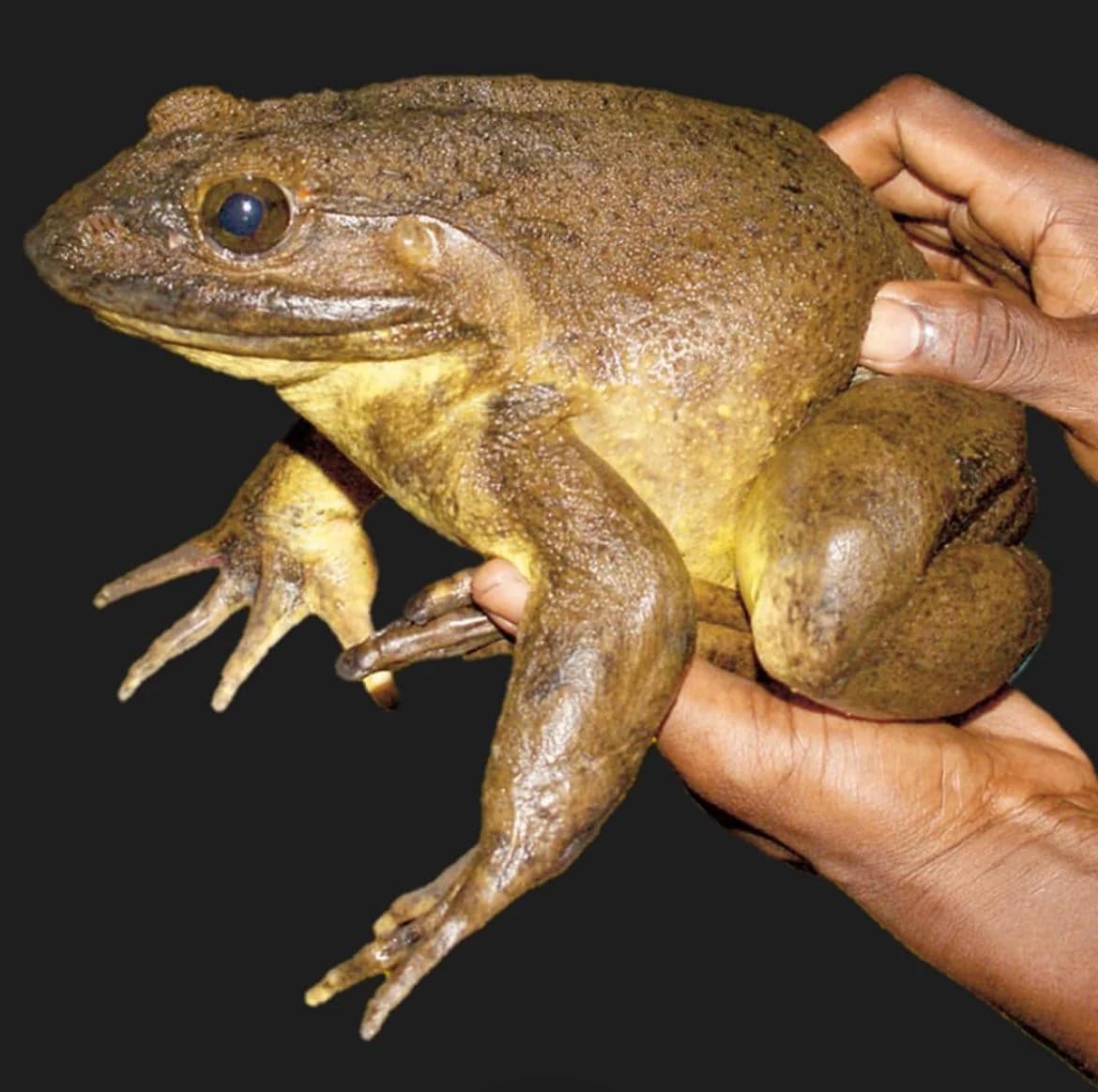
Seeing a Goliath frog in the field redefines what seems anatomically possible for an anuran. If suspended by its front limbs, an adult specimen easily matches the length of an average domestic house cat, spanning over 32 inches (80 centimeters) from its snout to its webbed rear toes. Their thighs are thick and heavily corded with muscle, giving them the explosive leverage to leap nearly 10 feet (3 meters) across whitewater channels in a single bound.
Unlike most frogs that fill warm summer nights with deafening choruses, the Goliath frog lacks a vocal sac. It cannot produce the deep, booming mating calls typical of standard bullfrogs. Instead, it relies on whistling sounds or simply opens its mouth wide to create sharp gurgles, relying on kinetic body language, territorial positioning, and chemical cues within high-velocity river rapids.
Its skin texture is uniformly granular and warty, bathed in mottled olive-green and earthen-brown shades along the dorsal side, while its belly displays a warm orange-yellow wash. This cryptic coloration renders the creature invisible when pressed against mossy granite boulders along fast-flowing waterfalls.
Engineering River Nurseries: The Rock-Shifting Discovery
The most groundbreaking scientific insight regarding the Goliath frog came when a research team from the Natural History Museum in Berlin, working alongside local hunters along the Mpoula River in western Cameroon, systematically mapped 22 separate breeding sites. For generations, regional bushmeat hunters insisted the frogs built their own ponds, but Western biology largely dismissed these claims as folklore until field surveys documented the physical structures.
The researchers categorized these engineering efforts into three distinct architectural designs:
- Pond Type 1 (Sediment Clearing): The frogs locate natural rock pools on large riverbank boulders, scrubbing away dense leaf litter and decomposing organic matter to prevent oxygen depletion.
- Pond Type 2 (Sediment Expansion): The frogs locate shallow pools on the river’s sandy fringe, bulldozing outward using their muscular hind legs to establish circular borders out of collected gravel and wood debris.
- Pond Type 3 (Quarried Rock Dams): The most sophisticated structures involve clearing circular perimeter depressions and physically hoisting rocks weighing up to 4.4 pounds (2 kilograms) into sturdy perimeter dams.
This rock-shifting behavior requires astonishing physical force. Male frogs push, shove, and leverage river rocks, dislodging stones from the stream bed and rolling them into place to wall off a stable pool from turbulent river currents.
| Species | Max Weight | Snout-to-Vent Length | Breeding Habitat Strategy |
|---|---|---|---|
| Goliath Frog(Conraua goliath) | 7.3 lbs (3.3 kg) | 12.6, 13.4 in (32, 34 cm) | Excavates and quarries custom rock nurseries along turbulent rivers |
| Cane Toad(Rhinella marina) | 5.8 lbs (2.6 kg) | 8.0, 9.4 in (20, 24 cm) | Lays continuous strings of toxic eggs in still ditches, ponds, and canals |
| African Bullfrog(Pyxicephalus adspersus) | 4.4 lbs (2.0 kg) | 9.0, 10.0 in (23, 25 cm) | Digs small channels between shallow rain pools to prevent tadpole desiccation |
| American Bullfrog(Lithobates catesbeianus) | 1.8 lbs (0.8 kg) | 6.0, 8.0 in (15, 20 cm) | Deposits large surface film egg masses in stagnant, vegetated wetlands |
| Blyth's River Frog(Limnonectes blythii) | 2.2 lbs (1.0 kg) | 7.5, 10.2 in (19, 26 cm) | Scoops shallow depressions in soft gravel or sand near forest trickles |
Why Evolution Favored Amphibian Stonemasons
The evolutionary driver behind this heavy labor is survival in violent hydrology. The swift-running, oxygen-rich mountain streams of equatorial Africa present severe hazards for amphibian reproduction. Flash floods can scour riverbeds bare within minutes, washing fragile eggs and tiny larvae downstream into the jaws of predatory fish like mormyrids and cichlids.
By quarrying self-contained rock basins along the edge of the torrent, the Goliath frog creates a calm microhabitat. The stone barrier breaks the pounding force of downstream surges while allowing clean, well-oxygenated water to seep through porous spaces between the stones.
Field cameras set up during field surveys recorded adult frogs standing sentry beside these constructed dams long after eggs were fertilized. The males often position themselves directly across the barrier entrance through the night, discouraging rivals and deterring predators from slipping inside. This level of physical investment and prolonged parental guarding represents one of the most energetically taxing reproductive behaviors ever documented among anurans.
The Narrow Ecological Niche Across Cameroon and Equatorial Guinea
Unlike versatile generalists such as the cane toad, the Goliath frog is an ecological specialist. Its entire wild range is limited to an area extending roughly 125 miles (200 kilometers) inland along the southwestern coast of Cameroon down to the northern river basins of Equatorial Guinea, notably along the Benito River.
These amphibians demand pristine, fast-flowing forest rivers characterized by:
- Highly oxygenated water with strong rapids and waterfall cascades.
- Dense forest canopies that prevent water temperatures from climbing too high.
- Abundant riverbed stones and rocky outcrops suited for both hiding and nest building.
- An uninterrupted supply of specialized aquatic vegetation (Dicraeanthus africanus), a riverweed that adheres to submerged rocks and serves as the primary food source for their herbivorous tadpoles.
When commercial logging operations fell surrounding trees, sunlight hits the stream bed directly, raising water temperatures and choking out the specific macroflora their larvae depend upon. Siltation caused by road construction and agricultural clearing fills in natural river fissures, eliminating the deep crevices where adult frogs shelter during the heat of the day.
Human Pressures and the Realities of Bushmeat Exploitation
Despite its status as an evolutionary marvel, Conraua goliath is categorized as Endangered on the IUCN Red List. The species faces persistent hunting pressure across its fragmented river corridors.
In regional markets throughout Cameroon and Equatorial Guinea, a mature Goliath frog commands premium prices, often selling for $15 to $20 USD each. Local communities view the meat as a culinary delicacy and an esteemed gift during cultural ceremonies. Hunters target the species at night using powerful headlamps and harpoons or specialized traps woven from forest vines and submerged near waterfall bases.
Because the frogs take several years to reach their full mass and sexual maturity, harvesting adult breeding stock causes population crashes in affected river drainages. Decades of unmanaged exploitation, paired with past captures for the international pet trade and illegal exotic animal collections, have eradicated the frog from dozens of historical streams.
Frequently Asked Questions (FAQ)
Q1: Can Goliath frogs be kept as pets or bred in home aquariums?
A1: No. Goliath frogs do not survive in domestic terrariums. They demand massive volumes of fast-flowing, oxygenated, cold water and require extensive physical space to prevent fatal injuries caused by jumping into glass walls. Captive breeding programs in zoological institutions have almost universally struggled due to the frog's complex nesting requirements.
Q2: What does an adult Goliath frog eat in the wild?
A2: Adult Goliath frogs are generalist carnivores. Their wild diet consists primarily of crabs, freshwater prawns, large aquatic insects, smaller frogs, scorpions, small fish, and occasionally juvenile snakes or young birds that come too close to the river’s edge.
Q3: Does the Goliath frog have a loud mating call like other bullfrogs?
A3: No. The species completely lacks vocal sacs and vocal slits. Because they inhabit the deafening roar of cascading waterfalls and river rapids, airborne acoustic calls are largely ineffective. Instead, they make sharp whistling sounds, exhibit visual displays, and build physical nesting sites to attract mates.
Conserving the Forest Engineers of Central Africa
Protecting the Goliath frog requires prioritizing habitat corridors over individual species intervention. Field researchers now collaborate with indigenous communities along the Mpoula and Loungahé river networks, recruiting former bushmeat hunters as paid ecological monitors and community conservation rangers.
When local hunters lead the monitoring effort, tracking breeding pools and safeguarding nesting zones from illegal poaching, juvenile survival rates jump noticeably. Ensuring the survival of this amphibian giant demands continuous, unbroken canopies of primary rainforest and unpolluted riverways. Safeguarding these rapid rivers preserves an extraordinary wildlife architect that reshapes its freshwater home stone by stone.