Not a Hollywood Backlot: The Real Florida Town Behind The Truman Show's Eerie Utopia
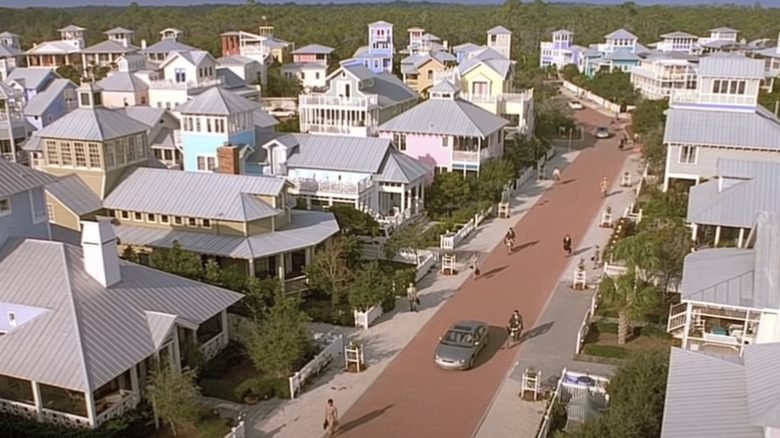
When director Peter Weir set out to build the artificial world of Seahaven Island for Paramount Pictures in the late 1990s, the initial plan called for an expensive, fully built soundstage backlot. Instead, Weir found an existing community along the Florida Panhandle whose manicured white picket fences, neoclassical gazebos, and pastel cottages felt more unnervingly staged than anything Hollywood carpenters could fabricate. As detailed in an Only In Your State Report, the picturesque backdrop that trapped Jim Carrey’s Truman Burbank was not an optical illusion, but Seaside, Florida, an 80-acre master-planned town on the Gulf Coast that remains fully inhabited today.
Decades after the film's 1998 theatrical release, travelers along County Road 30A still pause at the exact front porch where Carrey waved to his scripted neighbors. The town did not just serve as a visual prop; its strict architectural code provided the satirical backbone for the entire production.
📌 Key Takeaways:
- The Filming Location: The Truman Show was primarily filmed in Seaside, Florida, an experimental master-planned resort community along the Emerald Coast, rather than on a studio backlot.
- Architectural Vision: Director Peter Weir selected Seaside because its real-world "New Urbanism" design, characterized by pastel cottages, narrow pedestrian brick roads, and mandatory front porches, mirrored the hyper-controlled aesthetic of a 24-hour reality television set.
- Visiting Today: The original Truman Burbank house still stands at 31 Natchez Street, and Seaside continues to operate as an active luxury destination along Walton County’s scenic County Road 30A.
How Peter Weir Discovered Seaside Along County Road 30A
Screenwriter Andrew Niccol’s original script envisioned Seahaven as a gritty, neo-noir recreation of New York City, enclosed within a massive urban dome. Peter Weir pushed in the opposite direction. He believed the psychological trap of Truman’s life would sting deeper if the cage looked like an idyllic paradise. Weir wanted an aesthetic inspired by 1950s Saturday Evening Post covers, infused with bright Technicolor cheerfulness and unsettling order.
Paramount scouts initially surveyed suburban enclaves and considered erecting an enclosed neighborhood inside the gargantuan hangars of Universal Studios or Warner Bros. Everything felt either too worn or too blatantly fake. During a scouting trip along Florida’s Emerald Coast, Weir’s wife, Wendy Stites, pointed out an unconventional coastal development founded in 1981 by Robert and Daryl Davis. Seaside immediately ended the search. The town did not require vintage set dressing or weathered facades; it already featured pristine brick-paved lanes, symmetrical post offices, and candy-colored houses positioned at calculated angles to enforce neighborly social contact.
New Urbanism Architecture and the Illusion of Perfection
The eerie symmetry that defines Seahaven on screen is the founding ethos of New Urbanism. Urban planners Andrés Duany and Elizabeth Plater-Zyberk designed Seaside as an explicit antidote to suburban sprawl. The community enforced strict design codes: every home required a deep front porch placed close to the pedestrian path, garages were relegated to hidden alleys, and native vegetation replaced manicured front lawns to eliminate fences between private property and public paths.
For Weir and cinematographer Peter Biazon, these real-life civic guidelines provided immediate cinematic utility. The pedestrian-scaled layout allowed camera crews to rig hidden micro-lenses into lawn flamingos, bicycle handlebars, and exterior mailboxes without altering street structures. The pastel-colored wooden cottages, painted in seafoam green, buttermilk yellow, and soft rose, photographed with high-contrast saturation under the Florida sun. The community’s deliberate design, intended to foster authentic 19th-century neighborliness, produced an unintentional side effect: through the lens of a cynical media satire, it read as corporate surveillance masquerading as hometown warmth.
Movie Soundstages vs. Real Town: What Was Built and What Was Real
While the overwhelming majority of Seahaven's sun-drenched exteriors were captured directly on location in Seaside between December 1996 and April 1997, the production still required heavy industrial stage work to pull off the film's climactic revelations. Weir divided the shoot between outdoor Panhandle sets and specialized technical soundstages in Los Angeles.
| Film Element | Location / Method Used | Authenticity vs. Studio Build |
|---|---|---|
| Truman’s Neighborhood & Streetscapes | Natchez Street and Odessa Street, Seaside, FL | 100% Real residential town with minor studio signage |
| Seahaven Town Square & Post Office | Seaside Central Square & Amphitheater | Real municipal center; obelisk monument was practical |
| The Lunar Control Room | Paramount Stage 5, Los Angeles | Fully constructed studio set for Christof’s lair |
| The Artificial Sea & Storm | Falls Lake Tank, Universal Studios Backlot | Controlled water tank with giant wind & wave machines |
| The Edge of the World (Painted Sky Wall) | Universal Studios Exterior Tank Wall | Practical soundstage wall fitted with painted backdrop |
The production hired hundreds of local Seaside residents as extras, casting them as the background commuters who looped endlessly around the central square. Because the town was actively inhabited, residents had to coordinate daily movements with production assistants holding clipboards. The real-life post office served as Truman’s local dispatch point, while the town's beach pavilions provided the entry points to the forbidden ocean Truman feared to cross.
Inside the Real Truman Burbank House at 31 Natchez Street
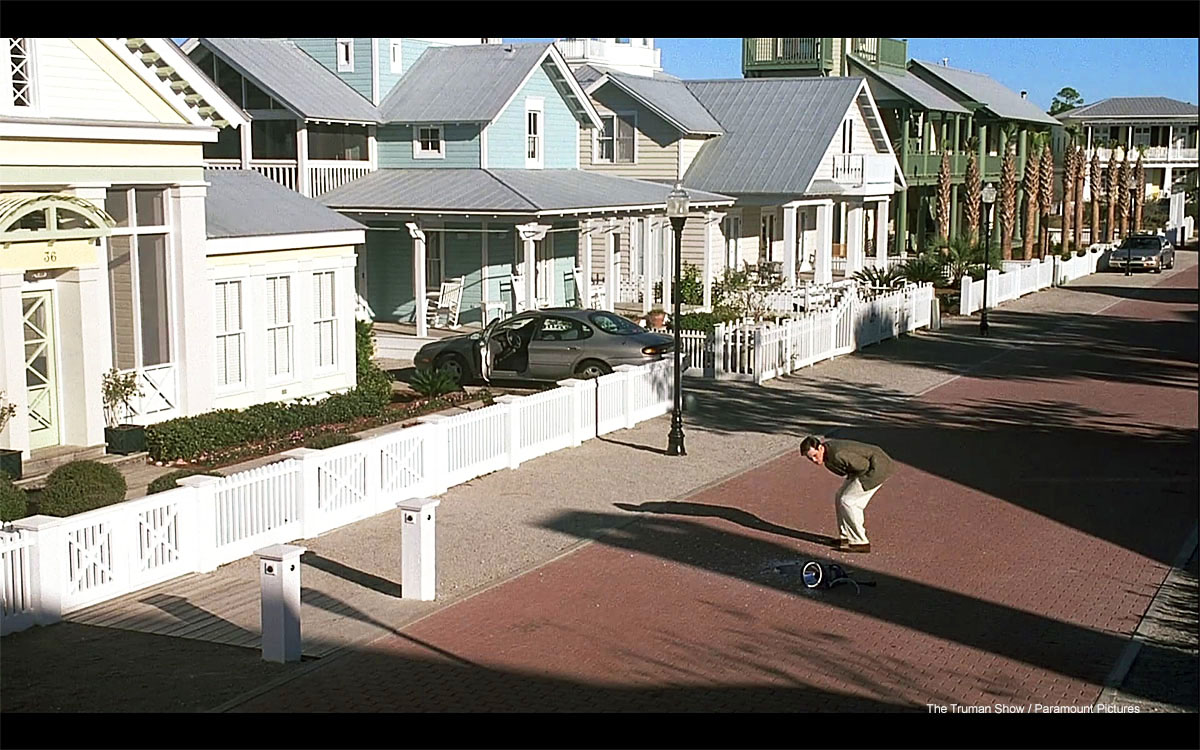
The centerpiece of any modern filming location tour along 30A is 31 Natchez Street, the two-story home chosen by Weir as the Burbank residence. Unlike Hollywood productions that rely on isolated exterior shells, the production used this private house for primary outdoor scenes. It was here that Jim Carrey practiced his daily greetings ("Good morning, and in case I don't see ya: Good afternoon, good evening, and good night!"), stepped past the manicured hydrangeas, and avoided neighborly dogs on his commute.
The home features classic Victorian-influenced coastal architecture, painted in soft butter-yellow with crisp white railings and wide veranda decks. During filming, the property was owned by the Gaetz family; it remained a private residence long after Paramount packed away its lighting rigs. Visitors to Natchez Street today will notice the house still looks almost identical to its 1998 appearance. A small house number marker above the entryway reads "Truman," preserving its Hollywood lineage for walking tourists who photograph the property from the public right-of-way.
Visiting Seaside Today: What Has Changed Along Highway 30A
In the late 1990s, Seaside was an insular curiosity known mostly among regional vacationers and architectural scholars. In the decades following the film's global success, the entire 24-mile stretch of Walton County’s Highway 30A exploded into one of the most exclusive luxury resort corridors in the southeastern United States.
Today, Seaside retains its core footprint, but the town is far denser and more commercialized than it was during filming. Airstream food trailers line the perimeter of the central amphitheater, serving upscale street food where Truman’s car once stalled in staged traffic. High-end boutiques, luxury bike rental outfitters, and crowded open-air cafes occupy the central plaza. Real estate valuations inside Seaside reflect this transformation: modest two-bedroom cottages that sold for low six figures in the early 1990s now regularly command valuations between $2.5 million and $7 million.
Despite the commercial density, the town operates strictly under its original urban charter. Automobile traffic inside residential lanes remains discouraged, golf carts are heavily regulated, and foot or bicycle transit remains the primary mode of travel. Walking down Natchez Street towards the Gulf of Mexico still evokes the sensation of moving through a high-definition movie set.
Frequently Asked Questions (FAQ)
Q1: Was Seahaven Island filmed entirely on a set or in a real town?
A1: The exterior world of Seahaven Island was filmed on location in Seaside, Florida, a master-planned town on the Gulf Coast. Only the high-concept technical scenes, such as the lunar control room, the sea storm, and the edge-of-the-dome wall, were shot on soundstages in California.
Q2: Can you visit the actual house where Truman Burbank lived?
A2: Yes. The house is located at 31 Natchez Street in Seaside, Florida. It remains an active private residence, meaning interior access is not permitted, but visitors can view and photograph the exterior from the public brick walkway.
Q3: Why did director Peter Weir pick Seaside instead of building a set?
A3: Building a full-scale town would have inflated production budgets dramatically. More importantly, Weir felt Seaside’s New Urbanism design, characterized by rigid architectural rules, immaculate front porches, and pastel color palettes, carried an inherently unsettling, manufactured perfection that perfectly captured the film’s media-surveillance premise.
Q4: Where along Florida’s coast is Seaside located?
A4: Seaside sits in the Florida Panhandle in South Walton County, along scenic County Road 30A between Destin and Panama City Beach, a region commonly referred to as the Emerald Coast.
The Lasting Legacy of Seahaven's Real-Life Stage
Cinema history is filled with iconic locations that relied on matte paintings, digital compositing, and timber backlots to construct impossible societies. The Truman Show endures precisely because Peter Weir bypassed artifice to find an authentic American development that had already organized itself around theatrical principles. Seaside, Florida was not designed to deceive a film audience; it was designed to prove that human communities could be engineered for order, walkability, and visual harmony.
By dropping a dystopian reality television narrative into that sunny coastal community, Weir cemented a permanent pop-culture association. For travelers strolling down the pristine brick alleys of 30A today, the pristine pastel cottages and symmetrical fences still produce that unmistakable, spine-tingling reflex: a subconscious urge to glance up at the sky, look past the clouds, and check the horizon for hidden camera lenses.


