Pediatric Speech Guidance 2026: Updated Milestones from Babbling to First Words

For generations, parents evaluated early cognitive development through a single milestone: the arrival of an unambiguous "mama" or "dada" on a child's first birthday. That narrow view is rapidly changing. Primary care providers now track communication long before a child utters a decipherable noun, treating sound formation as the final tier of a much larger architectural process. In an updated clinical review on speech and language delay in children released by the American Academy Of Family Physicians | AAFP Report, family physicians underscore that waiting passively for speech to emerge can mean overlooking subtle neurological and auditory markers during the most plastic phase of brain growth.
Most infants speak their true first word between 10 and 14 months of age, but vocal production does not begin in isolation. It relies on a delicate balance between receptive language skills, oral-motor control, and social reciprocal play. When parents ask at what point verbal fluency begins, pediatricians no longer provide an isolated month on a calendar. Instead, they look at the entire arc of communication, starting with the very first involuntary vocalizations of the newborn period.
📌 Key Takeaways:
- The Baseline Timeline: Most children say their first recognizable word with communicative intent between 10 and 14 months, expanding to two-word combinations by 24 months.
- Receptive Precedes Expressive: What an infant comprehends, points to, and tracks with their eyes signals cognitive health far earlier than spoken words can.
- Intervention Over Inaction: The clinical protocol on speech and language delay urges providers and parents to bypass the outdated "wait-and-see" philosophy in favor of early screenings and timely therapeutic support.
The Biology of Infant Babbling Stages and Early Sound Formation
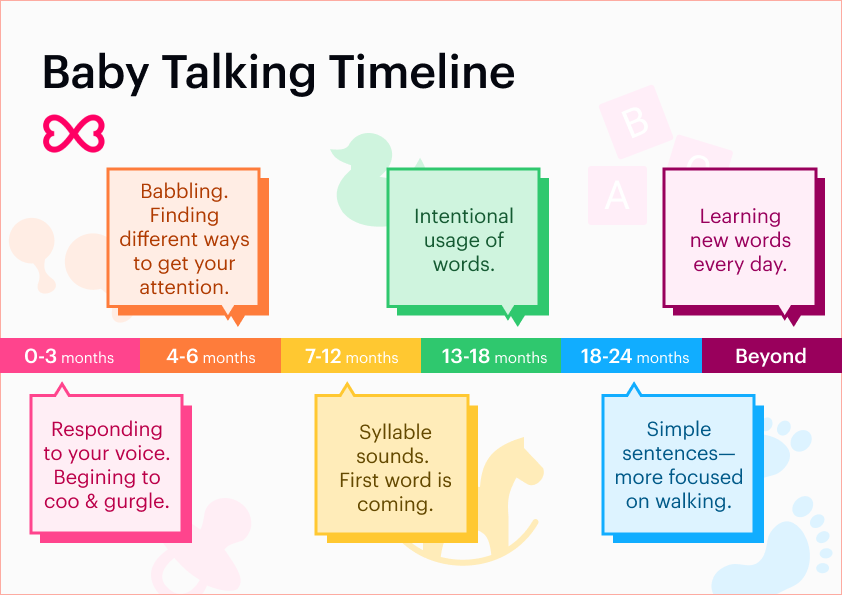
Babies do not wake up one morning with speech. Verbal expression develops through distinct structural phases. During the first two months of life, vocalizations remain largely reflexive, consisting of cries, grunts, and vegetative noises. Between 2 and 4 months, true cooing emerges. Infants discover the soft palate and produce open vowel sounds like "oooh" and "aaah." This phase marks the beginning of voluntary vocal tract control.
By 6 months, the soundscape shifts dramatically into the infant babbling stages. Babies enter canonical babbling, repeating identical consonant-vowel combinations such as "ba-ba-ba" or "da-da-da." While parents frequently celebrate these repetitions as early words, speech pathologists classify them as non-referential motor practice. The baby is playing with physical acoustics. They enjoy the sensation of lips touching and vocal cords vibrating.
Between 9 and 12 months, canonical babbling matures into variegated babbling, also known as jargon speech. The child strings together mixed syllables, "ba-de-ma-to", punctuated by adult-like inflection, rhythm, and declarative cadence. To an outside listener, it sounds as if the infant is speaking a foreign language with complete conversational fluency. This stage confirms that expressive language development is tracking normally, even if not a single dictionary word has landed.
Deciphering the 12 Month Speech Milestones: Real Words Versus Accidental Sounds
Differentiating an intentional word from vocal experimentation requires close observation. If an eleven-month-old looks at the ceiling fan and repeats "da-da," that vocalization remains babble. If the same child turns to their father, establishes direct eye contact, points, and says "Dada," they have crossed the threshold into intentional speech. A true first word must meet three strict clinical criteria: it is uttered with clear communicative intent, used consistently to reference a specific person or object, and produced in contexts beyond simple imitation.
The standard 12 month speech milestones focus heavily on joint attention and nonverbal communication. Speech pathologists emphasize that cooing and gesture development provide the scaffolding for verbal output. An infant who cannot point to a wanted cup, wave goodbye, or track an adult's gaze will rarely develop spontaneous verbal vocabulary on time. Gestures serve as the conceptual bridge to expressive words.
Research across developmental speech clinics reveals that children who display a rich repertoire of pointing, nodding, and communicative reaching at 12 months routinely meet expressive targets later in toddlerhood. Conversely, a child who produces occasional sounds but lacks intentional pointing requires closer developmental observation.
The Developmental Roadmap: Tracking Language from Infancy to Toddlerhood
Standard developmental assessments distinguish sharply between expressive language development (what a child says) and receptive language skills (what a child understands). Comprehension almost always outpaces production. Long before a one-year-old can vocalize their preferences, they understand dozens of household terms, familial names, and basic directional commands.
The following roadmap reflects updated surveillance recommendations used by family physicians and developmental pediatricians to monitor communication health:
| Age Window | Expressive Milestones | Receptive & Social Benchmarks | Clinical Watch Areas |
|---|---|---|---|
| 2, 4 Months | Sustained cooing, gurgles, differentiated distress cries | Turns head toward voices, startles at sharp sounds | Lack of social smile, no response to loud sounds |
| 6, 9 Months | Canonical babbling ("ba-ba", "ma-ma"), vocal turn-taking | Responds to own name, tracks vocal tone differences | Absence of consonant sounds, poor visual engagement |
| 10, 14 Months | 1, 3 consistent, meaningful words; varied babbling jargon | Understands "no", follows simple pointing cues | No waving or pointing, lack of consonant babble |
| 15, 18 Months | Spontaneous vocabulary of 5, 20 words; animal sounds count | Follows single-step directions ("bring the ball") | Fewer than 6 words, loses previously acquired sounds |
| 24 Months | 50+ spoken words, 2-word functional phrases ("more milk") | Identifies common objects, follows two-step requests | Inability to combine words, echolalia without intent |
Clinical Red Flags for Speech Delay and When to Intervene
Every infant progresses along an individual developmental curve. However, significant deviations from normative windows warrant structured evaluation rather than informal reassurance. Identifying red flags for speech delay early allows clinicians to separate benign expressive late-blooming from deeper neurological, receptive, or sensory processing deficits.
Primary care physicians monitor several critical clinical warning signs:
Silence or monotonic crying in early infancy: An absence of responsive cooing by 4 months or a failure to engage in vocal play by 7 months suggests potential receptive difficulties or sensory disruption.
Absence of communicative gestures at 12 months: A child who does not wave bye-bye, reach outward to be picked up, or point to objects of interest by their first birthday exhibits an expressive deficit that extends beyond oral speech.
Inability to respond to verbal cues: If an infant frequently fails to turn when their name is called across a quiet room, clinicians prioritize an immediate hearing screening evaluation. Undiagnosed middle-ear fluid from silent otitis media with effusion remains a primary contributor to delayed phonological emergence.
Developmental plateau or skill regression: Any sudden or gradual loss of previously mastered words, babbling patterns, or social reciprocity at any age represents an urgent diagnostic priority requiring immediate neurodevelopmental referral.
When these symptoms appear, the protocol outlined by the American Academy of Family Physicians advises comprehensive developmental screening using validated instruments like the Ages and Stages Questionnaires (ASQ) or the Parents' Evaluation of Developmental Status (PEDS).
Managing Toddler Vocabulary Growth and the Role of Pediatric Speech Therapy
Between 18 and 24 months, neurodevelopmental changes trigger what linguists call the vocabulary spurt. During this window, toddler vocabulary growth accelerates from a handful of deliberate words to an expansive lexicon. Children begin mapping new words to memory after hearing them only a few times. By age two, children typically assemble spontaneous two-word combinations, such as "big dog" or "go out."
When this growth stalls, families frequently seek guidance on pediatric speech therapy. The outdated standard of waiting until age three or four to begin speech intervention has been firmly rejected by developmental specialists. The human brain undergoes its most intensive period of synaptic pruning and linguistic mapping before age three. Initiating speech-language therapy during this critical window delivers markedly better outcomes than remediation started in kindergarten.
Therapy for toddlers does not resemble classroom instruction. It is play-based and structured around parent-coached conversational turns. Clinicians evaluate how the family environment facilitates language: Are adults narrating everyday actions? Do parents allow adequate response pauses after speaking to their child? Are digital screens displacing direct, face-to-face vocal interactions?
Pediatric studies consistently show that conversational turn-taking, the back-and-forth verbal dance between caregiver and infant, is the single strongest environmental predictor of cognitive and verbal proficiency. A child exposed to rapid verbal exchange develops richer vocabularies and stronger phonemic awareness than a child placed in front of educational video programs.
Frequently Asked Questions (FAQ)
Q1: What is the normal age range for a baby's very first word?
A1: Most infants produce their first true word between 10 and 14 months. Words counted in this benchmark must be used intentionally and consistently to refer to a specific person or object, rather than through random imitation or babbling.
Q2: How does a speech delay differ from a language delay?
A2: Speech refers specifically to the mechanical production of sounds and verbal articulation, involving vocal cords, tongue, and lips. Language refers to the broader cognitive system of understanding and communicating ideas. A child with a speech delay might struggle to form the sound "b" or "d," while a child with a language delay might be unable to combine concepts, comprehend simple directions, or use symbolic gestures.
Q3: Does growing up in a bilingual home cause children to start talking later?
A3: No. Extensive pediatric research demonstrates that bilingualism does not cause clinical speech or language delays. While a bilingual infant may divide their total vocabulary across two languages, producing fewer words in each individual tongue during early milestones, their total conceptual vocabulary matches that of monolingual peers. They achieve major communicative milestones on the exact same developmental timeline.
Reframing Early Speech Milestones for Families and Clinicians
Tracking an infant's speech development requires observing the full spectrum of their interactions rather than waiting for a single word. Communication is an intricate puzzle built from eye gaze, intentional gestures, auditory processing, and phonemic exploration. While an initial word at 12 months remains a helpful marker, it is merely one component of a wider developmental journey.
When parents and primary care providers pay attention to early pre-linguistic behaviors, such as interactive babble, reciprocal pointing, and shared social attention, they can identify developmental disruptions long before clear delays show up. Relying on validated guidance from family medicine specialists and prioritizing early support ensures that children struggling with early language acquisition receive the diagnostic clarity and intervention they need to build lasting communicative confidence.


