'Take This Job and Shove It' Lyrics, Meaning, and Legacy: Everything to Know After David Allan Coe's Death
When news broke that legendary outlaw country songwriter David Allan Coe passed away at 86, blue-collar workers across generations paused to revisit the defining track of his career. As detailed in the Wausau Pilot & Review Report, Coe's death closed a turbulent, unfiltered chapter of American songwriting. While Johnny Paycheck gave the song its gravelly voice and rebellious swagger in 1977, the fiery pent-up fury came straight from Coe’s pen.
Decades after dominating jukeboxes, the track remains the gold standard for workplace dissatisfaction. From factory assembly lines during the 1970s stagflation crisis to modern service workers airing grievances on social media, those eight monosyllabic words continue to express an unvarnished truth about manual labor: sometimes the paycheck simply is not worth the dignity you surrender to earn it.
📌 Key Takeaways:
- The Mastermind Behind the Pen: David Allan Coe penned "Take This Job and Shove It," gifting Johnny Paycheck the biggest smash hit of his career in late 1977.
- The Real Meaning: Beyond a surface-level workplace walkout, the lyrics tell a personal story of heartbreak, where losing a romantic partner removes the sole reason for enduring brutal labor.
- Enduring Cultural Impact: Certified Platinum by the RIAA, the track sparked a 1981 Hollywood film, inspired generations of protest anthems, and retains its position on streaming playlists worldwide.
The Night David Allan Coe Penned Country Music's Fiercest Retaliation
David Allan Coe never fit the clean-cut mold of Music Row. Before arriving in Nashville, he served time in the Ohio State Penitentiary, busked on street corners, and slept in a hearse parked outside the Grand Ole Opry. That lived experience informed his writing style: direct, raw, and completely free of suburban polish.
During the mid-1970s, country radio leaned heavily toward smooth production and strings. Coe, alongside contemporaries like Waylon Jennings and Willie Nelson, fought to strip the genre back to its rough edges. When Coe sat down to write "Take This Job and Shove It," he drew directly from his memories of grueling industrial shifts and dead-end employment. He understood the sensory details of physical exhaustion, sweating through clothing, aching joints, and the quiet humiliation of answering to an abrasive floor supervisor.
Coe recorded his own version, but he recognized that Johnny Paycheck possessed the specific vocal bite needed to send the track up the charts. Paycheck, born Donald Eugene Lytle, had his own history of bar fights, arrests, and label clashes. When Paycheck cut the vocal at Columbia Recording Studio in Nashville, his delivery sounded less like an entertainer singing a hook and more like an exhausted man walking out of a plant gates for the final time.
Full Lyrics: Reading the Story Behind the Chorus
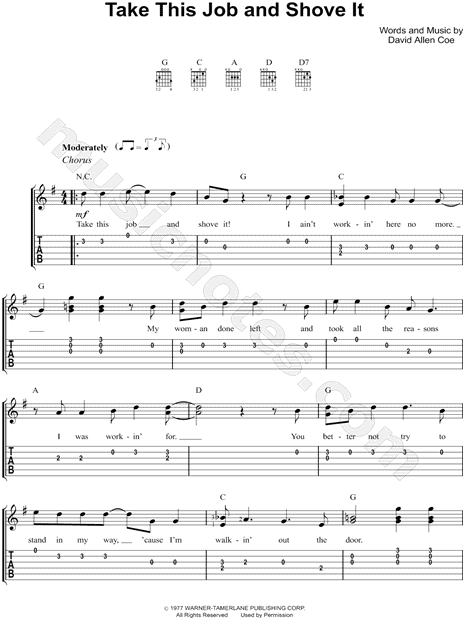
Listening to casual bar singalongs, many miss the narrative arc embedded within the verses. Below are the complete lyrics as popularized by Johnny Paycheck in 1977:
[Chorus]
Take this job and shove it
I ain't workin' here no more
My woman done left and took all the reasons
I was workin' for
You better not try to stand in my way
'Cause I'm walkin' out the door
Take this job and shove it
I ain't workin' here no more
[Verse 1]
I've been workin' in this factory
For nigh on fifteen years
All this time I watched my woman
Drownin' in a pool of tears
And I've seen a lot of good folk die
That had a lot of bills to pay
I'd give the shirts right off o' my back
If I had the guts to say
[Chorus]
Take this job and shove it
I ain't workin' here no more
My woman done left and took all the reasons
I was workin' for
You better not try to stand in my way
'Cause I'm walkin' out the door
Take this job and shove it
I ain't workin' here no more
[Verse 2]
Well that foreman, he's a regular dog
The line boss, he's a fool
Got a brand new flat-top haircut
Lord, he thinks he's cool
One of these days I'm gonna blow my top
And that sucker he's gonna pay
Lord, I can't wait to see their faces
When I get the nerve to say
[Chorus]
Take this job and shove it
I ain't workin' here no more
My woman done left and took all the reasons
I was workin' for
You better not try to stand in my way
'Cause I'm walkin' out the door
Take this job and shove it
I ain't workin' here no more
[Outro]
Take it and shove it
I ain't workin' here no more
(Take this job and shove it)
Beyond the Slogan: What the Lyrics Actually Mean
The track works as a piece of theater because of an internal contradiction in the storytelling. Most people remember the song as an act of defiance, yet the verses confess that the narrator is merely fantasizing about rebellion.
In verse one, the narrator admits: "I'd give the shirts right off o' my back / If I had the guts to say." In verse two, he doubles down on his hesitation: "Lord, I can't wait to see their faces / When I get the nerve to say." The song captures the internal monologue of a trapped laborer. He works fifteen years on the floor, watching older colleagues die before their debts are settled. He despises the foreman and ridicules the line boss, but economic survival forces him to swallow his pride every morning.
The turning point is romantic loss. The narrator tolerates the factory only because providing for his partner gives the misery purpose. Once she walks out, the financial pact collapses. Without love to justify the sacrifice, the grueling physical grind turns toxic. It transforms an anti-work anthem into an exploration of male grief and working-class isolation.

Chart Run, Cultural Impact, and Industry Evolution
Released in October 1977, the single took off immediately. It struck a nerve during an era marked by double-digit inflation, steel mill closures, and declining union strength across the Rust Belt. By January 1978, it secured the #1 spot on the Billboard Hot Country Singles chart, remaining on the survey for 18 weeks and crossing over into the Billboard Hot 100.
| Milestone / Metric | Historical Record (1977, 1981) | Modern Legacy (2020, 2026) |
|---|---|---|
| Peak Chart Position | #1 on Billboard Hot Country Songs | Maintains steady classic country catalog streaming |
| RIAA Certification | Platinum certification (Single & LP) | Over 100M cumulative on-demand audio streams |
| Hollywood Adaptation | 1981 feature film starring Robert Hays | Referenced in worker walkout TikTok and Reels audio trends |
| Grammy Nominations | Nominated for Best Country Song (Coe) | Recognized by Rolling Stone among Top 100 Country Songs |
The single proved so massive that Avco Embassy Pictures developed a full comedy film around the title in 1981. Paycheck made a cameo appearance, while Coe secured royalty payments that provided him financial breathing room for the rest of his life.
David Allan Coe’s Complicated Legacy and Songwriting Brilliance
Coe lived on the outer fringes of acceptable society, never apologizing for his abrasive persona. While mainstream Nashville institutions frequently distanced themselves from his controversial self-released novelty records, they could not deny his songwriting skill. Beyond Paycheck’s anthem, Coe wrote Tanya Tucker’s career-defining hit "Would You Lay with Me (In a Field of Feathers)" and penned outlaw staples like "The Ride."
Musicians from diverse genres routinely acknowledged Coe’s technical ear for melodies. Members of Pantera formed the country-metal hybrid project Rebel Meets Rebel with Coe in the early 2000s, drawn to his raw vocal presence. When news of his passing circulated through Nashville and beyond, peers remembered a writer who rejected creative sanitization. He captured the fury of ordinary people who lacked the vocabulary or platform to voice their complaints.
How the Outlaw Anthem Connects to Modern Worker Unrest
Labor dynamics have shifted away from assembly lines toward gig platforms, fulfillment hubs, and desk jobs, but the sentiment behind Coe's chorus remains potent. During the post-pandemic reshuffling and subsequent cost-of-living adjustments, younger employees turned to Paycheck's recording as soundtrack audio for resignation videos.
Recent coverage highlighting blue-collar music trends notes that modern workers still identify with the tension between financial duty and self-respect. Paycheck's narrator does not walk out because he despises productive labor; he walks out because management treats him as disposable capital. When pay rates fail to cover basic living expenses, workers lose their incentive to remain compliant.
Frequently Asked Questions (FAQ)
Q1: Who wrote the song "Take This Job and Shove It"?
David Allan Coe wrote the song entirely by himself. Johnny Paycheck recorded the famous vocal track that turned the composition into an international country hit in late 1977.
Q2: Did Johnny Paycheck ever actually quit a job using those words?
Paycheck joked in later interviews that while he had walked away from plenty of employers, record executives, and military posts, he rarely had the luxury of orchestrating a cinematic exit like the one described in Coe's lyrics.
Q3: Does the narrator in the song actually quit his job?
A close reading of the verses reveals the narrator is building up the courage to quit. Lines like "If I had the guts to say" and "When I get the nerve to say" confirm the chorus represents his inner fantasy until his partner leaves, finally giving him the catalyst to leave.
Q4: What film was based on "Take This Job and Shove It"?
A 1981 comedy feature film directed by Gus Trikonis and starring Robert Hays, Barbara Hershey, and Art Carney was built around the song's premise. Both Johnny Paycheck and David Allan Coe made cameo appearances.
The Permanent Mark of David Allan Coe's Blue-Collar Battle Cry
David Allan Coe lived without compromise, leaving behind a songbook that rattled Nashville's commercial instincts. While contemporary mainstream country frequently retreats into safe, sanitized nostalgia, "Take This Job and Shove It" remains unpolished and direct.
Every time an underpaid worker clocks out of a thankless shift and stares down an unreasonable manager, Coe’s words resurface with fresh relevance. Johnny Paycheck provided the megaphone, but Coe crafted the weapon. His legacy survives wherever honest wages fail to keep pace with the toll of hard labor.


