Tallest Man on Earth: Record-Breaking Giant or Acclaimed Folk Musician?
Every month, thousands of internet searchers punch the phrase "who is tallest person in world" into search engines and run headfirst into an odd collision of endocrinology and indie folk music. Ticketing platforms regularly promote tour dates for "The Tallest Man on Earth," prompting casual browsers to wonder whether an 8-foot biological wonder is touring concert halls with an acoustic guitar. As noted in concert coverage from an azcentral.com and The Arizona Republic Report, the marquee billing belongs to an acclaimed Swedish singer-songwriter who stands well below six feet, not a medical marvel.
The confusion highlights a fascinating intersection between cultural moniker and physical reality. The actual living record holder is a Turkish farmer navigating the daily mechanics of extreme human proportions, while the historical peak of human height belongs to an American icon from the early twentieth century. Disentangling the stage name from the medical record requires examining both the biology of extreme growth and the artistic alias that continues to baffle search algorithms.
📌 Key Takeaways:
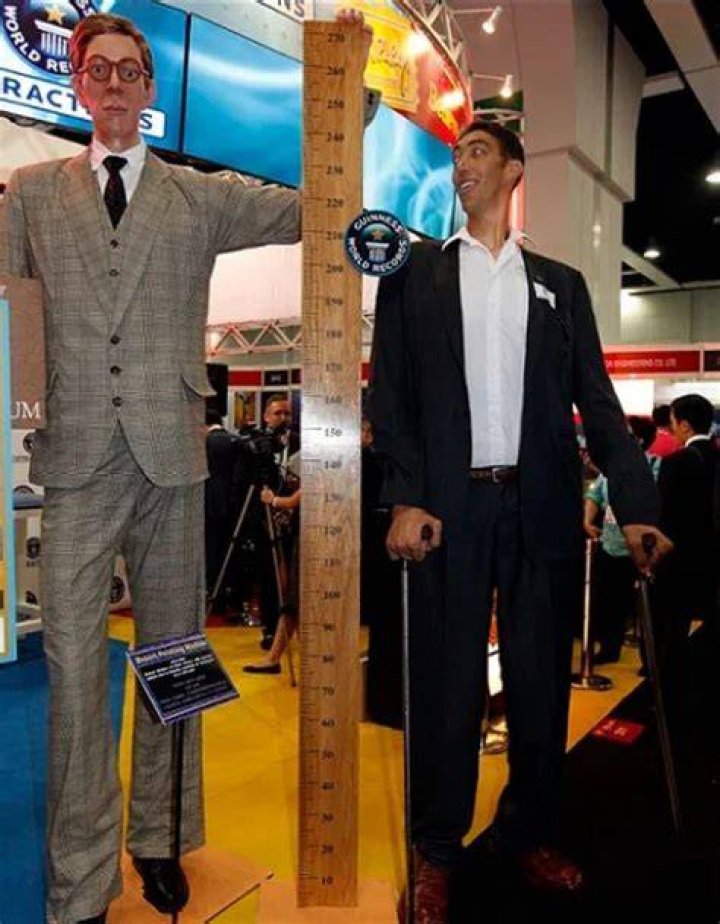
- The Living Record: Sultan Kösen of Turkey holds the verified Guinness World Records title as the tallest living man, measuring 8 feet 2.8 inches (251 cm).
- The Historical Peak: Robert Wadlow remains the undisputed tallest man in history at 8 feet 11.1 inches (272 cm) before his death in 1940.
- The Musical Moniker: "The Tallest Man on Earth" is the stage name of Kristian Matsson, an acclaimed Swedish folk singer who stands roughly 5 feet 7 inches (170 cm) tall.
The Viral Identity Mix-Up: Indie Stages Versus Record Books
Search engines operate on semantic associations, and the phrase "The Tallest Man on Earth" occupies two entirely different cultural domains. For music fans, the name identifies Kristian Matsson, a native of Leksand, Sweden, whose fingerpicked guitar style, raspy delivery, and poetic compositions have drawn comparisons to early Bob Dylan since his 2008 breakthrough album Shallow Grave. Matsson chose the alias early in his career as a playful, larger-than-life character to combat stage fright. He wanted a name that sounded absurdly grand for a solitary figure clutching an acoustic instrument.
For general readers searching for human extremes, the moniker produces immediate confusion. Event listings in major metropolitan centers regularly show up next to official medical records. Music coverage from outlets like Stereogum and Paste Magazine charting Matsson’s studio albums, such as Henry St. and his subsequent international tours, frequently intersects with queries from people seeking medical facts about human stature. Matsson does not hold a physical record; he simply adopted a brilliant, self-effacing brand.
The genuine biological records belong to individuals living with rare endocrine conditions. Those measurements are tracked with forensic precision by medical researchers and official adjudicators, far away from concert lighting and festival stages.
Sultan Kösen: The True Tallest Living Man on Earth
The recognized titleholder for the tallest living man is Sultan Kösen, born on December 10, 1982, in Mardin, Turkey. Guinness World Records officially confirmed his height in February 2009 at 8 feet 1 inch, but subsequent measurements documented further growth until he reached his definitive height of 8 feet 2.82 inches (251 cm). Kösen also holds the verified record for the largest hands on a living person, measuring 11.22 inches (28.5 cm) from the wrist to the tip of his middle finger.
Kösen grew at a typical rate until age ten, when an overproduction of growth hormone altered his physical trajectory. His height prevented him from completing his schooling, leading him to work part-time as a farmer to support his family. Navigating the world at over eight feet requires custom-made tailoring, reinforced furniture, and specialized footwear, his shoes measure European size 62.
His unchecked growth finally halted between 2010 and 2012 through intervention by endocrinologists at the University of Virginia Medical Center. Doctors administered Gamma Knife radiosurgery to target the non-cancerous tumor responsible for his pituitary disruption, safely arresting his growth and stabilizing his physical condition. Today, Kösen travels globally as a cultural ambassador for Turkey, using his platform to promote public awareness around endocrine health.
Robert Wadlow and the Ceiling of Human Stature
To find the tallest person documented in medical history, historians look back to Alton, Illinois. Robert Pershing Wadlow (1918, 1940), often remembered as the "Alton Giant," stood an astounding 8 feet 11.1 inches (272 cm) at the time of his final measurement in June 1940. Wadlow weighed 439 pounds (199 kg) and possessed an arm span exceeding 9 feet 5 inches.
Wadlow’s life offers sobering documentation of how the human musculoskeletal system responds to sheer mass. His bones and cardiovascular network endured immense strain. He required custom leg braces to walk and had limited physical sensation in his lower extremities. Tragic complications arose not from organ failure directly, but from an infected blister caused by a poorly fitted brace during a public appearance in Michigan. Without modern antibiotics, septic shock claimed his life at the young age of 22.
The table below contrasts historical records, verified living extremes, and the Swedish folk artist who inadvertently shares their search terms:
| Individual | Official Measurement | Category / Distinction | Underlying Cause |
|---|---|---|---|
| Robert Wadlow | 8 ft 11.1 in (272 cm) | Tallest man in medical history | Pituitary gigantism (hyperplasia) |
| Sultan Kösen | 8 ft 2.8 in (251 cm) | Tallest living man (verified) | Pituitary adenoma / acromegaly |
| Kristian Matsson | 5 ft 7 in (170 cm) | Swedish folk musician (moniker) | Standard human genetics |
| Global Male Average | 5 ft 7.5 in (171 cm) | Statistical baseline population | Polygenic inheritance & nutrition |
The Endocrinology Behind Extreme Stature: Gigantism and Acromegaly
Human growth operates under tightly regulated hormonal feedback loops. When those feedback systems fail, the body's physical architecture changes dramatically. In virtually every historical case of extreme human height exceeding 7 feet 6 inches, the root cause traces back to an endocrine disorder rather than natural polygenic variation.
The primary driver is pituitary gigantism. This occurs when a benign adenoma (tumor) develops on the anterior pituitary gland during childhood or adolescence, prior to the closure of the epiphyseal growth plates in long bones. The tumor secretes uncontrolled quantities of human growth hormone (HGH), which prompts the liver to produce elevated levels of insulin-like growth factor 1 (IGF-1). Because the growth plates have not yet fused, the skeleton elongates rapidly.
If the adenoma remains active or arises after the growth plates fuse in adulthood, the condition is diagnosed as acromegaly. While long bones cannot lengthen further after epiphyseal fusion, cartilage, soft tissues, and flat bones continue to expand. Patients experience enlargement of the hands, feet, jaw, and brow, alongside dangerous thickening of cardiac tissue.
Modern medical interventions have made cases like Robert Wadlow exceedingly rare. Advanced neuroimaging, transsphenoidal surgery, somatostatin analogs, and targeted stereotactic radiation can now suppress growth hormone hypersecretion early in life. As a result, future generations may rarely see individuals naturally surpass eight feet.
Kristian Matsson’s Irony: Why a 5-Foot-7 Songwriter Took the Title
When Kristian Matsson adopted "The Tallest Man on Earth" around 2006, he never anticipated his tour posters would confuse medical enthusiasts twenty years later. Standing at 5 feet 7 inches (170 cm), Matsson sits precisely around the global median for adult males.
In early interviews, Matsson explained that playing solo on stage felt daunting. Performing under his birth name felt vulnerable and quiet, whereas styling himself as "The Tallest Man on Earth" functioned as a psychological shield. It injected bravado into intimate performances, allowing him to command rooms with frantic foot-stomping, dynamic open tunings, and explosive stage presence.
Critical acclaim followed. From his breakout work The Wild Hunt to later recordings, Matsson cemented a permanent legacy in modern roots music. His regular international tours consistently pack mid-sized venues across North America and Europe. Audiences who enter venues looking for a Guinness-certified giant instead discover a kinetic Swedish songwriter whose outsized moniker serves purely as an artistic frame.
Guinness World Records and the Rigor of Official Measurement
Verifying human height extremes requires strict procedural oversight. Myth, folklore, and carnival promotions have historically exaggerated human measurements by several inches. To prevent inflated claims, Guinness World Records applies a stringent protocol before confirming any candidate for the title of tallest living person.
Under official rules, adjudicators require the candidate to be measured several times over the course of a single 24-hour period. Height fluctuates naturally throughout the day: spinal disc compression caused by gravity typically reduces an adult's stature by 0.5 to 1 inch between morning awakening and evening. Official measurements are taken both standing upright and lying recumbent (horizontal), and then averaged across morning, afternoon, and evening readings.
Medical personnel also document spinal curvature, joint health, and the subject’s ability to stand unaided. This clinical rigor ensures that verified figures represent accurate anatomical realities, distinguishing documented medical events from promotional hyperbole.
Frequently Asked Questions (FAQ)
Q1: Who is the tallest living man in the world today?
A1: The tallest living man verified by Guinness World Records is Sultan Kösen of Turkey, who measures 8 feet 2.82 inches (251 cm) tall.
Q2: Is "The Tallest Man on Earth" a real person or a band?
A2: "The Tallest Man on Earth" is the stage name of Kristian Matsson, a solo Swedish folk musician. He is not a biological giant and stands approximately 5 feet 7 inches (170 cm) tall.
Q3: Who was the tallest person ever recorded in human history?
A3: The tallest confirmed person in medical history was Robert Pershing Wadlow of the United States, who reached 8 feet 11.1 inches (272 cm) before his passing in July 1940.
Q4: Why do people with pituitary gigantism often face health complications?
A4: Extreme stature places enormous strain on the circulatory and skeletal systems. Hearts must pump blood across immense distances, joints endure extreme mechanical pressure, and nerve damage in peripheral limbs frequently leads to unperceived infections.
Q5: Can modern medicine prevent gigantism today?
A5: Yes. Pediatric screening and neuroimaging frequently identify pituitary tumors early. Medical teams use medication, microscopic surgery, and targeted radiation to arrest excess growth hormone production before extreme heights are reached.
The Cultural Fascination With Human Stature
Human interest in physical extremes remains constant. Tallness evokes authority, curiosity, and awe, explaining why both medical record-keepers and folk troubadours tap into its imagery. Whether observing Sultan Kösen crossing a bustling city square or Kristian Matsson electrifying an auditorium with a battered acoustic guitar, audiences respond instinctively to scale. One represents the outer boundaries of human biology; the other demonstrates how an ironic, audacious name can expand a songwriter's stage presence to match the world's grandest legends.


