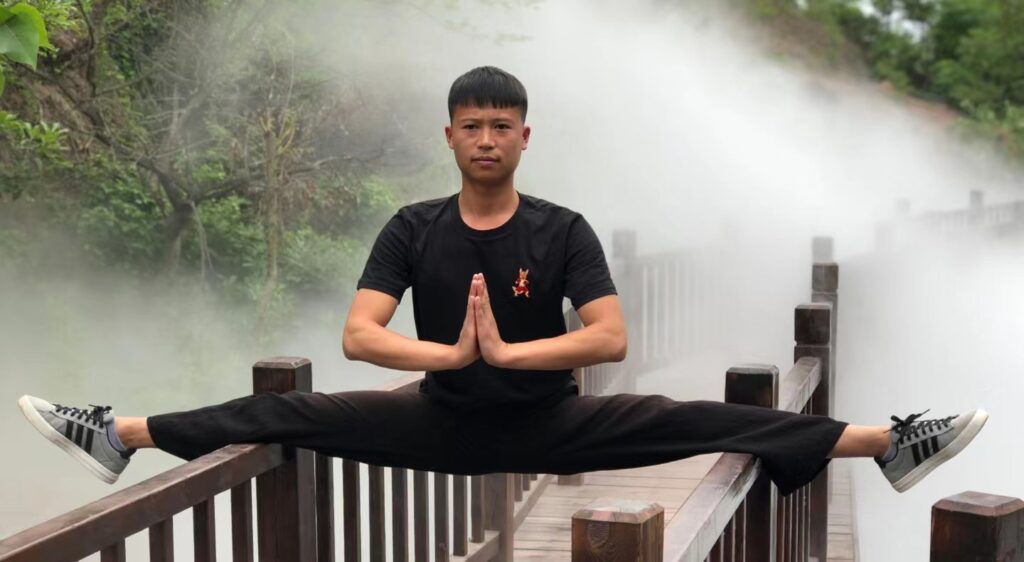
The Brutal Kung Fu Split Regimen: How Marvel and Karate Kid Stars Survived Extreme Flexibility Training
When Marvel Studios cast Simu Liu as Shang-Chi, the thirty-one-year-old actor possessed athletic charm and stuntman enthusiasm, but his hips were locked tight. To turn him into a convincing kung fu master, trainers put him through an excruciating stretching regimen designed to tear down decades of muscular stiffness. As documented in a Disney Fanatic Report on Liu’s physical transformation, the process involved brutal manual split work where coaches pinned the actor's legs to the floor while his nervous system screamed in protest.
Liu was not the first actor to endure this trial by fire. Over a decade earlier, behind-the-scenes footage from the 2010 reboot of The Karate Kid showed a pre-teen Jaden Smith weeping as Jackie Chan’s stunt team pressed him into full Chinese splits against a wall. For martial artists across Beijing, Dengfeng, and Hong Kong, these agonizing scenes are ordinary daily practice. In traditional wushu academies, split training is a baseline requirement for high kicks and explosive footwork. Replicating that range of motion safely requires an understanding of neuromuscular physiology rather than blind masochism.
📌 Key Takeaways:
- Extreme Adaptation: High-profile actors endure the same centuries-old Chinese wushu methods used on youth disciples, using physical traction to bypass neural resistance.
- Neurological Control: Achieving full martial splits requires retraining the stretch reflex and strengthening the hamstrings and adductors at their outer limits.
- Modern Biomechanics: Safe split acquisition demands replacing passive hanging with progressive PNF stretching techniques and hip mobility drills to guard against labral tears.
The Agony Behind the Screen: Simu Liu and Jaden Smith’s Martial Bootcamps
Simu Liu entered production with the muscular build of a recreational gym lifter. Tight hip flexors and dense quadriceps protected his joints during heavy squats, but they severely restricted his martial arts leg flexibility. Traditional Chinese martial arts demand that a practitioner execute a 180-degree vertical kick without curling the lumbar spine. Marvel stunt coordinator Brad Allan, a veteran of Jackie Chan’s elite stunt crew, imported traditional Chinese flexibility coaching directly into Liu’s daily calendar.
The routines pushed Liu through daily manual traction sessions. Multiple coaches loaded their body weight onto his inner thighs to force hip abduction past the point of intense discomfort. Liu documented the experience online, sharing videos of himself wincing, grimacing, and shouting as his adductors were pried apart. It looked barbaric to casual fitness enthusiasts. To Chinese martial arts veterans, it was simply Tuesday.
Jaden Smith experienced an even more unforgiving variation in 2009 while training in Beijing. Guided by master Wu Gang, Smith underwent classical Shaolin stretch methods where trainers elevated his heels on benches, forcing his pelvis downward under gravity. The footage shocked Western audiences. Observers debated whether forcing children into extreme ranges of motion crossed into physical mistreatment. Yet within Chinese sports academies, flexibility is viewed as a physical door that must be kicked open before skeletal ossification cements an adult’s structural limits.
The Biology of Resistance: Why the Nervous System Fights the Split
The human body does not lock down during a split because the muscles are physically too short. Skeletal muscle tissue can stretch roughly 150 percent of its resting length before cellular tearing occurs. The true barrier is neurological. When you sink into a middle splits workout or a deep front split, your muscle spindles register rapid elongation in the hamstrings and adductors. Fearing structural dislocation, these sensory receptors trigger the myotatic reflex, firing violent contractions to halt the movement.
Chinese martial arts systems overcome this defense mechanism through sensory saturation. By holding an athlete in deep ranges for three to five minutes, or using external weight to prevent retreat, trainers exhaust the muscle spindles. Eventually, the Golgi tendon organs override the panic response, initiating autogenic inhibition that forces the target muscle group to release.
For adult practitioners over twenty-five, brute-force sensory override carries serious physical dangers. Forcing hip joints past their neural tolerances without active muscular engagement risks chronic adductor tears, athletic pubalgia, and micro-tears in the hip labrum. Martial artists must navigate the delicate line between neural adaptation and permanent joint trauma.
Skeletal Geometry: Front Splits Progression vs. Middle Splits Mechanics
Not every human skeleton can achieve every type of split. Pelvic anatomy determines structural capacity just as much as tendon elasticity. Achieving a full middle split requires the femoral head to clear the acetabular rim, the bony edge of the hip socket. If an athlete possesses a deep socket or coxa vara (a reduced femoral neck angle), bone-on-bone impingement will halt horizontal abduction long before the legs hit 180 degrees. Trying to force that gap leads directly to femoroacetabular impingement (FAI).
A front splits progression is far more universally accessible across diverse body types. The front split moves the legs through sagittal plane flexion and extension, demanding length from the anterior hip flexors (psoas major and rectus femoris) of the trailing leg, alongside the proximal hamstrings of the lead leg.
| Training Parameter | Traditional Wushu / Shaolin Method | Modern Biomechanical Protocol |
|---|---|---|
| Primary Driver | External manual force & passive gravitational loading | Active vs passive stretching with PNF neuromuscular retraining |
| Target Adaptation | Total pain tolerance & sensory reflex exhaustion | End-range strength, tissue tolerance & motor control |
| Weekly Frequency | 6, 7 days per week (twice daily in residential schools) | 3, 4 days per week with 48-hour connective tissue recovery |
| Structural Risk Profile | High incidence of labral shearing, joint laxity, and avulsions | Low-to-moderate; protects pelvic floor and acetabular cartilage |
| Typical Adaptation Window | 3, 6 months (under high youth plasticity) | 9, 18 months for adult skeletal structures |
The contrast between these two systems highlights a core training shift. Traditional methods use forced external pressure to achieve fast results, accepting joint wear as collateral damage. Modern sports science relies on active strength at the end of a muscle's range to build flexibility that lasts without compromising joint stability.

The Shaolin Foundation: Dynamic Kicking and Isometric Stance Holds
Traditional Kung Fu flexibility exercises never isolate static stretching from functional movement. In authentic northern Shaolin practice, a morning flexibility session does not begin on the floor. It begins with dynamic leg swings known as Ba Tui (Eight Kicking Drills). Disciples spend forty-five minutes marching across stone courtyards executing straight-leg toe kicks, cross-body slashes, and outside crescent sweeps.
Dynamic ballistic mobility serves a critical biological purpose: it elevates intramuscular temperature, pumps synovial fluid into the hip joint capsules, and signals the brain that rapid elongation is safe. Static floor stretching only begins after the body has completed hundreds of dynamic kicking repetitions.
The most misunderstood kung fu flexibility drill is the Mabu, or Horse Stance. Practitioners drop their hips parallel to the floor with knees pressed outward and hold the position for up to ten minutes. While Western observers treat the horse stance as an isometric quad exercise, its true value lies in eccentric adductor conditioning. Holding a wide, deep stance under heavy body load forces the inner thigh muscles to support the pelvis at wide angles. This builds the foundational strength needed to prevent pelvic collapse during a true middle split.
Engineering the Full Splits: Modern PNF Protocols for Martial Artists
Adult practitioners who lack childhood wushu conditioning should look to Proprioceptive Neuromuscular Facilitation (PNF) rather than relying on brute force. PNF stretching techniques trick the nervous system into opening tight joints without the severe injury risks of classical manual methods.
To safely unlock middle splits, set your feet as wide as comfortably possible on sliding pads or a smooth floor, supporting your upper body with your hands on yoga blocks. Once you reach your maximum comfortable width, contract your adductors by driving your heels into the floor as if trying to scissor your legs together. Maintain that isometric contraction at 70 percent effort for seven to ten seconds. Then release the tension, exhale slowly, and let your hips drop two to three centimeters deeper into the stretch.
Repeat this contract-relax sequence three to four times per session. The brief, high-tension contraction forces the Golgi tendon organs to quiet your nervous system's alarm response, granting safe access to deeper joint angles. Perform this routine three days a week, giving adductor micro-fibers forty-eight hours to rebuild between workouts.
Injury Prevention for Splits: Protecting Tendons, Ligaments, and the Hip Labrum
Patience is the single most important factor in injury prevention for splits. Muscle tissue adapts to training within a few weeks because of its rich blood supply. Tendons, ligaments, and fibrocartilage possess minimal vascularity, requiring months to remodel under tension. Rushing the process risks tearing the proximal hamstring tendon off the ischial tuberosity, an injury that can sideline a martial artist for over a year.
A full splits stretch routine must pair flexibility drills with deep hip mobility exercises. Incorporating the 90/90 hip switch, Jefferson curls with light kettlebells, and loaded Cossack squats ensures your hips build control alongside raw flexibility. If your hips cannot actively pull you down into a split and lift you back out under your own muscular power, you do not own that range of motion. You are merely hanging from your passive connective tissues.
Watch for structural warning flags during training. A sharp, pinching pain at the front or outer rim of the hip indicates bone-on-bone impingement or labral compression, not tight muscles. When that pinch appears, stop the stretch immediately. Adjust your pelvic tilt, rotate your toes toward the ceiling to provide femoral clearance, and work with your anatomy instead of forcing your body into a damaging position.
Frequently Asked Questions (FAQ)
Q1: Can an adult over thirty learn how to do full kung fu splits from scratch?
A1: Yes, provided there are no underlying hip socket abnormalities or structural limitations. While adults lack the joint laxity of teenage wushu students, consistent training using PNF techniques, eccentric adductor loading, and active mobility drills can produce a complete front split within nine to eighteen months.
Q2: Why do Shaolin masters force students into painful stretches?
A2: Traditional Chinese martial arts academies focus on training young students before their pelvic bones finish developing. In this environment, heavy manual traction rapidly desensitizes the stretch reflex. This historical training model prioritized quick results over long-term joint health, which is why adult practitioners should rely on safer, modern training methods instead.
Q3: Should I prioritize the front split or the middle split for martial arts kicks?
A3: Front splits are the better priority. Front-to-back flexibility feeds directly into high front kicks, axe kicks, and jumping crescent strikes while putting far less stress on the hip joint capsule. Middle splits improve side and roundhouse kicks, but they demand specific pelvic structures that not every athlete has.
Building Combat-Ready Flexibility Without the Trauma
The viral stories of Simu Liu battling through intense training and Jaden Smith enduring grueling Beijing sessions have cemented the idea that splits require extreme suffering. Hollywood productions demand rapid, high-stakes physical transformations to meet tight filming schedules. Screen actors often have to endure aggressive, painful routines simply because their contracts leave them no time for gradual development.
Martial artists training for lifelong performance should take a smarter approach. Combining ancient dynamic kicking concepts like Ba Tui with modern PNF methods and intelligent recovery unlocks 180-degree hip range safely. You can build the dramatic kicks of a wushu champion while protecting your hips, keeping your joints strong and functional for decades to come.


