The True Origins of the Mexican Cowboy Hat: Debunking Western Myths

When political debates flared in early 2026 over whether Spain or Mexico created the quintessential American cowboy, historians and ranching communities pushed back with centuries of material proof. The unmistakable silhouette of the Western cattleman did not originate in Hollywood soundstages, nor did it arrive fully formed from Madrid. Its truest foundation rests in the Mexican countryside, where centuries of mestizo horsemen adapted Spanish equestrian gear to survive extreme sun, sudden torrential rains, and brush-choked terrain.
Today, that lineage is experiencing an aggressive renaissance. From custom hatters in Guadalajara to immigrant workshops in California and Nevada, master artisans are reclaiming the craft. As highlighted in a recent profile by a Raiders.com Report, contemporary master craftsmen like Gilberto Marquez are using Mexican cultural heritage to revolutionize how high-end sports culture and modern western wear understand the cowboy hat. The modern tejana and the wide-brimmed felt hat are not derivative offshoots of American frontier fashion, they are its source code.
📌 Key Takeaways:
- The Historical Anchor: The American cowboy hat is an adaptation of the Mexican vaquero’s wide-brimmed felt and palm hats, developed across central Mexico centuries before the Texas cattle boom.
- The Stetson Borrowing: John B. Stetson’s 1865 "Boss of the Plains" directly borrowed its structural profile, materials, and proportions from hats worn by Mexican ranch hands and northern vaqueros.
- Modern Craftsmanship: Mexican artisanal hatmaking continues to dominate elite Western wear, through traditional charrería ceremonial designs, resilient palm-leaf weaves, and bespoke felt tejanas crafted by artisans shaping major cultural platforms.
The Vaquero Roots That American Frontier Myth Erased
The iconic image of the lone frontiersman in a wide felt hat obscures a fundamental reality: open-range cattle handling was created in Mexico. Following the Spanish conquest, Spanish landowners brought horses and longhorn cattle into the Bajío and northern plateaus. However, imperial laws initially barred indigenous and mestizo workers from riding horses. When ballooning herds demanded an expanded workforce, colonial authorities relented, giving birth to the vaquero.
These working horsemen quickly discarded European garments. The flat-brimmed Andalusian sombrero cordobés provided insufficient shade under the harsh Mexican sun and turned soggy under seasonal downpours. In response, local artisans began shaping heavy rabbit fur, hare felt, and woven palm fibers into wide-brimmed headwear with high crowns. These hats, known historically as sombreros de ala ancha, created an insulated microclimate around the head.
By the late 1700s, the vaquero uniform featured leather chaparreras (chaps), the reata (lariat), and a reinforced hat designed to hold its shape after years of saddle abuse. When Anglo settlers moved into Texas, New Mexico, and California during the 1820s and 1830s, they wore city caps, wool derbies, or floppy straw hats. Surviving the harsh climate required immediate adaptation. They simply adopted the vaquero's equipment, from saddle design to the hat.
How John B. Stetson Adapted the Mexican Working Hat
Pop culture assigns the creation of the Western hat to John B. Stetson in 1865. The historical record tells a more pragmatic story of reverse engineering.
During an expedition to Colorado in the early 1860s to treat his tuberculosis, Stetson observed Mexican ranch hands, indigenous hunters, and Anglo prospectors struggling against blinding UV exposure and windstorms. The prospectors' felt derbies offered zero sun defense. Stetson took note of the local vaqueros, who wore thick, water-shedding beaver-felt sombreros with broad rims and rounded crowns.
Using skills learned from his father, an East Coast hatter, Stetson created his famous Boss of the Plains hat in 1865. It featured a four-inch crown, a four-inch flat brim, and was crafted from fine beaver fur felt. It was lightweight, remarkably waterproof, and could carry water from a creek without disintegrating.
Stetson did not engineer this design from thin air. He manufactured a commercial, industrialized version of the hats Mexican frontiersmen had produced by hand for over a century. Marketed aggressively to Anglo cowboys riding the Chisholm Trail, the Boss of the Plains capitalized on an existing Mexican innovation, packaged it for Eastern capital, and secured the patent footprint in American historical lore.
Evolution of Frontier Headwear Across Two Centuries
The functional needs of the working horseman determined the architecture of Western headwear. Different terrains called for distinct brim cuts, weights, and finishes, leading to a long evolution from early colonial craft to modern commercial fabrication.
| Era & Headwear Style | Materials & Construction Profile | Historical Function & Origin |
|---|---|---|
| Sombrero Vaquero (1750, 1840) | Coarse wool felt or hand-woven soyate palm; low-to-medium crown; 5, 7 inch flat brim. | Born in northern New Spain; served as an umbrella, sun shield, and fan for campfires. |
| Boss of the Plains (1865, 1890) | Pure beaver underfur felt; uncreased 4-inch open crown; flat, circular 4-inch brim. | Industrial adaptation by Stetson; sold to post-Civil War trail drivers across the American West. |
| Sombrero Charro (1890, 1940) | Heavy wool or rabbit felt; high sugarloaf crown; upturned roll brim; silver thread embroidery. | Formalized through the Charrería national sport; acted as a functional crash helmet during equine maneuvers. |
| La Tejana Clásica (1940, 2026) | Hare, beaver, and wild rabbit blends (4X to 100X quality); cattleman crease; curved side brims. | Ubiquitous working and lifestyle hat across northern Mexico and Texas; staple of Norteño music culture. |
The Charrería Tradition Versus the Everyday Tejana
To understand Mexican western headwear, one must distinguish between the ceremonial sombrero charro and the working tejana.
The sombrero charro is governed by strict athletic regulations codified by the Federación Mexicana de Charrería, Mexico's official governing body for its national equestrian sport. Charro hats feature an enormous brim, often exceeding six inches, curled slightly at the back, paired with an arched crown featuring four distinct indentations known as pedradas (stone dents). Built from dense, pressed felt or tightly braided palm straw, these hats are structural marvels. In competitive charrería, where riders perform intricate roping and reining movements, the sombrero charro functions like a modern equestrian helmet. The inner suspension system absorbs the force of falls and hoof strikes.
In contrast, the tejana is the daily driver of Mexican ranching life and northern regional culture. The name itself reflects cross-border trade, referencing Texas styles that were themselves modeled on earlier vaquero shapes. Tejanas carry a closer silhouette: typically a cattleman crease along the top, side-flared brims, and a focus on weather resilience.
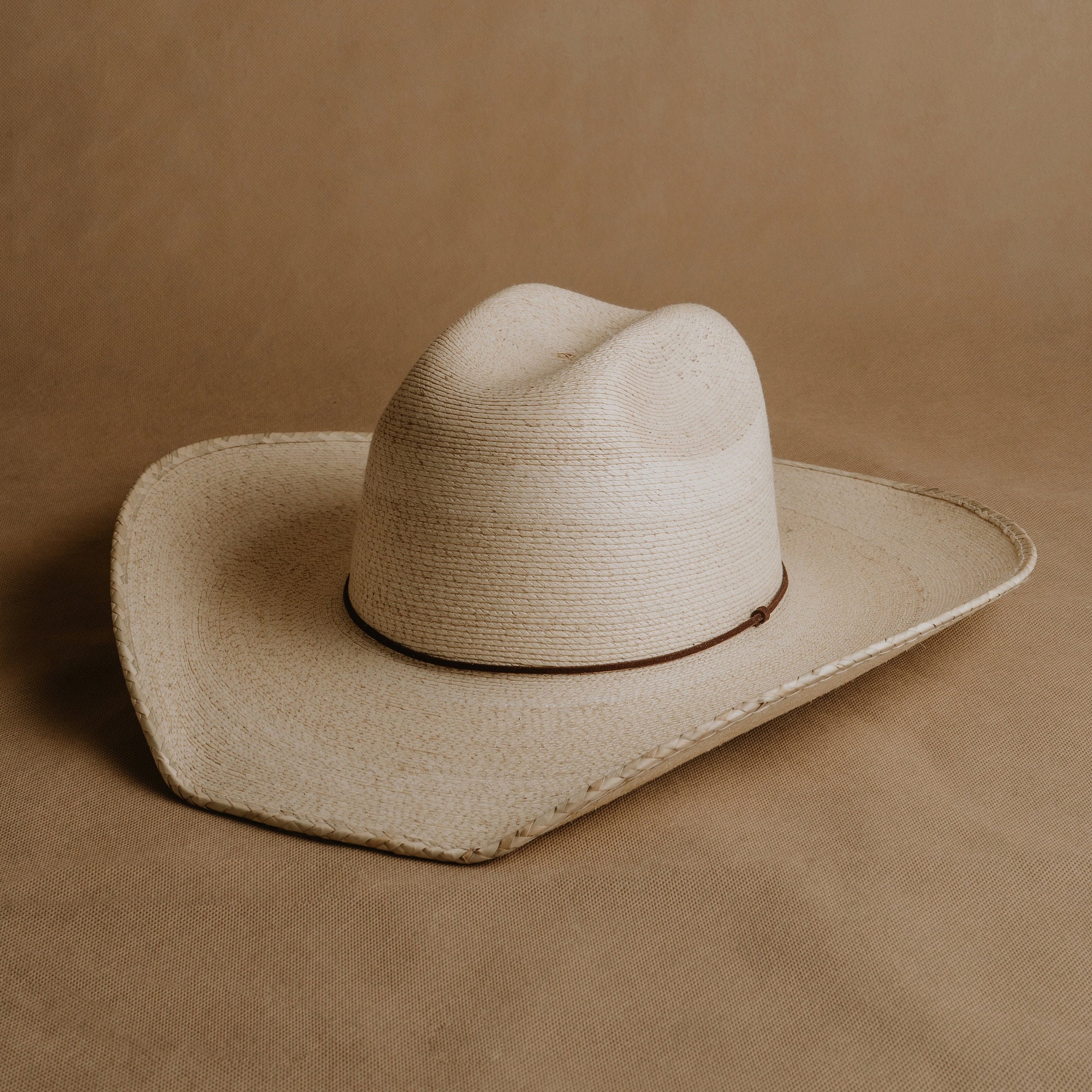
During the hot dry season, felt tejanas yield to hats woven from palma soto or toquilla. In regions like San Luis Potosí and Guerrero, artisan families harvest wild palm leaves, boil them, dry them under the sun, and weave them into tight braids. These straw hats breathe exceptionally well while blocking 98% of direct solar heat, proving indispensable for long workdays in northern pastures.
Master Artisans Reshaping Western Aesthetics in 2026
Over the past five years, the narrative around Mexican cowboy headwear shifted from rustic folklore to high-level couture. Master craftsmen are challenging the dominance of mass-produced commercial brands by returning to hand-shaped, custom techniques.
A prominent voice in this movement is Gilberto Marquez, a master hatter whose work exemplifies how Mexican artisanal techniques are taking center stage in mainstream American sports and entertainment. Working out of specialized ateliers, Marquez constructs hats using heritage steaming, wood-block pressing, and freehand iron techniques passed down through generations. These pieces blend the raw durability of ranch gear with modern luxury aesthetics, drawing attention from professional athletes and musicians looking for authentic, identity-driven silhouettes.
The artisanal process relies on meticulous material grading:
- High-end tejanas use dense European hare or American beaver fur blanks rather than synthetic wool blends.
- Craftsmen heat the blank over pressurized steam boilers, hand-pulling the felt over wooden molds carved from solid pine or cherry wood.
- Unlike rigid factory stamps, artisans work freehand using brass irons and thumb pressure, customizing the crown to the client's facial geometry.
- Pumice stone and fine-grit sandpaper shave away surface hairs, producing a velvet-smooth finish called the planchado, which sheds water droplets cleanly.
This resurgence is not purely about fashion. It is an economic reclaiming of a craft that was commercially outsourced and culturally sanitized for decades.
Frequently Asked Questions (FAQ)
Q1: What is the primary difference between a sombrero and a tejana?
In Spanish, "sombrero" is a broad umbrella term meaning any hat with a brim. However, in cultural parlance, a *sombrero charro* refers to the large, round, embroidered ceremonial hat used in Mexico's equestrian national sport. A *tejana* specifically refers to the classic cowboy-style hat with a creased crown and curled brim, favored in northern Mexico and across Western cowboy culture.
Q2: Why do cowboy hats use "X" ratings, and what does it mean in Mexican hatmaking?
The "X" rating historically indicated the percentage of pure beaver or fine animal fur blended into a felt hat compared to cheaper wool. While modern commercial brands lack a standardized X rating, artisan Mexican workshops typically reserve 10X to 100X labels for hats containing heavy concentrations of pure hare, wild rabbit, or premium beaver belly fur, which deliver superior water resistance and structural lifespan.
Q3: How do Mexican palm cowboy hats compare to regular straw hats?
Mexican palm hats, particularly those woven from Mexican fan palm or *palma soto*, are significantly more durable than standard paper-straw (Toyo) or wheat-straw hats. Palm straw can be soaked directly in water, reshaped by hand without cracking, and naturally maintains UV resistance without requiring heavy chemical lacquers.
Reclaiming the Narrative of Western Frontier Headwear
For generations, Western cinema pushed a single narrative: that the iconic cowboy silhouette sprang directly from Anglo-American resourcefulness during the post-Civil War era. The physical artifacts, historical ledgers, and living traditions tell an unmistakable story. The cowboy hat is, at its root, a Mexican innovation created by mestizo vaqueros out of hard necessity.
As artisans like Gilberto Marquez bring these historic techniques to the national stage in 2026, the conversation around Western wear is finally matching the historical record. Honoring the tejana, the sombrero charro, and the master hatmakers who build them is not about revising history. It is simply about acknowledging who put the brim on the cowboy in the first place.


