The Ultimate 2002 World Cup Final Retrospective: Lineups, Goals, Stats, and Historic Legacy
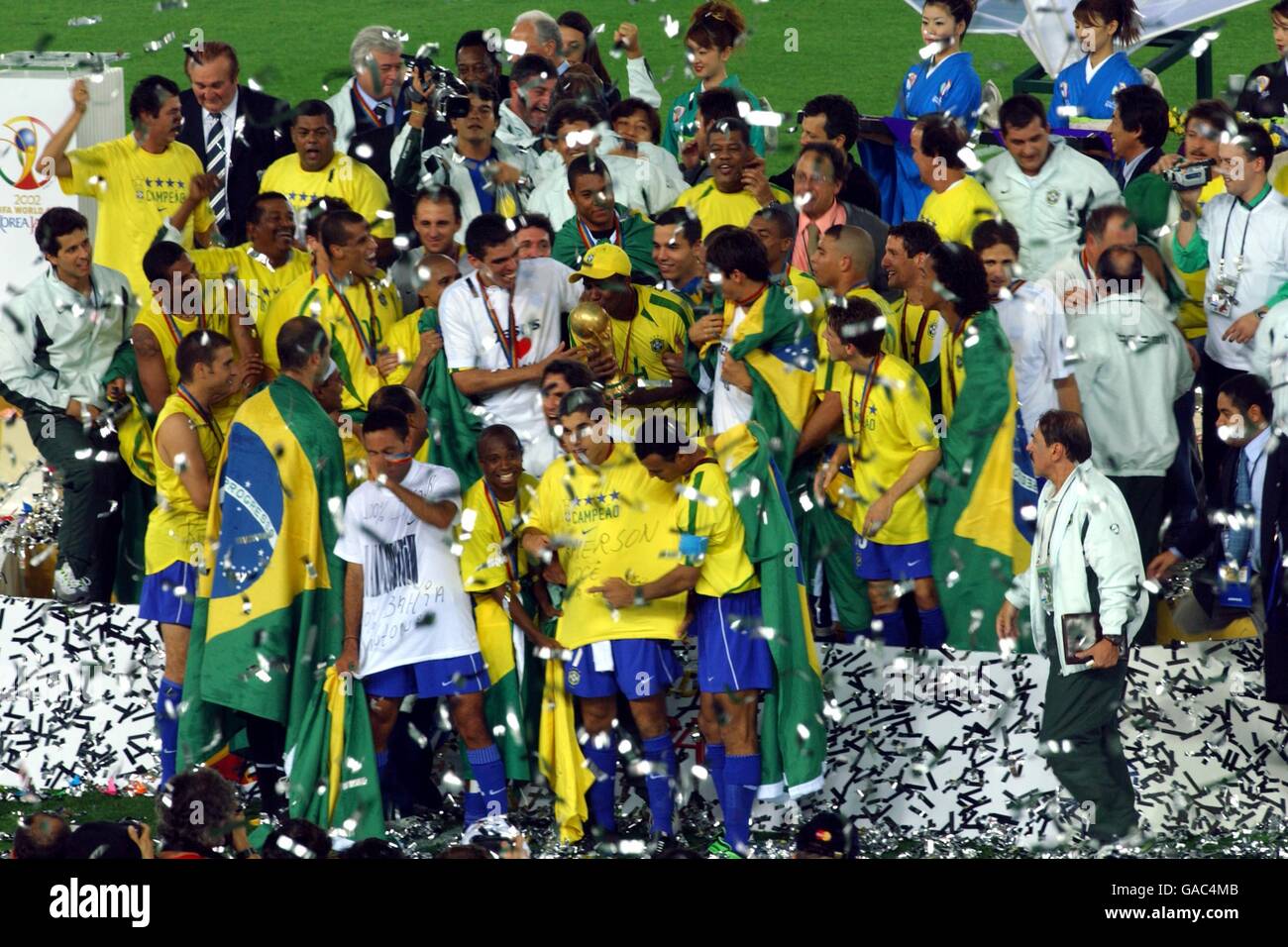
On June 30, 2002, the International Stadium Yokohama hosted a fixture that felt destined for soccer mythology long before kickoff. For all their shared dominance across twentieth-century international football, Brazil and Germany had never met in a World Cup match. The clash served as the theatrical peak of the first World Cup hosted in Asia, closing out a tournament defined by shocking upsets, contentious refereeing, and relentless drama. Even as modern analytics teams prepare for expanded 48-team formats, as recently dissected in tournament retrospectives by tactical outlets such as the RotoWire Report, the tactical discipline and individual brilliance on display in Yokohama remain the benchmark against which global finals are judged.
The match was underpinned by two distinct personal storylines. On one side stood Oliver Kahn, the scowling German captain who had conceded just a single goal across six matches, carrying an otherwise unremarkable national side through sheer intimidation and reflexes. On the other stood Ronaldo Nazário, battling back from devastating patellar tendon ruptures that had stolen years of his prime and clouded his memory of the 1998 final in Paris. When the final whistle blew in front of 69,029 spectators, the narrative arc had bent toward complete redemption.
📌 Key Takeaways:
- Ronaldo’s Redemption: Ronaldo Nazário scored both goals in the second half, finishing the tournament with 8 goals and capturing the Golden Boot.
- The Crucial Absence: Michael Ballack missed the match due to accumulated yellow cards, stripping the German midfield of its primary attacking thrust.
- The Uncharacteristic Mistake: Oliver Kahn’s 67th-minute spill off a Rivaldo strike broke a tight defensive gridlock and decided the championship.
How Brazil and Germany Navigated Chaos to Reach Yokohama
Neither finalist entered the 2002 tournament viewed as an untouchable juggernaut. Brazil had stumbled severely through CONMEBOL qualifying, cycling through four managers before appointing Luiz Felipe Scolari. They lost six matches during qualification, barely securing their ticket to South Korea and Japan in the final fixture against Venezuela. Scolari stripped away stylistic indulgences, built a pragmatic three-man backline, and trusted his attacking trio, Ronaldo, Rivaldo, and Ronaldinho, popularly dubbed the "Three Rs", to generate scoring opportunities on the break.
Germany arrived under an even bleaker cloud. Rudi Völler took charge of a side lacking technical creativity, relying heavily on a veteran core and physical aerial play. After suffering a humiliating 5, 1 defeat to England in Munich during qualifying, Germany had to survive a tense playoff against Ukraine. In the tournament itself, they ground out successive 1, 0 knockout victories over Paraguay, the United States, and co-hosts South Korea. Kahn was their shield, repeatedly producing world-class saves while midfielder Michael Ballack provided decisive late goals.
That balance cracked in the semifinal against South Korea. Ballack committed a professional foul in the 71st minute to halt a dangerous counterattack, receiving a yellow card that triggered an automatic suspension. Four minutes later, Ballack scored the winner. His self-sacrifice propelled Germany to Yokohama but stripped Völler of his only complete central midfielder for the biggest match of his managerial career.
Lineups and Tactical Blueprints: Scolari’s Shape vs. Völler’s Depleted Engine
The 2002 FIFA World Cup lineups reflected contrasting footballing cultures attempting to mask their own vulnerabilities. Scolari organized Brazil in a fluid 3-4-1-2 formation. Edmílson stepped forward from central defense to act as a deep pivot alongside Gilberto Silva and Kléberson, while wing-backs Cafu and Roberto Carlos provided relentless width. Ronaldinho, returning from his quarterfinal red card against England, operated behind Rivaldo and Ronaldo, creating pockets of space between the German midfield and backline.
Germany countered with a disciplined 3-5-2 setup under Rudi Völler. With Ballack sidelined, Jens Jeremies stepped into central midfield alongside Dietmar Hamann to disrupt Brazil’s supply lines. Oliver Neuville partnered Miroslav Klose up front, tasked with pressing Brazil’s center-backs and attacking set-pieces. Bernd Schneider took on heightened playmaking responsibilities from the right flank, testing Roberto Carlos' defensive discipline.
| Category | Germany (Manager: Rudi Völler) | Brazil (Manager: Luiz Felipe Scolari) |
|---|---|---|
| Starting Formation | 3-5-2 | 3-4-1-2 |
| Key Absences | Michael Ballack (Suspension) | Emerson (Dislocated shoulder pre-tournament) |
| Total Shots (On Target) | 12 (4) | 9 (7) |
| Corners Earned | 13 | 3 |
| Disciplinary Record | 1 Yellow Card (Miroslav Klose 9') | 1 Yellow Card (Roque Júnior 6') |
Germany controlled possession through the first half hour, frustrating Brazil with compact central passing and high pressing. Yet Brazil carried the sharper edge on counterattacks. Kléberson rattled the crossbar from 25 yards out just before halftime, while Kahn denied Ronaldo from close range with sharp kick-saves, preserving a tense 0, 0 score at the interval.
The 67th-Minute Spill: Kahn’s Agony and Ronaldo’s Instinct
The turning point arrived midway through the second half, born from an uncharacteristic sequence of errors. In the 67th minute, Dietmar Hamann was dispossessed roughly 35 yards from his own goal by Ronaldo. The ball rolled to Rivaldo, who immediately unleashed a swerving, low drive toward the center of the net.
It was a speculative strike, well within the scope of Kahn’s demonstrated abilities throughout the tournament. Yet as Kahn crouched to gather the ball into his chest, it bounced off his torso. Ronaldo had anticipated the spill the split second Rivaldo struck the ball, sprinting past Thomas Linke. He pounced on the rebound and slipped it under Kahn into the bottom corner. The German goalkeeper sat motionless on his knees, head bowed against the Yokohama turf.
Later reports revealed that Kahn had sustained a torn ligament in his right ring finger following an earlier collision with Brazil forward Gerald Asamoah. Whether physical trauma or momentary lapse, the error dismantled Germany’s tactical resolve. Völler was forced to open up his formation, bringing on Oliver Bierhoff and Gerald Asamoah to chase an equalizer.
The Yokohama Clincher: Rivaldo’s Dummy and the Second Strike
Twelve minutes after breaking the deadlock, Brazil executed one of the most aesthetically refined counterattacking moves in World Cup final history. Kléberson surged down the right flank, exploiting the vast spaces left by an overextended German midfield. He spotted Rivaldo arriving at the edge of the penalty box and delivered a crisp low cross.
Rivaldo, sensing Ronaldo tracking behind him, let the ball run between his legs without touching it. The dummy paralyzed German defender Thomas Linke and pulled Kahn out of position. Ronaldo collected the delivery with his right foot, adjusted his stride in a single movement, and curled a low shot into the bottom-right corner. It was his eighth goal of the competition, breaking the six-goal barrier that had held firm at every men's World Cup since 1974.
The second goal extinguished German resistance. Bierhoff forced a brilliant diving stop from Brazil goalkeeper Marcos in the dying minutes, but the outcome had long since tilted. Brazil did not merely survive Germany; they exposed the limitations of Völler’s conservative structure once trailing on the scoreboard.
Pierluigi Collina’s Masterclass: Authoritative Control on the Biggest Stage
The 2002 World Cup was severely marred by officiating controversies, particularly during the knockout matches involving South Korea against Italy and Spain. FIFA appointed Italian referee Pierluigi Collina to lead the final in Yokohama, an assignment widely welcomed across the sport due to his undisputed international standing.
Collina set the operational tone within the opening ten minutes. When Roque Júnior took down Oliver Neuville with a cynical challenge in the sixth minute, Collina produced an immediate yellow card. Three minutes later, Miroslav Klose received a caution for a reckless challenge on Edmílson. By setting strict disciplinary parameters early, Collina prevented the final from descending into the attritional physical battles that characterized earlier tournament phases.
Collina allowed physical shoulder challenges while clamping down on shirt-pulling and simulation. His clear communication with captains Kahn and Cafu eliminated gamesmanship, ensuring the sporting outcome remained untainted by disputed whistle calls. To this day, his handling of the 2002 final remains a gold standard in global tournament administration.
Cafu’s Podium Ascent and the Lasting Pentacampeão Era
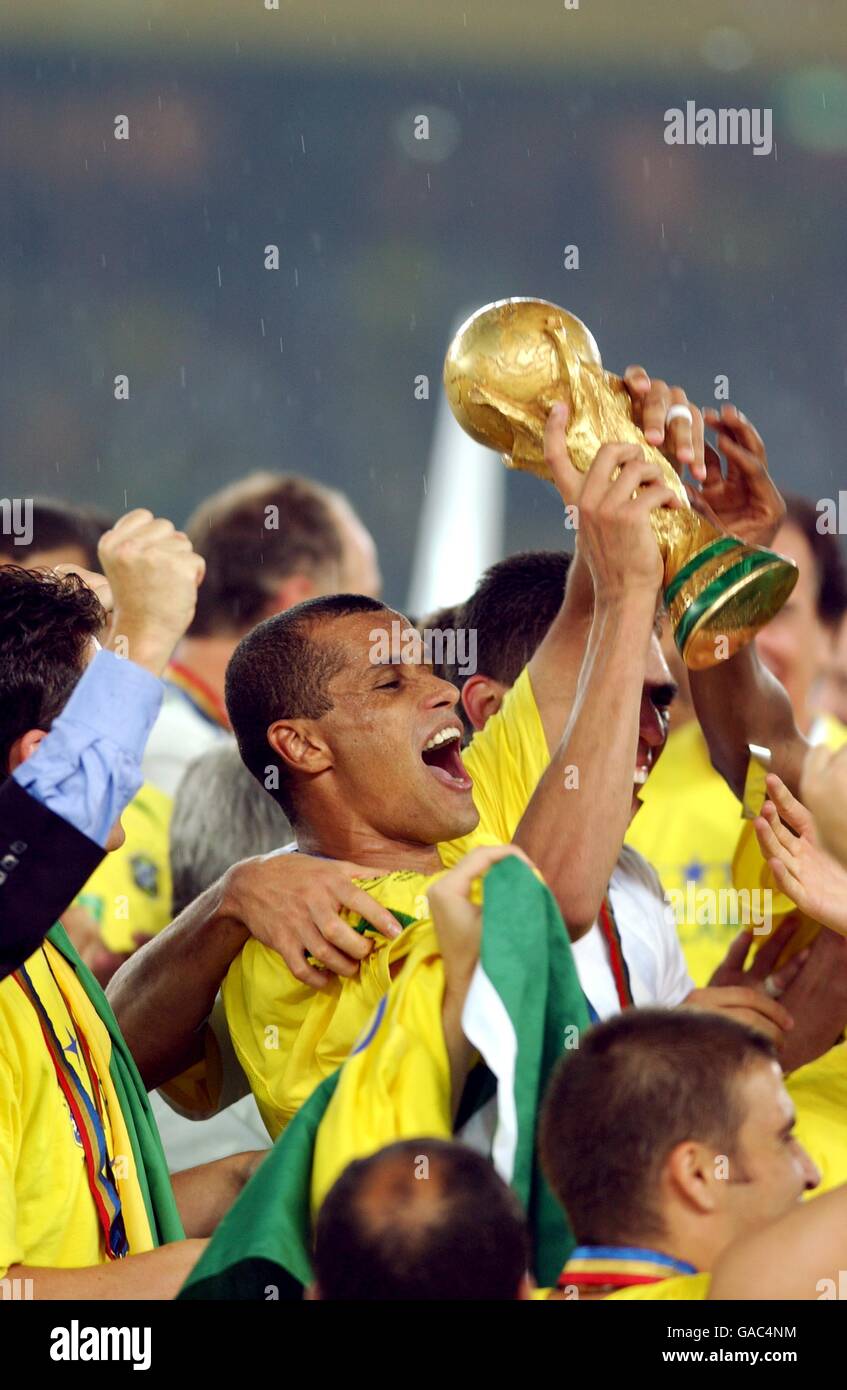
When Collina blew the final whistle, it marked the coronation of the Pentacampeão, Brazil’s fifth World Cup victory. Fullback Cafu climbed onto the circular presentation stage, balanced on the narrow handrail above his teammates, and lifted the FIFA World Cup trophy into the Yokohama night sky. Written across his jersey in marker pen was the handwritten tribute "100% Jardim Irene," honoring the impoverished São Paulo favela where he grew up.
That moment marked the end of an era. The 2002 victory remains the last time a non-European nation lifted the World Cup trophy until Argentina's victory in Qatar twenty years later. Scolari’s pragmatic tactical framework proved that Brazil could retain defensive stability without suppressing individual genius, transforming public perception of a squad that had faced vitriolic media criticism throughout qualification.
For Oliver Kahn, the evening ended with tragic grace. Despite the fatal error, he became the first and only goalkeeper to win the tournament’s Golden Ball as the best player, having dragged an aging national side to the threshold of glory. His performance triggered a total tactical overhaul inside the German Football Association (DFB), catalyzing youth academy investments that eventually produced their 2014 title-winning squad.
Frequently Asked Questions (FAQ)
Q1: Why was Michael Ballack absent from the 2002 World Cup final?
A1: Ballack received a mandatory one-match suspension after picking up his second knockout-stage yellow card in the 71st minute of the semifinal against South Korea. Under 2002 tournament rules, yellow cards were not wiped clean before the semifinals.
Q2: How many goals did Ronaldo score in the 2002 World Cup final?
A2: Ronaldo scored both goals for Brazil, finding the net in the 67th and 79th minutes to seal a 2, 0 victory. This brought his tournament total to eight goals, earning him the Golden Boot.
Q3: Did Oliver Kahn play the final with an injury?
A3: Yes. Kahn suffered a torn ligament in his right ring finger following an impact earlier in the match. While he refused to cite the injury as an excuse, it likely impaired his handling on Rivaldo’s shot leading to the opening goal.
Q4: What was the tactical system Luiz Felipe Scolari used in the match?
A4: Scolari deployed a 3-4-1-2 formation. Three central defenders (Lúcio, Edmílson, Roque Júnior) anchored the structure, dynamic wing-backs (Cafu and Roberto Carlos) provided width, and Ronaldinho linked play behind twin strikers Ronaldo and Rivaldo.
Why Yokohama Remains the Definitive Global Final
Decades after the confetti settled in Japan, the 2002 final endures because it delivered narrative closure rather than tactical paralysis. Too many international finals devolve into sterile, risk-averse stalemates decided by penalty shootouts or set pieces. Yokohama gave the world a direct collision between the tournament’s most impenetrable defense and its most lethal forward line.
Ronaldo Nazário’s two-goal exhibition remains sports cinema at its purest. Four years after experiencing a convulsive seizure hours before the 1998 final, he walked off the pitch in Yokohama as a world champion, top scorer, and undisputed focal point of global football. Brazil’s fifth star was not just an entry into the record books; it closed out the golden era of individual, instinctive South American attacking supremacy before the modern era of high-pressing European systems took hold.


