Tracing the Receipts: The Exact Origins of 'I Ain't Reading All That'
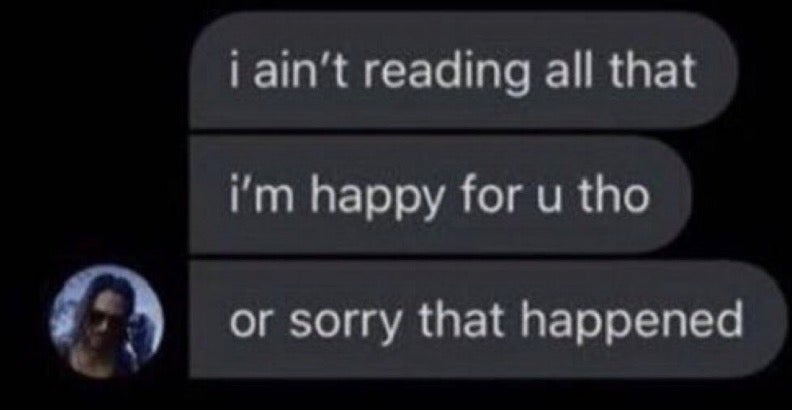
Kentucky Representative Thomas Massie did not mince words when Donald Trump issued an expansive, multi-paragraph broadside endorsing Massie's primary challenger for the 2026 midterm election cycle. Confronted with hundreds of words detailing his perceived disloyalty on Truth Social, Massie reached straight into the internet's defensive lexicon. As detailed by a WHAS11 Report, the congressman countered the former president's screed with a brutally minimalist reply: "i aint reading all that."
Massie followed with the second half of the ubiquitous social media copypasta: "i'm happy for u tho / or sorry that happened." It was a watershed moment for digital rhetoric. A phrase that began as an anonymous, unpunctuated text exchange between teenagers had scaled Capitol Hill, weaponized against the standard-bearer of the modern Republican Party. The wall of text reaction had evolved from an adolescent brush-off into an elite tool of political deflection.
📌 Key Takeaways:
- The Lineage: Traced back to a viral screenshot from late 2019, the phrase originated as a private messaging reaction before spreading across iMessage, Reddit, and Twitter discourse.
- The Rhetorical Shift: Unlike standard TLDR culture, which requests an executive summary, "i aint reading all that" functions as an aggressive assertion of status by treating an opponent’s detailed argument as worthless clutter.
- Mainstream Weaponization: The phrase crossed into high-stakes governance when figures like Rep. Thomas Massie deployed it against multi-paragraph political endorsements in early 2026.
The Anatomy of the Dismissal: How Five Words Replaced Argumentation
Online argument used to require engagement. Blog posts prompted counter-essays. Lengthy tweets yielded threaded rebuttals with block quotes and hyperlinks. That dynamic collapsed under the weight of information overload.
"I ain't reading all that" short-circuits the social contract of online discourse. When an interlocutor spends forty minutes crafting an intricate thesis, the recipient does not counter the logic or point out factual errors. They reject the time investment itself. It is the ultimate expression of asymmetric warfare: maximal effort met with absolute, performative apathy.
As documented in a retrospective on online dismissive slang by MEL Magazine, the phrase captures the exhaustion of an era inundated with frantic, unvetted declarations. In digital sociology, attention is the scarcest currency. To declare that you will not spend yours reading an opponent’s earnest prose is to strip them of leverage instantly. The phrase asserts dominance precisely because it treats passion as an embarrassing character flaw.
The Screenshot Trail: Unearthing the Original Viral Exchange
The phrase did not materialize from thin air. It emerged from the messy, claustrophobic dynamics of group chats and romantic breakups. Digital archaeologists tracking the meme origin story point to late 2019, when a set of cropped mobile screenshots began circulating across Reddit forums such as r/GoodFakeTexts and r/me_irl.
The foundational image depicted an emotional, unbroken blue bubble on an iPhone, a dense wall of text spanning multiple screen heights, likely outlining relationship grievances. Directly beneath this emotional outpouring sat a clean, lowercase gray bubble containing the fatal blow:
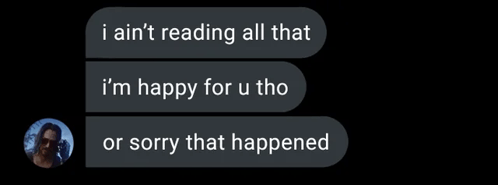
i aint reading all that
i'm happy for u tho
or sorry that happened
The response offered a surgical parody of human empathy. By providing an either/or formulation ("happy for u" / "sorry that happened"), the responder demonstrated they had not even bothered to parse whether the incoming essay was triumphant news or personal tragedy. By early 2020, Twitter users clipped the text, transcribing it as a universal copypasta to respond to unsolicited essays, long-winded fan-fiction updates, and political manifestos.
Evolution of the Brush-Off: From Old Forums to Modern Copypasta
Internet users have always resisted long-winded screeds, but the tone of that resistance has mutated drastically over three decades. Early web culture demanded brevity, but retained a grudging respect for effort. Modern meme culture treats effort with contempt.
| Era & Slang | Primary Medium | Underlying Intention | Power Dynamic |
|---|---|---|---|
| TL;DR (Too Long; Didn't Read)Circa 2002, 2012 | Usenet, SomethingAwful, early Reddit | A utilitarian request for an executive summary or bullet points. | Collaborative: Assumes the author's point is valid if condensed. |
| "Much Sugar, Very Sweet" / "Cool Story Bro"Circa 2008, 2015 | 4chan, Facebook comment threads | Mild sarcasm aimed at mundane, overly detailed personal anecdotes. | Playful mockery: Challenges the entertainment value of the text. |
| "I Ain't Reading All That"Circa 2019, 2026 | Twitter/X, TikTok, Political Feuds | Aggressive refusal of receipt; deliberate humiliation of sincerity. | Dominance display: Invalidates the speaker's right to demand time. |
The transition from "TL;DR" to "i aint reading all that" tracks the decay of conversational generosity. TL;DR was an invitation to distill meaning. The modern response is a closed door. It informs the speaker that their interior life, analysis, and emotional stake are fundamentally worthless to the reader.
Political Clapback Tactics: Massie, Trump, and High-Stakes Deflection
When Rep. Thomas Massie deployed the meme against Donald Trump's primary endorsement screed in 2026, he wasn't just being cheeky. He was executing a calculated political defense.
Trump's signature communications playbook has long relied on breathless, stream-of-consciousness diatribes posted to proprietary platforms. These screeds dictate entire news cycles because mainstream media anchors spend hours parsing every capital letter and exclamation mark. Challengers historically fell into the trap of writing dense counter-statements defending their legislative voting records line by line.
Massie’s rebuttal upended that cycle. By posting the copypasta, he denied Trump the oxygen of a substantive defense. The five-word reply framed the former president's lengthy condemnation not as an authoritative political decree, but as the tedious venting of a digital nuisance. Within two hours, political strategists on both sides realized the dynamic had fundamentally broken: the traditional power of the long-form endorsement had been neutralized by a teenagers' screenshot from 2019.
The Cognitive Toll: Information Overload and the Rise of Defensive Slang
The meteoric rise of the phrase reflects cognitive triage. The average internet user in 2026 navigates a firehose of algorithmically boosted outrage, corporate public relations apologies, micro-influencer apologies, and sprawling political manifestos.
Humans do not possess the working memory to emotionally process every long-form plea pushed into their feeds. Behavioral psychologists note that defensive slang acts as a psychological buffer against cognitive exhaustion. When confronted with an overwhelming wall of text, the brain experiences decision fatigue. Choosing to engage with an essay means agreeing to carry its emotional and intellectual burden.
Deploying a meme response offloads that burden instantly. The user does not process the content, evaluate the premises, or form a complex counter-argument. Instead, they slap a linguistic "Return to Sender" stamp on the envelope and move on.
Frequently Asked Questions (FAQ)
Q1: Who literally wrote the very first "i aint reading all that" message?
The original author remains anonymous. The phrase originated in unverified direct-message screenshots posted to Reddit and Twitter between late 2019 and early 2020. No single influencer has established a verified trademark or undeniable claim to the raw interaction.
Q2: Why is the secondary line "happy for you though or sorry that happened" so crucial?
The second sentence provides the comedic engine of the meme. By explicitly listing two opposite emotional reactions, the speaker admits they did not read enough of the message to know if the sender was celebrating or grieving. That indifference transforms a simple refusal to read into an act of satirical cruelty.
Q3: How does this phrase differ from standard TLDR culture?
TLDR is functional; it asks for a summary so communication can proceed. "I ain't reading all that" is adversarial; it ends the conversation immediately while asserting that the author's effort was an embarrassing waste of time.
Q4: Why did Thomas Massie's use of the meme gain so much traction in 2026?
Massie used it against Donald Trump's primary challenger endorsement. Applying a frivolous internet dismissive trope to a high-stakes, career-threatening political directive shattered traditional expectations for congressional deference and reshuffled the rules of political discourse.
The Future of Digital Attention Defiance
The migration of "i aint reading all that" from obscure messaging boards to the front lines of American politics signals an irreversible collapse in rhetorical etiquette. Attention spans are not merely shrinking; they are actively defending themselves.
As automated artificial intelligence tools flood public forums with millions of synthetic, hyper-detailed essays every hour, human readers will increasingly reject the expectation of engagement. Long-form argumentation now carries an inherent strategic vulnerability: the more words you write, the easier it is for your target to dismiss you with five. The era of the point-by-point rebuttal is over, replaced by the crushing weight of public indifference.


