What Comes After Trillion? Fact-Checking Math Scales and Economic Milestones
When the United States federal balance sheet crossed $40 trillion in mid-2026, the reaction across bond desks was less shock than exhausted resignation. That threshold, confirmed by both NPR and The Washington Post as rising yields accelerated borrowing costs, landed right alongside private market records. Apple broke through the $5 trillion market valuation mark, while an extensive Yahoo Finance Report analyzed the road ahead after Amazon climbed past $3 trillion. At the same time, Time Magazine tracked Elon Musk’s approach toward verified trillionaire status following the historic SpaceX public listing. Numbers that once belonged strictly to theoretical astrophysics now appear routinely in market tickers and congressional budget resolutions.
The sheer velocity of this capital expansion has pushed language to its limits. When ordinary citizens hear about trillions in sovereign debt and corporate equity, the question quickly follows: what comes next? Mathematically, the immediate successor to a trillion is a quadrillion, followed by quintillion, sextillion, and septillion. Understanding those terms requires separating pure mathematics from global finance, where jumping to the next order of magnitude carries severe economic consequences.
📌 Key Takeaways:
- The Direct Sequence: In the short-scale system used across modern English, a quadrillion ($10^{15}$) immediately follows a trillion ($10^{12}$), followed in sequence by quintillion ($10^{18}$), sextillion ($10^{21}$), and septillion ($10^{24}$).
- The International Divide: Continental Europe and Latin America largely maintain the long-scale system, where a "trillion" represents a million times a million times a million ($10^{18}$), creating frequent diplomatic and translation confusion.
- Economic Reality: Total annual global gross domestic product sits near $110 trillion; the only financial metric currently touching quadrillion territory is the gross notional exposure of the global over-the-counter derivatives market.
The Mathematical Ladder: Powers of Ten and Standard Nomenclature
Every step up the large number ladder represents a sharp escalation in scale. In the naming system established by French mathematician Nicolas Chuquet in the fifteenth century and later formalized for English, standard names derive from Latin numerical prefixes joined to the suffix "-illion."
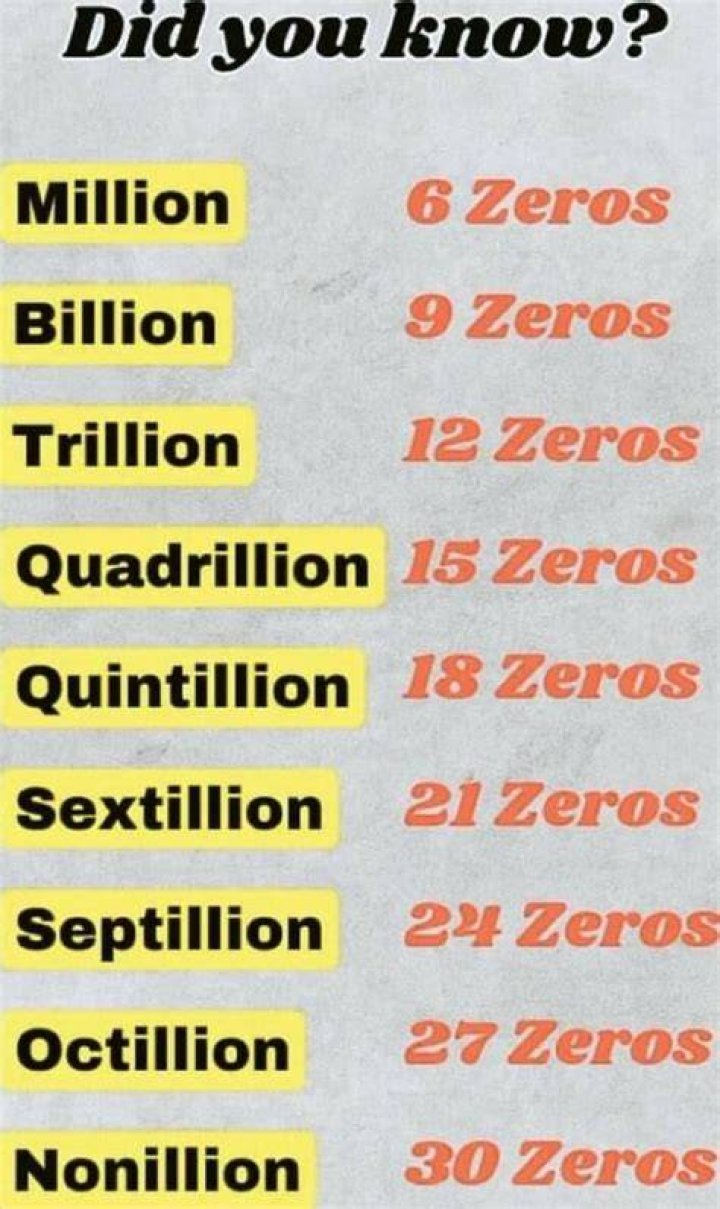
A million is one thousand thousands ($10^6$, or 1 followed by 6 zeros). Multiply that by one thousand, and you reach a billion ($10^9$, 9 zeros). Scale up by another factor of one thousand, and you arrive at a trillion ($10^{12}$, 12 zeros). Next in sequence comes the quadrillion ($10^{15}$, 15 zeros), built on the Latin root quadri- for four. Advance another thousandfold, and you hit quintillion ($10^{18}$, 18 zeros), followed by sextillion ($10^{21}$, 21 zeros), septillion ($10^{24}$, 24 zeros), octillion ($10^{27}$, 27 zeros), nonillion ($10^{30}$, 30 zeros), and decillion ($10^{33}$, 33 zeros).
These values expand exponentially rather than linearly. Moving from a trillion to a quadrillion is not an incremental adjustment; it requires stacking one thousand individual trillions together. Written out entirely, one quadrillion appears as 1,000,000,000,000,000. Because managing strings of zeros quickly becomes unwieldy, physicists and engineers rely on scientific notation. A trillion becomes $1 \times 10^{12}$, while a quadrillion is noted as $1 \times 10^{15}$. At the extreme theoretical fringe rests the googol, a 1 followed by 100 zeros ($10^{100}$), coined in 1920 by nine-year-old Milton Sirotta, nephew of American mathematician Edward Kasner. While mathematically useful, a googol exceeds the estimated total count of fundamental particles in the observable universe, which stands around $10^{80}$.
Short Scale vs. Long Scale: The Linguistic Border Dispute
A primary source of confusion around large numbers is geographical. Depending on where you stand on the globe, the word "trillion" can mean two entirely different sums.
The English-speaking world, including the United States, Great Britain, Canada, and Australia, operates on the short scale. Under this logic, every new "-illion" name occurs at an interval of $10^3$ (one thousand). The United Kingdom officially abandoned its traditional system in 1974 when Chancellor of the Exchequer Harold Wilson directed government statistics to match the American short-scale convention to avoid transnational banking discrepancies.
Much of continental Europe, French-speaking Africa, and Latin America retains the long scale, popularized by French mathematician Jacques Peletier du Mans. Under long-scale conventions, values increase by a factor of $10^6$ (one million) for each new "-illion" tier. The intervening thousand-multiples take the suffix "-illiard."
Under the long scale, a billion is not $10^9$; it is one million millions, or $10^{12}$, the exact equivalent of an American trillion. What Americans call a billion is termed a milliard in French and German. Consequently, a long-scale trillion represents $10^{18}$, equal to a short-scale quintillion. When European media translate American financial reporting without adjusting for the scale, market metrics can appear warped by orders of magnitude. A foreign reporter translating a $40 trillion US national debt milestone into a long-scale language must translate it as 40 billion (or 40 billionen/billones), otherwise they inadvertently describe a sum one million times larger than reality.
The Numeric Hierarchy: From Millions to a Googol
Tracking these values requires a structured comparison across notation methods, linguistic systems, and physical baselines.
| Name (Short Scale) | Scientific Notation | Long-Scale Equivalent | Physical or Economic Benchmark |
|---|---|---|---|
| Million | $10^6$ (6 zeros) | Million | Median net worth of top 10% US household |
| Billion | $10^9$ (9 zeros) | Milliard / Thousand Million | Cost of a state-of-the-art semiconductor fab ($10B, $20B) |
| Trillion | $10^{12}$ (12 zeros) | Billion | Mega-cap tech equities; US sovereign debt ($40T) |
| Quadrillion | $10^{15}$ (15 zeros) | Billiard / Thousand Billion | Global financial derivatives gross notional value |
| Quintillion | $10^{18}$ (18 zeros) | Trillion | Estimated grains of sand on all Earth beaches (~7.5 quintillion) |
| Sextillion | $10^{21}$ (21 zeros) | Trilliard / Thousand Trillion | Number of visible stars in the observable universe |
| Septillion | $10^{24}$ (24 zeros) | Quadrillion | Mass of the Earth in kilograms (~5.97 septillion kg) |
| Googol | $10^{100}$ (100 zeros) | Ten Duotrigintillion | Exceeds total subatomic particles in the visible cosmos ($10^{80}$) |
Wall Street and Washington: When Trillions Become Ordinary
The transition of "trillion" from an academic curiosity to everyday financial shorthand happened with stunning speed. In 2018, Apple became the first publicly traded American company to record a $1 trillion market capitalization. By mid-2026, the company traded at $5 trillion, while retail and logistics heavyweight Amazon crossed $3 trillion. Individual fortunes expanded alongside equity indices, bringing Elon Musk within striking range of becoming the world's first verified individual trillionaire on the heels of major SpaceX valuation updates.
Sovereign finances followed an even steeper trajectory. The United States national debt crossed $10 trillion during the 2008 financial crisis, doubled to $20 trillion by 2017, and surged past $40 trillion in 2026. Data published by the Congressional Budget Office and reported by NPR and The Washington Post revealed that debt accumulation accelerated months ahead of schedule as elevated Federal Reserve benchmark rates drove annual net interest payments past the defense budget.
This inflationary bracket creep has created psychological scale insensitivity. Cognitive scientists refer to the phenomenon as "numerical numbness." The human mind naturally conceptualizes small counts, herds of cattle, seasonal cycles, family units, through linear spatial reasoning. Visualizing the jump from a million to a billion is difficult enough: one million seconds is roughly 11.5 days, while one billion seconds spans nearly 31.7 years. One trillion seconds equals 31,709 years, stretching back to before the dawn of recorded human civilization. When economic debates casually swap billions for trillions, the public loses touch with the underlying resource realities.
Crossing into Quadrillions: The Real-World Limits of Capital
Could an economic metric ever genuinely touch a quadrillion? Under current productive realities, the answer is an emphatic no for real assets, but a qualified yes for paper risk.
The total annual output of humanity, global gross domestic product, stands at approximately $110 trillion across all 195 nations combined. All the mined gold in human history, totaling roughly 212,000 metric tons, carries a combined value hovering around $16 trillion depending on spot pricing. Total global real estate, encompassing every farm, skyscraper, residential home, and industrial park on Earth, is valued at roughly $380 trillion. Even if an investor purchased all global equities, sovereign bonds, and physical land, the aggregate wealth of humanity falls well short of a single quadrillion dollars.
The sole realm where quadrillions already surface is within the financial derivatives market. The Bank for International Settlements (BIS) in Basel regularly tracks the gross notional value of over-the-counter derivatives contracts, including interest rate swaps, credit default swaps, and currency forwards. At periodic peaks, that metric has approached or exceeded $1 quadrillion ($1,000 trillion).
Notional value is largely an accounting ghost. It tracks the face value of the underlying financial assets upon which a contract is written, not the actual cash committed. If two institutional banks swap interest obligations on a $100 million bond portfolio to hedge against yield curve fluctuations, the notional value is logged as $100 million, while the cash changing hands might amount to a fraction of a percent. The quadrillion figure describes layered gross counterparty exposure rather than unencumbered capital.
Hyperinflationary Distortions: The Dark History of Million-to-One Swaps
Real-world economies usually hit quadrillion, quintillion, or sextillion milestones only during severe monetary failures. Raw numeric milestones in fiat currency signify currency devaluation rather than capital growth.
During the Weimar Republic collapse in 1923, German monetary authorities printed the 100-trillion-mark banknote as workers collected wages in wheelbarrows twice daily to beat hourly retail price increases. Zimbabwe repeated the cycle in 2008, eventually printing a 100-trillion-dollar note that could barely cover a loaf of bread, before abandoning its currency entirely.
The most extreme monetary breakdown occurred in postwar Hungary in 1946. Experiencing the highest recorded hyperinflation rate in history, prices doubled every fifteen hours. The central bank moved from the standard pengő to the milpengő (one million pengő), then to the b.-pengő (one billion pengő under the long scale, or $10^{12}$). The final printed bill was the 100-million b.-pengő, representing $10^{20}$ (100 quintillion pengő). When the government finally stabilized the economy by issuing the forint on August 1, 1946, the official conversion rate was set at 400 octillion ($4 \times 10^{29}$) pengő for a single new forint. Outside of runaway printing presses, large numeric labels belong to astronomical physics, not sound economic management.
Frequently Asked Questions (FAQ)
Q1: What exact number comes immediately after a trillion?
A1: In standard American and English usage (the short scale), the number that immediately follows a trillion is one quadrillion. It is written as a 1 followed by 15 zeros (1,000,000,000,000,000) or $10^{15}$ in scientific notation. It takes one thousand individual trillions to make one single quadrillion.
Q2: Why do French and German sources sometimes use different terms for these amounts?
A2: Continental Europe primarily uses the long-scale system, where each new "-illion" tier scales by a factor of one million rather than one thousand. Under this framework, an American trillion ($10^{12}$) is named a billion, and an American quadrillion ($10^{15}$) is referred to as a billiard or thousand billion.
Q3: Will the United States national debt ever reach a quadrillion dollars?
A3: Hitting a quadrillion dollars in national debt would require a twenty-five-fold expansion from the current $40 trillion level. Under normal economic growth and moderate inflation, reaching $1,000 trillion is mathematically improbable for generations. Such a milestone would only occur under an extreme, multi-year hyperinflationary collapse of the currency.
Q4: What is the largest named number recognized in mathematics?
A4: While numbers are infinite, specific named quantities exist for theoretical applications. A googolplex is 1 followed by a googol of zeros ($10^{\text{googol}}$). In formal mathematical proofs, much larger quantities have been established, including Graham’s number and TREE(3), which are so massive they cannot be written using standard scientific exponential notation.
Navigating the New Scale of Global Capital in 2026
The transition from counting billions to managing tens of trillions has fundamentally altered monetary diplomacy and investor expectations. When major sovereign states absorb multi-trillion-dollar borrowing requirements as standard operating procedure, the boundary between sound budgeting and structural inflation thins considerably. While the vocabulary of quadrillions, quintillions, and sextillions provides mathematicians and astrophysicists with exact tools to map the universe, its emergence in economic headlines remains a warning sign. Real productivity grows incrementally through labor, energy efficiency, and technological innovation. Whenever paper valuations jump multiple orders of magnitude without a matching explosion in physical output, society is simply discovering new names for depreciating money.


