What Does 'Crashing Out' Actually Mean? The Dark Shift Behind Gen Z's Favorite Slang
Every few months, internet culture mints a phrase that travels rapidly from niche subcultures to mainstream ubiquity. Few linguistic exports have moved as aggressively, or carried as heavy an emotional charge, as "crashing out." On TikTok, Instagram Reels, and YouTube Shorts, millions of short-form videos depict creators slamming desks, confronting strangers, or reacting violently to minor provocations under the banner of having a sudden "crash out." As detailed in investigative coverage from a recent Yahoo Report, the term has transitioned from localized street slang to one of the most pervasive Gen Z slang trends.
Yet behind the humor and viral theatrics lies a far grimmer reality. What began as regional vernacular has mutated into a shorthand for severe emotional dysregulation. Behind the algorithmically amplified punchlines, public health professionals are sounding alarms about what the phrase reveals regarding anger and impulsivity among young people navigating an increasingly precarious social world.
📌 Key Takeaways:
- Linguistic Definition: To "crash out" means to react to an event with reckless, disproportionate rage, intentionally risking one's future, freedom, or safety without regard for consequences.
- Cultural Migration: Rooted in African American Vernacular English (AAVE) and Southern hip-hop, the term lost much of its literal gravity as social media algorithms flattened it into a catch-all meme.
- Clinical Urgency: Public health organizations, including Crisis Text Line, treat the phrase as a legitimate warning sign pointing toward severe emotional burnout and untreated psychological distress.
From Baton Rouge Rap to Global Feeds: The Street Origins
Before "crash out" entered the corporate lexicon or suburban middle school classrooms, it carried life-and-death stakes. The phrase originates directly within African American Vernacular English (AAVE), deeply tied to Southern street and hip-hop culture, particularly across Louisiana and Texas. In artists' lyrics from Baton Rouge, most visibly popularized through tracks and streams connected to Louisiana rap circles in the early 2020s, a "crash dummy" referred to someone reckless enough to commit a high-stakes crime with zero exit plan.
To "crash out" meant throwing away your life, freedom, or physical safety for momentary pride or blind fury. It was not lighthearted. It described individuals who, pushed to their psychological or economic margins, decided they had nothing left to lose.
By early 2024, TikTok algorithms decoupled the term from its localized socio-economic roots. The phrase was flattened into an umbrella label for any intense reaction. Minor workplace grievances, bad customer service interactions, and video-game losses were suddenly branded as "crashing out." When language travels from marginalized communities into hyper-commercialized internet spaces, nuance is frequently stripped away, leaving behind a stylized caricature of volatile emotion.
The Anatomy of Reckless Behavior: Meme vs. Reality
In digital spaces, the phrase thrives because it captures absolute surrender to rage. Unlike "losing your temper" or "throwing a fit," a genuine crash out requires an intentional disregard for consequences. It implies an internal calculation where the individual acknowledges the ruinous outcome of their action, arrest, expulsion, severe physical injury, total reputational destruction, and executes it anyway.
Online, creators stage elaborate parodies of this mindset. Skits showing workers walking out of retail jobs mid-shift, smashing equipment over slight reprimands, or screaming at referees routinely pull tens of millions of views. But sociologists tracking youth culture observe that this humor functions as an ironic coping mechanism. Young people use performative volatility to process chronic powerlessness. When financial security, climate stability, and institutional trust seem unattainable, the aesthetic of reckless abandon carries a strange emotional resonance.
The Spectrum of Impulsivity: Casual Venting vs. Acute Risk
Distinguishing between hyperbole and dangerous behavioral patterns has become an operational challenge for educators, parents, and managers. The term operates across a wide spectrum, from harmless digital irony to immediate behavioral health emergencies.
| Expression Level | Behavioral Markers | Real-World Consequence |
|---|---|---|
| Hyperbolic Irony | Posting memes about minor inconveniences (e.g., traffic, broken ice-cream machines). | Zero actual disruption; serves as digital bonding and stress relief. |
| Situational Burnout | Verbal outbursts, walking off shifts abruptly, explosive arguments with authority figures. | Job loss, academic suspension, damaged personal and professional relationships. |
| Clinical Crisis Point | Physical violence, dangerous driving, property destruction, explicit indifference to survival. | Legal intervention, severe bodily injury, involuntary psychiatric holds. |
The dividing line lies in the preservation instinct. When a person no longer factors their own future into an emotional response, venting ceases to be benign. It transforms into an acute behavioral hazard.
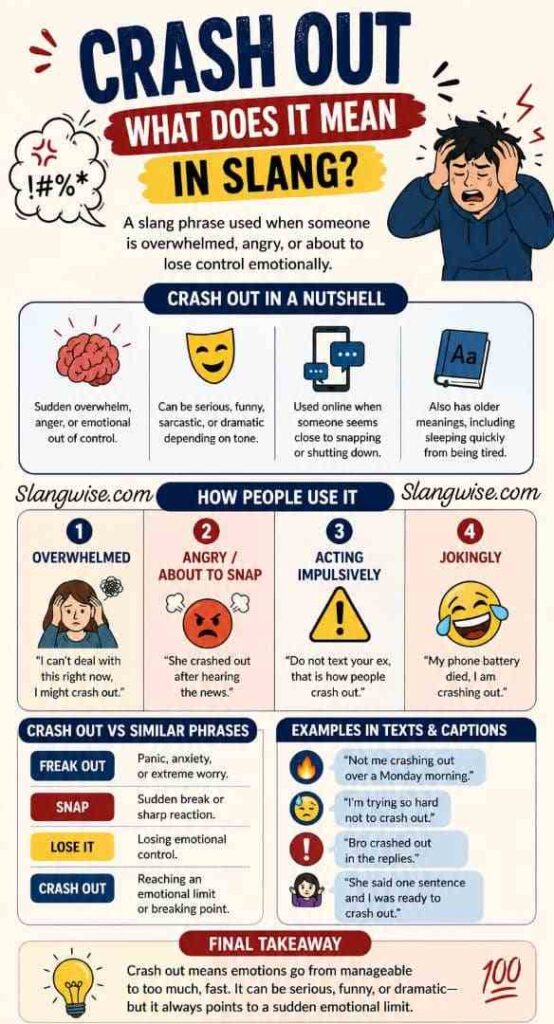
Crisis Text Line Warnings: Reading the Psychological Red Flags
Mental health practitioners are paying close attention to this vocabulary shift. Analysis published by Crisis Text Line highlighted that when young people reach out mentioning an impending "crash out," it frequently correlates with profound despair rather than simple anger.
Text-based crisis intervention platforms note that slang often acts as an emotional Trojan horse. A teenager may feel uncomfortable typing "I am experiencing acute suicidal ideation" or "I am having a nervous breakdown." Instead, typing "I'm about to crash out" feels culturally normative, emotionally defensive, and less vulnerable. It cloaks extreme pain in the armor of aggression.
Clinicians identify several underlying drivers behind real-world crash outs:
- Compounded Chronic Stress: Continuous low-grade anxiety weakens cognitive executive function, making sudden impulse control failures far more frequent.
- Algorithmic Desensitization: Endless feeds featuring explosive public conflicts normalize antisocial reactions as appropriate problem-solving methods.
- Sleep Deprivation and Digital Fatigue: Severe sleep deficits among teenagers directly undermine the prefrontal cortex, the biological seat of emotional self-regulation.
When young people repeat the phrase in serious contexts, they are rarely celebrating anger. They are communicating that their emotional containment systems are failing under sustained pressure.
Replacing Viral Rage with Sustainable Coping Mechanisms
De-escalating an individual approaching an explosive breakdown requires practical intervention rather than moral condemnation. Lectures about digital etiquette or disciplinary threats typically accelerate volatile behaviors by reinforcing the feeling that the individual has nothing left to protect.
Rebuilding emotional self-regulation starts with biological down-regulation. The physical sensations preceding an emotional explosion, accelerated heart rate, tunnel vision, shallow breathing, indicate an activated sympathetic nervous system. Somatic reset strategies, such as intense temperature changes (holding ice cubes, splashing cold water on the face) or the physiological sigh (two quick nasal inhales followed by an extended oral exhalation), interrupt adrenaline surges within seconds.
Beyond immediate physical resets, institutional support systems must adapt to modern linguistic signals. High schools and universities implementing restorative behavioral circles find that teaching young adults to identify their specific emotional baselines prevents explosive incidents before they materialize. Giving youth practical, non-judgmental avenues to voice absolute exhaustion strips the allure away from self-destructive spectacles.
Frequently Asked Questions (FAQ)
Q1: Is "crashing out" considered offensive or inappropriate to say?
A1: While not profanity, it derives from African American Vernacular English (AAVE) where it carries specific, severe weight regarding violence and systemic hardship. Using it casually in professional settings is inappropriate, and treating real-life crises as humorous internet slang can diminish actual distress signals.
Q2: What is the main difference between "crashing out" and "snapping"?
A2: "Snapping" implies a temporary loss of emotional control where someone screams or cries. "Crashing out" explicitly involves engaging in self-destructive or reckless behavior that carries devastating, long-term personal consequences, often executed with conscious indifference to the fallout.
Q3: How should I respond if a friend or family member texts me that they are "about to crash out"?
A3: Treat the message with calm seriousness. Do not match their agitation or dismiss it as simple internet humor. Ask open-ended grounding questions such as, "Where are you right now?" or "What happened in the last hour that pushed you here?" If they express indifference to their safety or threaten harm to themselves or others, encourage them to contact support services like the Crisis Text Line (text HOME to 741741) or call 988 immediately.
Beyond the Viral Outrage Cycle
The viral popularity of "crashing out" exposes the emotional friction of a generation coming of age in public view. Slang terms arrive and fade, but the psychological conditions that give them power remain stubborn and real. Internet culture often celebrates unhinged volatility because dramatic conflict generates clicks, watch-time, and engagement metrics.
Treating reckless behavior solely as meme fodder ignores the quiet crisis unfolding beneath the screen. When someone expresses a desire to throw everything away, the task for those around them is not to film the fallout, but to recognize the distress behind the bravado before the damage becomes irreversible.


