What Does 'Stan' Mean? The Complete Beginner's Guide to Online Fandoms and Slang
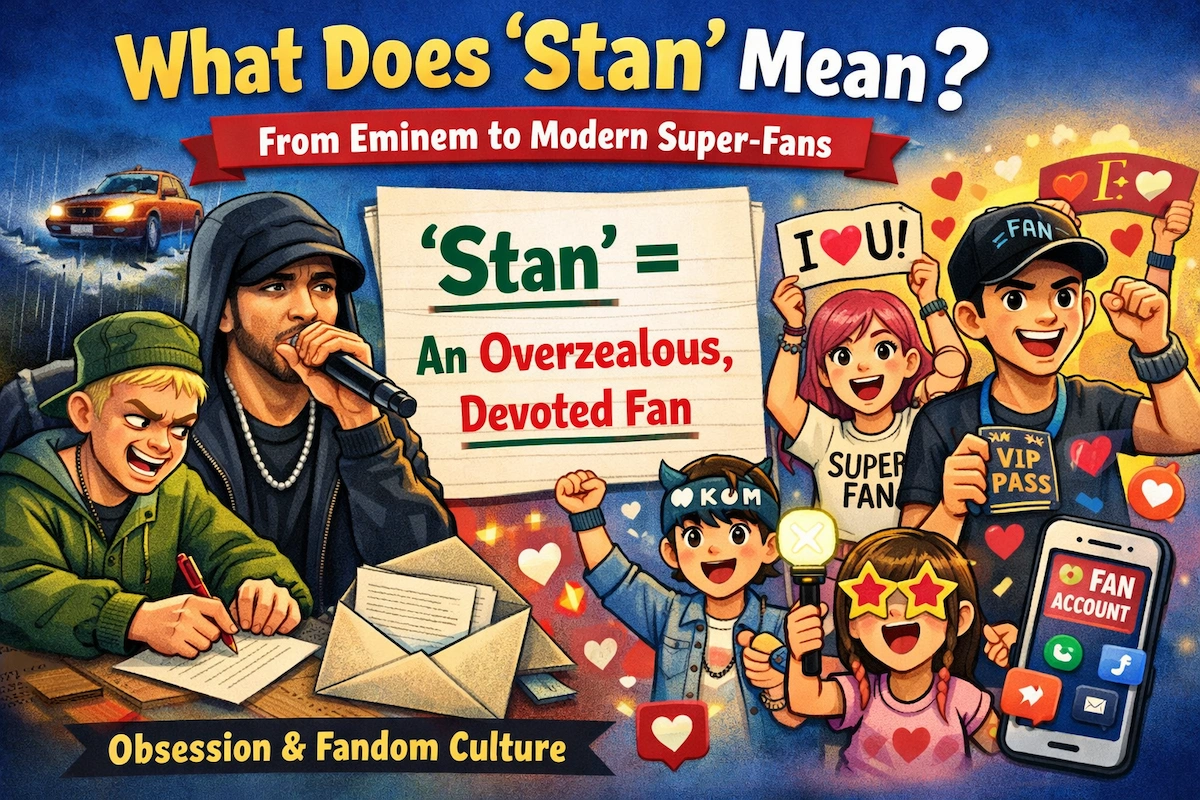
The word entered pop culture as a cautionary tale about lethal obsession, but it now dictates how millions of people consume music, defend celebrities, and speak online. When internet users say they "stan" an artist, actor, or creator, they rarely mean they are harboring dangerous intent. Instead, the term functions as shorthand for aggressive devotion, algorithmic advocacy, and communal loyalty across social feeds. The vernacular moves fast; as tracked in a recent Grazia Daily UK Report exploring new subcultural variants like "4chan stans" in pop lyrics, the boundaries between irony, affection, and weaponized harassment remain remarkably fluid.
Untangling this corner of digital culture requires looking past the surface memes. What started as hip-hop storytelling has morphed into an organized social machine driven by streaming goals, synchronized defense campaigns, and insular insider codes.
📌 Key Takeaways:
- The Definitional Root: Originating from Eminem’s 2000 narrative track, the term represents a portmanteau of "stalker" and "fan" that evolved into an everyday badge of brand allegiance.
- The Behavioral Engine: Deep parasocial bonds and algorithmic platforms incentivize fans to act as unpaid publicists, streaming coordinators, and defensive buffers for their idols.
- The Culture Shift: Communities have developed intricate dialects and insular insults, shifting standard fan admiration into high-stakes digital tribalism.
From Eminem's Dark Ballad to Everyday Vocabulary
The origins of the label trace directly to Marshall Mathers. In 2000, Eminem released "Stan," a psychological horror story told through unsent letters from a fictitious, deeply disturbed admirer named Stanley. In the narrative, Stanley bleaches his hair to match the rapper, writes frantic letters detailing his devotion, and eventually drives off a bridge with his pregnant girlfriend locked in the trunk because his idol failed to respond fast enough.
For years after the song dominated global airwaves, the word functioned as an explicit insult. To call someone a stan was to identify them as unhinged, unstable, and blinded by boundary issues. The portmanteau theory, blending "stalker" with "fan", spread across early hip-hop message boards like Okayplayer and SoHH, giving critics a quick label for listeners who defended artists beyond reason.
By the early 2010s, that negative connotation had reversed. Communities on Tumblr and early Twitter adopted the term as a badge of honor. To say "I stan" transformed from an admission of stalking into a statement of unconditional artistic support. By 2017, the Oxford English Dictionary formally canonized the word as both a noun ("an overzealous or obsessive fan of a particular celebrity") and a verb ("be an overzealous or obsessive fan"). What started as a bleak warning against idol worship became a standard expression of brand preference.
The Mechanics of Stan Twitter and In-Group Slang
Modern fandom operates through specialized vocabularies designed to telegraph community status while filtering out casual observers. On platforms like X, TikTok, and Discord, online stan communities trade in lightning-fast micro-dialects borrowed heavily from Black American Vernacular English (AAVE), ball culture, and niche forum boards.
Fandoms use this specialized lexicon to stage coordinated attacks or mock underperforming rivals. In March 2026, Out Magazine dissected the viral surge of the "Khia asylum" meme across pop culture feeds, a derogatory community trope referencing rapper Khia, used by rival fanbases to banish washed-up or underperforming artists to an imaginary psych ward for commercial failures. This brand of hyper-niche fandom drama highlights how competitive the online arena has become. Fan groups monitor chart debuts, second-week sales drops, and daily Spotify figures with the cold precision of hedge fund analysts.
Understanding standard interactions requires decoding a constantly shifting glossary:
- Oots/Fancams: Looped, highly edited video clips of idols performing, frequently spammed under unrelated viral threads to game platform impression counts.
- Flop: Any project, single, or tour date that fails to hit projected commercial numbers or internal fandom expectations.
- Doxxing: Maliciously unmasking and publishing private personal information (addresses, phone numbers, places of work) of critics or rival fans.
- Clear the Searches: A synchronized campaign where thousands of accounts flood specific phrases to push damaging headlines out of auto-complete search algorithms.
Mapping the Fandom Spectrum
Devotion operates along a wide continuum. While casual listeners consume work at arm's length, organized stans turn personal consumption into an unpaid, round-the-clock digital operation.
| Engagement Level | Primary Online Behaviors | Reaction to Outside Criticism |
|---|---|---|
| Casual Admirer | Streams music casually; follows verified main accounts; purchases occasional tour tickets or physical releases. | Indifference; acknowledges artistic flaws; moves on without engaging. |
| Dedicated Stan | Runs designated update handles; coordinates mass streaming targets; participates in community-wide voting drives. | Defensive argument; quote-tweets dissenting reviews; uses platform blocklists to curate feeds. |
| Toxic / Radicalized Actor | Engages in mass doxxing; tracks flight records and hotel manifests; organizes mass-reporting brigades against detractors. | Sustained offline harassment, death threats, automated bot swarms, and workplace interference. |

Parasocial Bonds and the K-Pop Streaming Engine
The engine driving modern fandom is the parasocial relationship: an intense, one-sided emotional bond where a consumer feels deep mutual intimacy with a public figure who does not know they exist. Social media platforms systematically cultivate these illusions. Direct-to-consumer apps like Bubble, Weverse, and Instagram Broadcast Channels allow celebrities to deliver voice notes, candid photos, and casual texts straight to a fan's lock screen, blurring the line between distant artist and personal friend.
This dynamic reached industrial execution within K-pop stan culture. Agencies run training programs that teach performers to project unconditional affection toward their supporter bases. In exchange, fandoms like BTS's ARMY, BLACKPINK's BLINKs, and Stray Kids' STAYs mobilize with military efficiency.
These groups do not simply buy music; they deploy multi-device streaming stations, buy VPN subscriptions to register sales across multiple international territories, and raise hundreds of thousands of dollars to run independent promotional billboards in Times Square. Success on Billboard charts and global streaming leaderboards is treated not as a commercial byproduct, but as a shared moral victory between fan and star.
When that emotional investment peaks, celebrity worship can eclipse basic critical thinking. Fans internalize negative reviews of an album as personal attacks against their own identity, driving cycles of outrage that keep platforms buzzing with conflict.
When Loyalty Turns Predatory: Spotting Toxic Behavior
While collective organizing can produce positive outcomes, such as fans matching celebrity charity drives with millions of dollars in mutual aid, the darker fringe of fandom subculture regularly breaks through into real-world harm. Toxic fandom thrives in spaces where loyalty is measured by cruelty toward outsiders.
In these environments, moderation breaks down rapidly. Music journalists who write mixed reviews regularly face coordinated harassment campaigns, with their private home addresses, medical histories, and family contact details published within hours of an article going live.
Recognizing toxic behavior comes down to identifying a few key boundary violations:
- Identity Fusion: When an individual treats any artistic, commercial, or personal setback of a celebrity as an existential crisis in their own life.
- Coordinated Brigading: Joining mass-reporting campaigns designed to shut down the accounts of dissenters, critics, or everyday users who express mild dislike.
- Real-World Surveillance: Tracking private jet movements, booking rooms in private celebrity hotels, or stalking family members' social media profiles for private information.
- Retaliatory Doxxing: Searching archives to unearth decade-old statements from private internet users to destroy their careers over minor disagreements about an artist's discography.
When an online community treats artistic allegiance as a blood sport, the original joy of cultural discovery disappears, replaced by an ongoing struggle for algorithmic dominance.
Frequently Asked Questions (FAQ)
Q1: Is being called a stan an insult or a compliment?
It depends heavily on context. Within online communities, identifying as a stan usually means you are an active, supportive fan who loves an artist's work. Outside those communities, or among older demographics, the label still carries its historic connotation of extreme, boundary-blind obsession.
Q2: How does a stan differ from a normal fan?
Normal fans enjoy an artist's output, attend concerts, and listen to music on their own terms without altering their daily routines. Stans integrate the artist into their core online persona, often coordinating streaming numbers, tracking commercial charts, and actively defending the celebrity during digital controversies.
Q3: Why do stans speak in their own coded language?
In-group slang establishes community status, signals insider knowledge, and helps bypass automated content moderation algorithms during online arguments. It creates a unified identity that separates active members from outsiders.
The Long-Term Trajectory of Participatory Culture
Fandom is no longer a secondary cultural byproduct; it is a primary distribution network. Entertainment corporations, record labels, and PR firms recognize that a passionate, self-mobilizing group of dedicated followers accomplishes more than millions spent on traditional billboard and radio advertising. These networks shape streaming charts, dictate tour routing, and control the tone of public conversation.
Yet the lines between genuine community and calculated exploitation remain thin. When consumer dedication morphs into round-the-clock defense work, the relationship ceases to be about the art. A healthy culture demands room for healthy detachment. Appreciating an artist's creative voice does not require defending their flaws or weaponizing their work against the world. Moving forward, the healthiest fan communities will be the ones that reclaim fandom as a space for shared joy, rather than an endless digital turf war.


