When Do Babies Start Smiling? The Complete Pediatric Guide for Anxious Parents
The first month of parenthood often feels like an endless cycle of feedings, diaper changes, and broken sleep, punctuated by a quiet longing for feedback. Parents stare intently into the bassinet, waiting for the first definitive proof that their newborn recognizes them. According to clinical guidance compiled in the latest Parents Report, that transformative moment, the emergence of the true social smile, typically arrives between 6 and 8 weeks of age.
Prior to that window, involuntary twitches and sleep-induced grins tease exhausted parents. Understanding the biological timeline of infant development helps distinguish between early autonomic nervous system activity and the genuine, reciprocal grins that mark a major leap in cognitive and emotional bonding.
📌 Key Takeaways:
- The Baseline Timeline: Reflexive smiling occurs from birth to 6 weeks, while true reciprocal social smiles appear between 6 and 8 weeks (or 6 to 8 weeks past the original due date for premature infants).
- The Biological Shift: Early smiles during sleep stem from subcortical brainstem activity; intentional smiling requires primary visual cortex maturation and visual tracking.
- Clinical Thresholds: A lack of social smiling or eye contact by 12 weeks warrants an evaluation during a routine pediatrician developmental check to assess vision, hearing, and social communication.
From Involuntary Twitches to Intentional Grins
Newborn smiling begins long before a baby registers a parent's face. Ultrasonography reveals that fetuses smile in the womb as early as the 30th week of gestation. These intrauterine and early postpartum expressions are reflex smiles. They are spontaneous, subcortical motor patterns generated by the brainstem without emotional intent or cognitive awareness.
During the first month, reflex smiling happens almost exclusively during active sleep, particularly the rapid eye movement (REM) phase. The baby’s central nervous system processes internal neurochemical discharges, causing brief twitches of the facial muscles. These involuntary flutters confirm that the peripheral facial nerves are functioning, but they do not reflect joy, comfort, or recognition.
True social smiling demands sophisticated neurological wiring. Around 6 weeks, the infant's cerebral cortex begins taking control over primitive subcortical reflexes. The visual cortex sharpens, allowing the baby to focus on objects held 8 to 12 inches away, the exact distance to a caregiver’s face during nursing or bottle-feeding. Once this neural circuit integrates visual input with the limbic system, a genuine social smile emerges in direct reaction to external stimuli like an encouraging voice or a familiar face.
Gas Smile vs Real Smile: Visual Clues for Parents
Generations of grandparents have dismissed early baby grins as mere trapped flatulence. While gut discomfort does cause infants to grimace or purse their lips in ways that mimic a grin, pediatricians draw distinct physical lines between physical reflexes and genuine smiles.
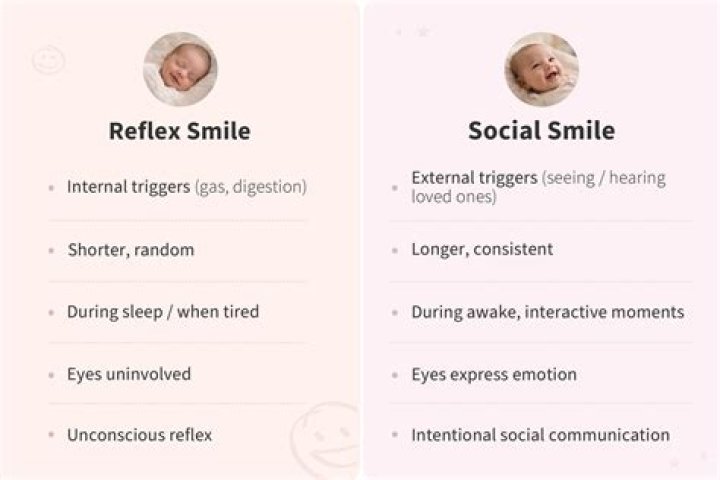
A reflex or "gas smile" is fleeting, asymmetrical, and random. It often appears while the baby drifts off to sleep, during active digestion, or alongside grunting and leg squirming. The infant's eyes remain glazed, unfocused, or closed entirely. The mouth may curl upward for a fraction of a second, disappearing as quickly as it surfaced.
A real social smile engages the entire face. Known in developmental psychology as a Duchenne smile, it involves both the zygomaticus major muscle (which pulls the lip corners upward) and the orbicularis oculi muscle (which crinkles the outer corners of the eyes). The infant holds locked eye contact, widens their gaze, and brightens noticeably. The smile lingers for several seconds, frequently accompanied by eager arm movements, open hands, and soft cooing sounds.
The Infant Smile Progression: Birth to 3 Months
Infant expressive development follows a predictable anatomical sequence as sensory perception matures.
| Developmental Phase | Typical Age Window | Neurological Mechanism | Observable Behaviors |
|---|---|---|---|
| Reflexive Smiling | Birth to 5 weeks | Brainstem motor discharges during REM cycles | Brief, sporadic twitches while sleeping; unfocused gaze; no external trigger. |
| Responsive Smiling | 5 to 8 weeks | Early visual cortex maturation; sensory recognition | Smiles triggered by high-pitched voices, soft stroking, or high-contrast faces. |
| True Social Smiling | 6 to 10 weeks | Limbic-cortical pathway integration; emotional reciprocity | Sustained eye contact, reciprocal grinning, eye crinkling, body wriggling. |
| Vocal Social Smiling | 10 to 14 weeks | Advanced audio-visual processing and social drive | Smiles paired with coos, gurgles, chuckles, and tracking parents across the room. |
For babies born prematurely, calculating milestones requires using their adjusted gestational age rather than their birth date. A baby born 4 weeks early who is currently 8 weeks old has a corrected age of 4 weeks. Expecting them to exhibit reciprocal social smiles at the same chronological date as a full-term infant creates unwarranted anxiety.
Catalyzing the Social Smile: Interaction Techniques
Parents cannot force a neurological connection that has not yet myelinated, but they can provide an environment that invites social engagement. Newborns are naturally drawn to high-contrast patterns and human faces, with an innate preference for the human voice over mechanical sounds.
To encourage social smiling, position your face roughly 10 inches from your baby during calm, alert windows, typically right after a feeding and gentle burping session. Speak using parentese: a melodic, high-pitched vocal cadence with elongated vowels and exaggerated facial animations. Research shows this vocal pattern captures infant attention far more effectively than standard conversational speech.
Practice serve-and-return communication. When your baby looks toward you, meet their eyes, smile warmly, and wait patiently for 5 to 10 seconds. Newborn cognitive processing speeds are slow; they need time to register your expression, organize their motor signals, and return the gesture. If the baby looks away, yawns, or arches their back, they are overstimulated. Respect their pause and try again later.
When to Consult Your Pediatrician
Parental anxiety frequently spikes when peers in parenting groups post milestone photos ahead of schedule. Normal developmental curves have wide margins. Some completely healthy, full-term infants smile at 5 weeks, while others do not share a clear social smile until 10 or 11 weeks.
However, distinct clinical red flags require professional evaluation. Schedule a targeted pediatrician developmental check if your infant exhibits any of the following by 12 weeks of age:
- Shows no consistent eye contact or visual tracking of objects or faces moving side to side.
- Does not respond to loud sounds, parental voices, or visual engagement.
- Displays persistent motor asymmetry, such as smiling or moving limbs with only one side of the face or body.
- Remains excessively floppy (hypotonic) or unusually stiff (hypertonic).
- Demonstrates complete apathy or lack of responsiveness to environmental cues.
These signs do not automatically indicate a permanent developmental delay. They serve as diagnostic triggers to check for common, correctable issues like visual impairment, hearing deficits, or torticollis before investigating deeper neurological concerns.
Frequently Asked Questions (FAQ)
Q1: Why does my 4-week-old only smile in their sleep?
A1: Smiles during sleep at 4 weeks are reflexive motor actions driven by the brainstem during active REM sleep cycles. They indicate healthy nervous system activity rather than a conscious reaction to dreams or emotional happiness.
Q2: Should I be worried if my 8-week-old hasn't smiled socially yet?
A2: No. The standard window for early social smiling spans 6 to 8 weeks, but variations up to 10 or 12 weeks fall within normal healthy limits, especially for infants with sensitive temperaments or those born slightly before their due date.
Q3: How does prematurity affect the smiling timeline?
A3: Pediatricians calculate milestones using adjusted gestational age. If your baby was born 3 weeks early, evaluate their developmental progress based on the date they were due, giving their nervous system the necessary time to catch up.
Navigating the Wait with Realistic Expectations
Tracking early milestones can easily become an exercise in comparison, amplified by curated social media moments. Every infant develops along an individual biological schedule dictated by brain maturation, sensory processing, and temperament.
The transition from solitary reflex to reciprocal interaction is gradual. By providing steady eye contact, responding to vocal cues, and allowing your baby the time they need to process the world, you lay the groundwork for strong emotional bonding. That first genuine grin will arrive soon enough, fundamentally reshaping the early parenting experience.


