Where Did Argentina’s Black Population Go? The Hidden History and Modern Reckoning
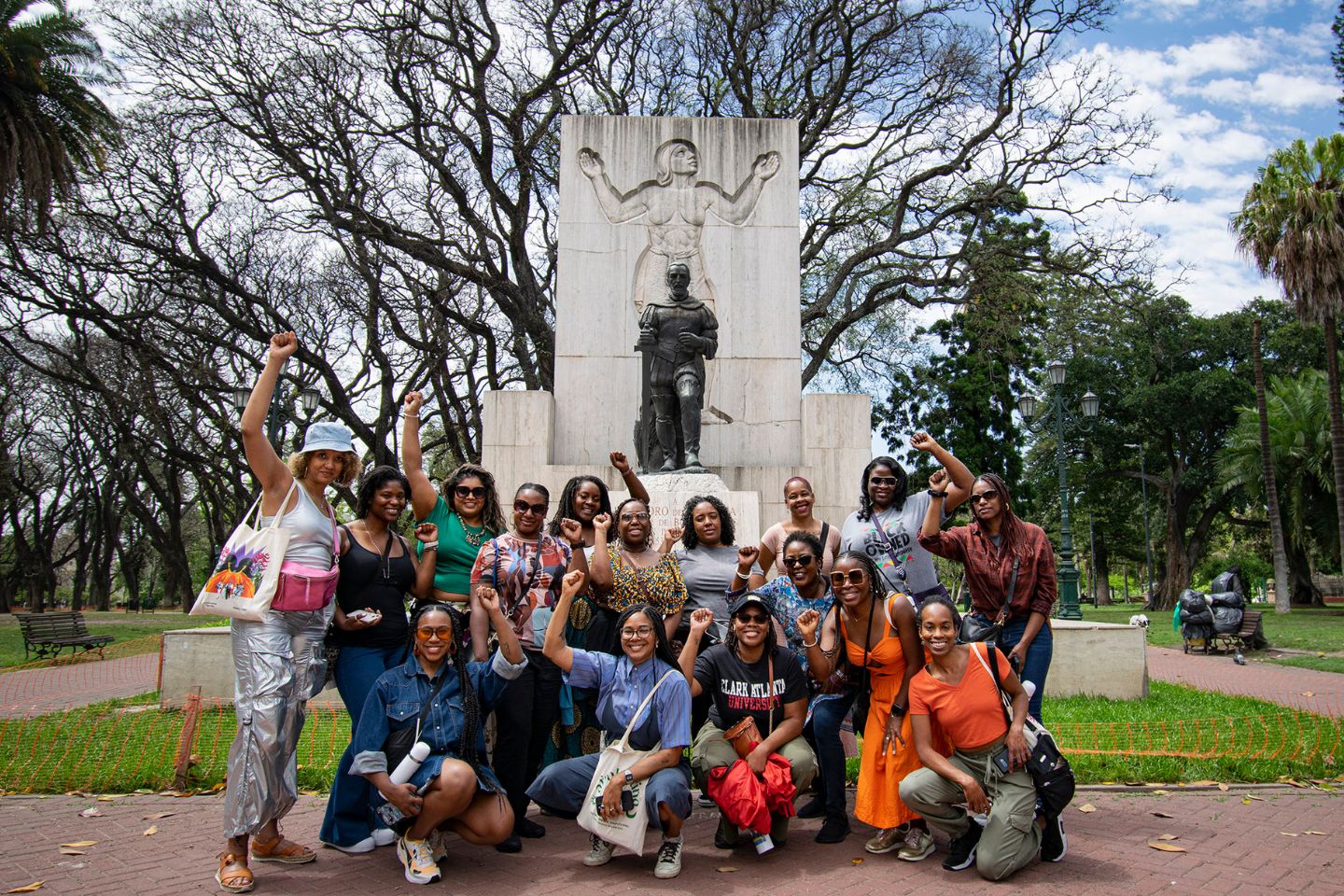
Every time Argentina takes the global sports stage, international commentators pose the same bewildered question: why does the nation look almost entirely white? The query resurfaced in political commentary and viral debates analyzed in an investigative Medium Report by William Spivey, detailing how public interest spiked over claims that Argentina went from nearly a third Black to less than one percent. The prevailing myth suggests that Afro-Argentines simply died out in 19th-century conflicts or succumbed to disease. That story is historically false.
Argentina did not lose its Black population to an inevitable natural tragedy. The disappearance was the calculated outcome of deliberate state policy, bureaucratic reclassification, aggressive European immigration campaigns, and a systematic cultural whitewashing program. Behind the national myth of an exclusively European enclave at the foot of South America lies an intentional, century-long erasure that modern activists and historians are finally dismantling.
📌 Key Takeaways:
- Colonial Demographics: Afro-Argentines accounted for roughly 30% of Buenos Aires and over 50% of the interior provinces during the late colonial and revolutionary eras.
- The Elimination Myth: The War of the Triple Alliance and the 1871 yellow fever epidemic caused heavy casualties, but they did not wipe out Black Argentines; state policies deliberately dispersed and uncounted them.
- Bureaucratic Blanqueamiento: 19th-century leaders orchestrated European mass migration and manipulated national census categories, systematically reclassifying Black citizens into mixed or white categories.
- Cultural Survival: Central pillars of Argentine identity, most notably the foundational rhythms and steps of tango, originated directly from Afro-descendant communities.
The Thirty Percent Reality of Colonial Buenos Aires
During the late 18th century, the Viceroyalty of the Río de la Plata functioned as a primary terminal for the transatlantic slave trade. Thousands of enslaved people from West and Central Africa arrived at the port of Buenos Aires before being marched toward regional markets or forced into domestic servitude, agriculture, and artisanal trades. By the time Argentina began its fight for independence in 1810, demographic surveys showed that Afro-Argentines comprised roughly 30% of the population of Buenos Aires. In north-central provinces like Santiago del Estero, Catamarca, and Córdoba, people of African descent represented over 40% to 54% of registered inhabitants.
Afro-Argentine regiments formed the backbone of General José de San Martín’s liberation army. San Martín actively recruited enslaved men by promising freedom in exchange for five years of military service in the Army of the Andes. These battalions suffered brutal casualties across the mountain passes and battlefields of Chile and Peru. Their sacrifice earned military respect, but it also initiated a demographic imbalance: thousands of young Black men perished while fighting for a republic that would marginalize their descendants.
Enslaved women remained in urban centers, purchasing freedom through communal mutual-aid societies called naciones. These community hubs preserved African dialects, traditions, and musical forms along the muddy banks of the Río de la Plata. Far from being a statistical anomaly, Black community life defined the sounds, culinary habits, and daily labor of Buenos Aires throughout the early decades of the 19th century.
The War of the Triple Alliance and the Epidemic Myth
For more than a century, standard Argentine school curricula repeated a convenient narrative: Black men died on the front lines of the War of the Triple Alliance (1864, 1870), and the remaining Black families perished during the devastating yellow fever epidemic of 1871. Both events took a catastrophic human toll, yet neither caused total biological extinction.
President Bartolomé Mitre drafted thousands of working-class Afro-Argentines into frontline infantry units during the war against Paraguay. The mortality rate among these units reached staggering heights due to direct combat, cholera, and substandard logistics. Still, thousands survived and returned to Buenos Aires, Rosario, and Santa Fe. Their survival directly contradicts the claim that the military conflict eradicated the entire population.
When yellow fever struck Buenos Aires in 1871, killing approximately 14,000 residents, it tore through low-lying, overcrowded southern neighborhoods like San Telmo and Monserrat. The wealthy elite fled north toward Recoleta and Palermo, leaving poorer populations, including Afro-Argentines and poor Italian laborers, without adequate sanitation or medical care. Afro-Argentines suffered heavily, but Italian immigrants died at comparable or higher rates. The epidemic did not selectively erase a race. It revealed class vulnerability. The physical survival of Afro-Argentine families continued; what disappeared was the state's willingness to acknowledge them.
State-Sponsored Blanqueamiento and European Immigration
The systematic disappearance of Afro-Argentines was an intellectual project designed by the nation’s 19th-century founding thinkers. Influential figures like Juan Bautista Alberdi and President Domingo Faustino Sarmiento believed that Argentina’s path to modernity required shedding its Indigenous and African elements. Alberdi’s famous maxim, "Gobernar es poblar" (To govern is to populate), was explicitly racialized: he argued that the nation must replace mixed populations with "superior" Anglo-Saxon and European stock.
The Argentine Constitution of 1853 codified this philosophy in Article 25, legally mandating the federal government to encourage European immigration. Between 1870 and 1930, more than 6 million European immigrants, primarily from Italy and Spain, flooded through the port of Buenos Aires, with roughly 4 million settling permanently. In less than three generations, a country of approximately 1.8 million people was demographically overwhelmed by European arrivals.
Sarmiento celebrated the demographic shift openly. In 1883, he wrote with undisguised pride that the Black population of Buenos Aires had dwindled to almost zero, declaring that the city would soon be completely white. Intermarriage and racial mixing (mestizaje) diluted visible African traits across generations. The state framed this gradual blending not as integration, but as a triumphant national policy of blanqueamiento (whitening).
Paper Genocide: How National Censuses Erased Black Citizens
Beyond physical dilution through mass migration, Afro-Argentines faced statistical erasure. Government census bureaus systematically altered demographic categories, engineering what modern historians describe as a "paper genocide."
Colonial registers had distinguished between negros, mulatos, and pardos. By the national census of 1895, census takers quietly eliminated African racial identifiers altogether. State clerks routinely assigned terms like trigueño (wheat-colored), morocho (dark-haired or tan), or pardo to dark-skinned citizens, effectively subsuming Black Argentines under generalized mixed or European-adjacent classifications.
| Timeframe | Recorded Black Population Share | Primary Driver of Demographic Shift | State Narrative & Policy Action |
|---|---|---|---|
| 1778, 1810 | 28%, 32% in Buenos Aires; up to 54% in provinces | Transatlantic slave trade importation through Rio de la Plata | Colonial caste records acknowledge African racial status |
| 1810, 1870 | Declining from 25% to under 10% | War casualties (Independence, Triple Alliance), yellow fever | Promotion of military enlistment via freedom promises; early mestizaje |
| 1870, 1914 | Dropped to under 2% in official registries | Arrival of over 4 million European immigrants | Constitutional mandate (Article 25); census eliminates Black racial categories |
| 1914, 2000 | Statistically unrecorded (treated as 0%) | Generational intermarriage and social concealment | State myth of total European homogeneity taught in national education |
| 2010, 2026 | 0.4%, 1.0%+ self-identifying (growing steadily) | Modern diaspora migration and grassroots genealogical awakening | Afro-descendant questions restored to national censuses (INDEC) |
When the national census of 1914 took place, government inspectors officially declared that the country possessed no remaining Black citizens. For nearly a century, the Argentine state operated under the premise that race had ceased to exist within its borders. Anyone with darker skin was assumed to be an Indigenous person from the interior or an immigrant from neighboring Bolivia or Paraguay, masking their Afro-descendant heritage.
The Stolen Rhythm: How African Roots Built Argentine Tango
While the state erased Black citizens from administrative records, it could not erase their imprint on Argentine popular culture. The country’s most celebrated cultural export, the tango, is rooted in Afro-descendant traditions.
The word tango itself derives from Kongo and Bantu roots, originally designating enclosed spaces where enslaved people gathered to play percussion instruments and dance. In the late 19th century, Afro-Argentines in the San Telmo neighborhood held street gatherings called candombes. These gatherings featured syncopated polyrhythms, call-and-response chants, and intricate footwork.
Disenfranchised European immigrants settling in Buenos Aires’ port tenements adopted these African dance steps, blending them with the Spanish habanera, the Czech polka, and the Argentine milonga. Over decades, the music drifted from raw percussion to the melancholic strains of the German bandoneón. As tango traveled to high-society Parisian dance halls in the early 20th century, Argentine elites embraced it. They sanitized the dance, stripping away its African origins to repackage it as a purely European-Creole creation.
Afro-Argentine linguistic influence runs equally deep in everyday speech. Essential terms of Lunfardo, the Buenos Aires street slang, trace back to African languages. Words like quilombo (originally a settlement of escaped enslaved people in Brazil, now slang for chaos), mucama (housekeeper), mina (woman), and milonga remain fixtures of daily conversation.
The Afro-Descendant Rights Movement and Modern Reckoning
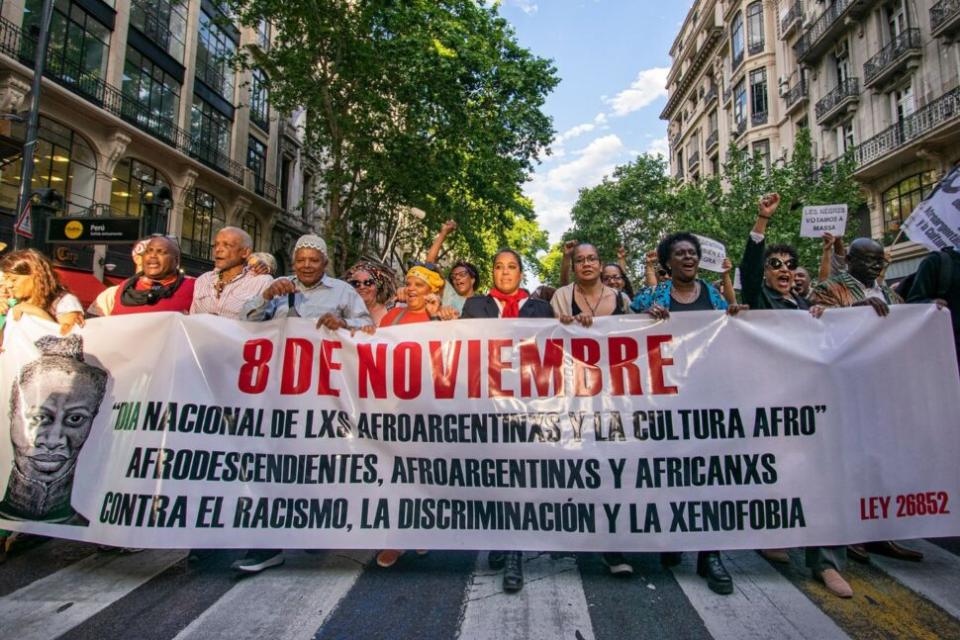
The myth of a white Argentina began cracking at the turn of the 21st century. Grassroots organizations such as Misibamba (an association of historic Afro-Argentines) and Comisión 8 de Noviembre demanded institutional recognition and accountability. In 2010, after an absence lasting over a century, the national statistical institute (INDEC) reintroduced a question regarding African descent into the national census. Approximately 150,000 people officially identified as Afro-descendant.
By the 2022 National Census, that count climbed past 300,000 citizens. Activists note that the real number of people with African ancestry is significantly higher, likely reaching into millions, because generations of social stigma led families to conceal their roots. Genetic mapping studies conducted by the University of Buenos Aires found that roughly 4% to 9% of the genetic makeup of the central metropolitan population carries African markers.
Legal milestones followed cultural pressure. In 2013, the Argentine Congress designated November 8 as the National Day of Afro-Argentines and Afro-Culture. The date honors María Remedios del Valle, an Afro-descendant woman who served on the battlefront alongside General Manuel Belgrano during the War of Independence, earning the rank of captain and the title Madre de la Patria (Mother of the Fatherland). For almost two centuries, official textbooks erased her contribution. Today, her portrait hangs in government buildings, and her likeness appeared on the 10,000-peso banknote in 2024.
Frequently Asked Questions (FAQ)
Q1: Did the yellow fever epidemic of 1871 wipe out Argentina's Black population?
No. While the 1871 outbreak killed roughly 14,000 people in Buenos Aires and severely affected working-class southern neighborhoods, it struck immigrant groups, particularly Italian laborers, just as hard. Thousands of Black residents survived, but state institutions stopped tracking them in municipal registries.
Q2: Why does Argentina have far fewer Black citizens today than Brazil or Colombia?
Brazil and Colombia received vastly larger numbers of enslaved Africans across multiple centuries and had large plantation-based cash crop economies. Argentina received fewer enslaved individuals overall, and between 1870 and 1930, it absorbed more than 4 million European immigrants. That demographic deluge, paired with interracial marriage and census reclassification, diluted visible African ancestry over generations.
Q3: How many Afro-descendants live in Argentina today?
In the 2022 census, over 300,000 people explicitly identified as Afro-descendant. Genetic studies show that up to 9% of people in Buenos Aires carry African genetic markers, suggesting the number of people with partial African heritage is far higher than self-reported counts indicate.
Reclaiming Argentine Identity Beyond the European Myth
Argentina's racial composition is not an accident of biology, nor is it the tragic aftermath of wartime annihilation. It is the legacy of an engineered national project designed to project an exclusively European identity to the world. For generations, national institutions scrubbed African contributions from schoolbooks, public squares, and statistical tables.
That false consensus is unraveling. Propelled by genetic ancestry testing, grassroots civil rights campaigns, and international scrutiny, the descendants of Argentina’s colonial builders are stepping forward to demand recognition. Black Argentines did not vanish into the past. They remain woven into the nation's bloodlines, its street language, its foundational musical heritage, and its ongoing cultural transformation.