Why Does 0°C Equal 32°F? The Historical Reason the World Never Picked One Scale

Every elementary school student eventually memorizes the conversion: the freezing point of water sits at precisely 0 degrees on the Celsius scale and 32 degrees on the Fahrenheit scale. Yet few question why such a straightforward physical phase transition, liquid water locking into crystalline ice, is saddled with an offset of thirty-two arbitrary increments. That thirty-two-degree gap is not a mathematical quirk. It is the lingering fingerprint of eighteenth-century laboratory experimentation, eighteenth-century human physiology, and deep-seated industrial resistance.
As detailed in a recent News18 Report analyzing why humanity remains split across three major temperature systems, our modern measurement landscape is fundamentally fragmented. Scientists rely on the Kelvin scale, the global community measures weather in Celsius, and the United States remains anchored to US customary units. Understanding how freezing arrived at 32°F requires untangling Daniel Gabriel Fahrenheit's quest for precision thermometry, Anders Celsius's inverted Swedish winter scale, and the stubborn economics that kept America from going metric.
📌 Key Takeaways:
- The Brine Baseline: Daniel Gabriel Fahrenheit defined 0°F as the stabilization point of an equal-parts ice, water, and ammonium chloride brine solution, making ordinary water freeze at exactly 32°F.
- The Scale Inversion: Anders Celsius originally published his 1742 centigrade scale backwards, assigning 100°C to freezing and 0°C to boiling, which botanist Carl Linnaeus reversed three years later.
- Industrial Path Dependency: The United States failed to switch during its 1970s metrication push primarily due to astronomical tooling costs in manufacturing and consumer apathy, leaving Fahrenheit entrenched in American daily life.
Daniel Gabriel Fahrenheit and the Search for Absolute Cold
Before the early 1700s, temperature measurement was wildly unreliable. Glassblowers fashioned crude thermoscopes filled with air, wine, or linseed oil, but each device read differently based on atmospheric pressure and inconsistent tube bores. Enter Dutch-German-Polish instrument maker Daniel Gabriel Fahrenheit, who in 1714 revolutionized the field by inventing the first repeatable mercury thermometer.
Mercury expanded and contracted with remarkable uniformity compared to alcohol. It did not stick to the glass walls and could measure temperatures well beyond the boiling point of alcohol. To calibrate his instruments so that two thermometers built miles apart would yield identical readings, Fahrenheit needed fixed reference points. Crucially, he wanted to avoid negative numbers for standard winter weather measurements in Northern Europe.
For his zero point, Fahrenheit mixed equal parts crushed ice, water, and sal ammoniac (ammonium chloride). This saturated brine solution dropped the freezing point significantly through freezing-point depression, hitting the coldest temperature reproducible in an eighteenth-century workshop. He labeled that equilibrium 0°F.
His second calibration mark was a mixture of plain water and ice without salt, which settled at roughly 32°F. His third fixed point was human core body temperature, obtained by placing the bulb under his wife's tongue or under an armpit, which he pegged at 96°F. Fahrenheit favored intervals divisible by 12, splitting the span between freezing water and body heat into 64 distinct gradations. Later adjustments by the Royal Society pinned the boiling point of water at exactly 212°F, refining standard human body temperature to 98.6°F and cementing the pure water freezing point at 32.
Anders Celsius and the Upside-Down Centigrade Scale
Eighteen years after Fahrenheit published his scale in 1724, Swedish astronomer Anders Celsius proposed an alternative approach in Uppsala. Celsius found Fahrenheit’s salt mixtures unnecessarily convoluted. Why calibrate an everyday instrument against an artificial chemical slurry when water covered two-thirds of the planet?
Celsius opted for two universal, easily accessible benchmarks: the melting point of ice and the vaporization point of pure water at one standard atmosphere of barometric pressure. He divided the distance between them into 100 equal increments, earning it the original name "centigrade" (from the Latin centum for hundred and gradus for step).
However, Celsius made an unexpected editorial choice. In his 1742 paper presented to the Royal Academy of Sciences in Uppsala, he assigned 0°C to the boiling point of water and 100°C to the freezing point. His logic was pragmatic for high-latitude astronomy: Swedish winter readings would rarely dip into negative territory, keeping outdoor registers positive as the air grew colder.
The scale did not stay inverted for long. Following Celsius’s death from tuberculosis in 1744 at age 42, his colleague, renowned taxonomist Carl Linnaeus, flipped the numbers. In 1745, Linnaeus commissioned thermometers with 0°C at freezing and 100°C at boiling. That orientation swept through revolutionary France in the 1790s, becoming an integral pillar of the newly minted metric system.
The Mathematical Translation: Decoding the Conversion Formula
The disparate origins of both scales created an arithmetic headache that engineers, meteorologists, and travelers still navigate. Moving between the systems requires accounting for two distinct variables: a differing zero-offset and an unequal step size between degrees.
Between freezing and boiling, the Celsius scale spans exactly 100 degrees (0 to 100). The Fahrenheit scale spans 180 degrees (32 to 212). This establishes a fundamental ratio: 180 divided by 100 simplifies to 9/5, or 1.8. Every single degree of Celsius change equals 1.8 degrees of Fahrenheit change.
To convert from Celsius to Fahrenheit, one must first scale the interval by 1.8 and then add the 32-degree baseline shift:
°F = (°C × 9/5) + 32
Conversely, converting Fahrenheit to Celsius demands subtracting the 32-degree offset first before dividing by 1.8:
°C = (°F − 32) × 5/9
Because the two lines run on different slopes, they cross at a single point in the physical continuum: -40°C is equal to -40°F. Below that marker, Fahrenheit values read as larger negative numbers than their Celsius equivalents.
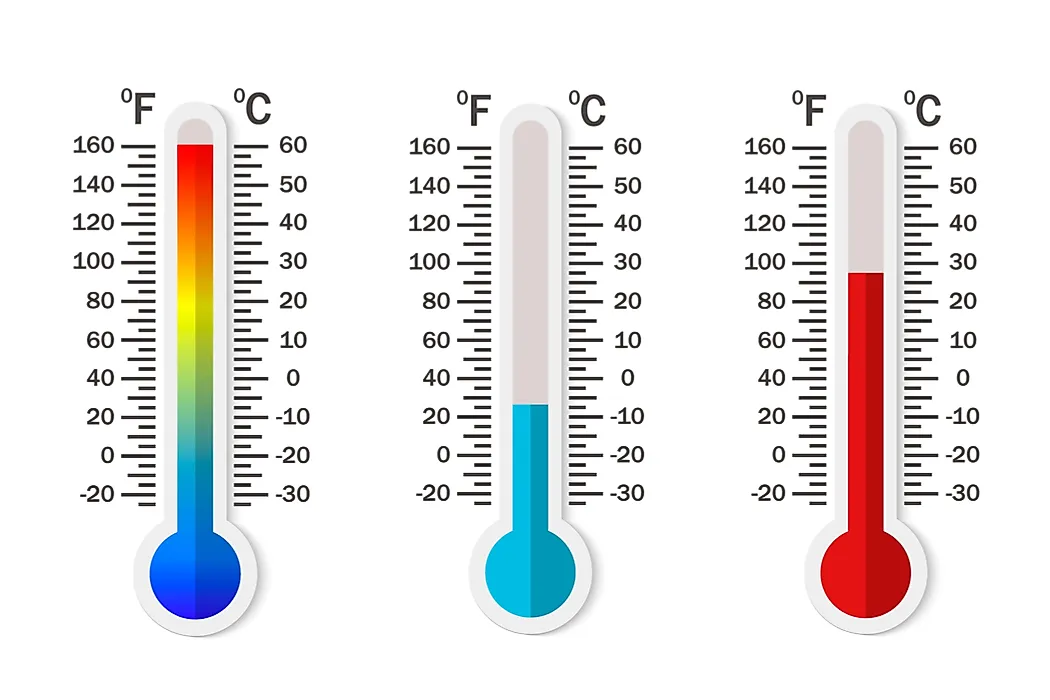
Thermal Baselines: Comparing Global Measurement Systems
The table below summarizes the key physical markers across Fahrenheit, Celsius, and Kelvin, highlighting how each standard handles thermodynamics and regulatory implementation.
| Thermal Physical Benchmark | Fahrenheit (°F) | Celsius (°C) | Kelvin (K) | Primary Application Domain |
|---|---|---|---|---|
| Absolute Zero | -459.67°F | -273.15°C | 0 K | Quantum physics, cryogenics |
| Fahrenheit Brine Equilibrium | 0°F | -17.78°C | 255.37 K | Historical calibration point |
| Pure Water Freezing Point | 32°F | 0°C | 273.15 K | Meteorology, road safety warnings |
| Average Human Core Body | 98.6°F | 37.0°C | 310.15 K | Clinical diagnostic medicine |
| Pure Water Boiling Point | 212°F | 100°C | 373.15 K | Culinary standards, steam power |
The Economic Inertia That Kept America on Fahrenheit
The British Empire exported Fahrenheit around the globe during the Industrial Revolution. By the mid-twentieth century, however, virtually every industrial nation abandoned imperial units in favor of the metric system. The United Kingdom began its transition in 1965; Canada initiated metrication in 1970. Today, only the United States, Liberia, and Myanmar continue to use Fahrenheit as their official ambient standard.
America came remarkably close to switching. In 1975, President Gerald Ford signed the Metric Conversion Act, establishing the U.S. Metric Board to orchestrate a transition across schools, public signs, and commercial trade. Weather forecasts began quoting Celsius alongside Fahrenheit, and highway departments in states like Ohio experimented with dual-marked kilometer-per-hour speed limit signs.
The effort stalled rapidly. The law lacked teeth: compliance was strictly voluntary. Machine shops, automotive suppliers, and aerospace fabricators balked at the astronomical costs of replacing machine tooling, die sets, and calibrated blueprints during the inflation-heavy late 1970s. Converting every pipe fitting, screw thread, and technical diagram carried estimates in the tens of billions of dollars.
Public backlash was equally fierce. Citizens viewed the metric system as an unnecessary bureaucratic imposition from abroad. In 1982, President Ronald Reagan dismantled the U.S. Metric Board entirely, ending federally funded civilian conversion campaigns. American industry adopted a two-tiered reality: science, automotive manufacturing, and military operations integrated metric internally to stay compatible with overseas markets, while residential HVAC systems, weather forecasts, and consumer cooking remained firmly tethered to Fahrenheit.
Human Sensory Resolution Versus Scientific Cleanliness
The enduring debate between metric and Fahrenheit advocates often hinges on utility. Celsius is undeniably superior for physics and engineering. It integrates cleanly with standard SI units: a calorie is defined by heating one gram of water by one degree Celsius, and converting Celsius to Kelvin requires simply adding 273.15.
For daily weather perception, however, Fahrenheit users defend the scale on grounds of biological ergonomics. On an ambient meteorological scale, 0°F to 100°F maps neatly onto human experience:
Zero degrees Fahrenheit marks the onset of dangerously brutal, skin-numbing cold. One hundred degrees Fahrenheit marks the threshold of oppressive, dangerous summer heat. A typical annual cycle in a temperate zone sits almost entirely between 0 and 100.
In Celsius, that identical atmospheric range compresses into an awkward window between -17.8°C and 37.8°C. A single degree of Fahrenheit represents a fine enough temperature gradient that smart home thermostats can adjust indoor climates in single-digit increments without requiring decimals. In Celsius, a full degree step is nearly twice as wide, forcing digital thermostat manufacturers to use 0.5-degree increments to provide comparable comfort regulation.
Frequently Asked Questions (FAQ)
Q1: Why does 0°C equal 32°F instead of 0°F?
A1: Daniel Gabriel Fahrenheit set 0°F as the lowest temperature he could reliably reproduce using a freezing brine solution of water, ice, and ammonium chloride. Pure water freezes at a higher temperature than salt-saturated water, which measured exactly 32 degrees higher on his graduated scale.
Q2: What is the fastest mental math shortcut to convert Celsius to Fahrenheit?
A2: Double the Celsius temperature, subtract 10 percent of that result, and add 32. For example, to convert 20°C: double it to 40, subtract 10 percent (4) to get 36, and add 32. The result is 68°F. This mental trick gives the exact mathematical answer without working through fractions.
Q3: At what specific temperature do Celsius and Fahrenheit read the exact same value?
A3: They intersect at -40° (-40°C equals -40°F). Because the Fahrenheit degree step is 5/9 the size of a Celsius degree and starts 32 degrees higher, the lines converge precisely forty degrees below zero.
Q4: Will the United States ever officially transition to Celsius?
A4: A mandated federal transition remains virtually impossible due to the cost of retrofitting existing building codes, HVAC infrastructure, civil road systems, and consumer packaging. The US operates under an unofficial hybrid model: professional science, medical diagnostics, and military systems utilize Celsius and Kelvin, while consumer weather, residential real estate, and retail appliances remain on Fahrenheit.
The Dual Reality of Modern Thermal Measurement
Three centuries after Daniel Gabriel Fahrenheit dipped his mercury tubes into freezing ammonium chloride, the divide between 0°C and 32°F persists not because of scientific confusion, but because of human comfort and economic reality. Anders Celsius designed a system tailored to the chemistry of water; Fahrenheit produced a scale calibrated to the extremes of weather and human physiology.
Neither scale is broken. One provides the mathematical elegance needed for laboratory equations, while the other offers granular resolution for deciding whether to grab a winter coat. Until the prohibitive friction of replacing millions of industrial machine tools and weather databases justifies an overhaul, global thermometers will continue reporting the exact same physical phase change with two different, historically stubborn numbers.


